I'm taking a huge chance here.
The identity and specific religion of the student are
protected under Canada’s privacy laws. Whatever religion it is, this case
points to a long-standing problem.
I fully support freedom of religion, and will defend everyone’s
right to believe and practice whatever they like, as long as it is not hurting
anyone else nor infringing on any else’s rights. But it’s time we all stopped
using religion or philosophy to excuse inexcusable behaviour and to justify
unjustifiable ideas.
That’s right. I’m telling the world that I do not believe
that you can use the Bible, the Quran, Mao’s little red book, the Communist
Manifesto or any other book to defend your ideas. I just don’t accept the
argument “because God says so.”
You can’t prove that, and the fact that you have a book that’s
called “God’s words” does not constitute proof. I can write a book called “God’s
Words, too.”
 |
| See? |
The devil is in the details
In September, 2013, sociology professor J. Paul Grayson
assigned a mandatory group assignment that required students to work together
in person. One student, who was taking the course online, asked Dr. Grayson to exempt
him because his religious beliefs forbade him from meeting in public with a
group of women.
Dr. Grayson refused the request, and after discussion, the
student agreed to participate in the assignment and completed it. However, the
university administration ordered Dr. Grayson to accommodate the request.
To his credit, Dr. Grayson refused the administration’s
order to accommodate this religious request. “What if I said my religion frowns
upon my interacting with blacks?” he wrote. This accommodate would set a precedent,
he said, and make him an “accessory to sexism.”
The public reaction was telling and uplifting. I could not
find a single person or opinion in the media that supported the religious
accommodation. And rightfully so.
(The Dean of Arts at York University defended his action
partly because the student asked to be able to complete the assignment in
another way, and another online student who was situated outside the country
was allowed another way to do the work.)
The media reaction
Every political leader in the country decried the university’s
accommodation order. Every opinion speaker and writer I heard or read likewise
sided with the professor. Every online comment also supported the professor,
and pointed out that this type of religious accommodation damages women’s
sexual equality rights, hard-won over the last century.
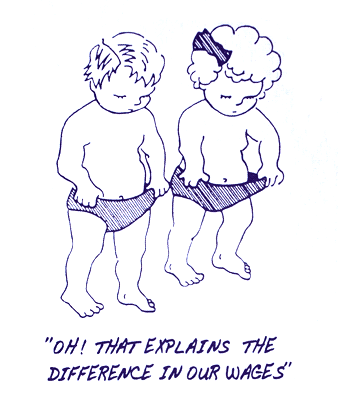
This is an example where the right of freedom to practice
your religion conflicts with gender equality rights. Many Canadian schools provide
prayer rooms, segregated by gender, as part of their “religious accommodation.”
Canadian institutions — funded by Canadian taxpayers — accommodate religious
practices that defy the Canadian Charter of Rights and Freedoms — part of the
law that supposedly governs those institutions.
Religious versus
human rights
I repeat, I support your right to believe and practice any
religion you like. But I do not support anyone’s attempt to infringe on anyone
else’s human rights. And equality of women and men is one of the most
important.
I thought it was telling that CBC radio’s program, The
Current, introduced this story with a clip of televangelist Pat Robertson
saying that according to the Bible, men and women are not equal.
According to this logic, religion justifies unequal
treatment and unequal rights between the sexes. It says so in the Bible.
I’m not trying to criticize any particular religion here, nor am I trying to open a general debate about crime and punishment. All I want to do is to point out the hypocrisy of the argument that goes: “I must do this/I cannot do that because the Bible/Quran/whatever other text I hold out as justification for every ridiculous idea that comes out of my mouth, says so.”
 |
| Crazy idea icon by mehagopijiji. Licenced under Creative Commons. |
Otherwise rational people are afraid to criticize religious
beliefs and practices because they fear being branded as intolerant, racist, or
xenophobic. Well, I’m none of those things, but I will say this: I don’t accept
the “It’s God’s will” argument, because the people who use it don’t accept it,
either.
Nobody actually follows the entire Bible, even though they
say they do. Not even Pat Robertson. How many people sacrifice cattle to God? Does
Pat Robertson? Yet Leviticus, the Biblical book that instructs believers in how
to live every minute of their lives, tells readers to sacrifice bulls just
about every day.
Have you ever seen a televangelist making that kind of
sacrifice, or indeed, any kind of sacrifice of his own property?
Do religious leaders in Canada promote the death penalty for
adultery? How many religious people think that’s okay? Should Canada accommodate
religious sects that want to put adulterers to death?
 |
| From Leviticus, Chapter 20. Source: ReadBibleOnline.net |
The Bible also tells believers to put homosexuals to death.
I’m pretty sure that Canadian law does not accommodate this practice.
The Quran tells a husband to beat his wife — mildly, yes,
but definitely to use force — if she defies his authority. Would Canadian law
accommodate this? Would US law? I hope not.
No one follows any scriptures absolutely. No one in
Canada can put adulterers or homosexuals to death. If they do, the law will
punish them.
The point is that even the most religious choose among
obligations to follow, adhering to some and ignoring others. It’s a human
decision.
Not a divine one.
Basing all your life actions on an ancient book
is an unsupportable idea. Every religious person chooses the scriptures he or
she will follow, because no one follows all of them. No one can.
I won’t argue whether the Bible and Quran were divinely
inspired, because I cannot change anyone’s belief on that point in a blog. But
how about if I add this: God told me to write this post.
Prove
to me that He (or She, or Whatever) did not.


