
Showing posts with label persuasion. Show all posts

Thursday, April 03, 2014

Writing tips: Persuade by making it matter to your audience

Image credit: http://www.brandingstrategyinsider.com/2014/03/10-keys-for-brand-persuasion-and-change.html#.UyXBv61dXJ4

You can’t persuade an audience with unproven ideas, nor can you fire one up without appealing to their values.

Read this opening to a seminar on secure information technology practices and then answer this question: do you care?

“Why is security important to us? Because the effectiveness of our programs, activities and services depends on the level of trust our partners have in us. Central to that trust is rigorous stewardship over our digital and physical assets...”

The statement is true, as far as it goes. But for the average worker, it’s not compelling. There are too many steps between the proposition and the audience’s own life.

Image courtest Flixlist 
Someone else, working for an organization that I don’t work for, won’t trust our website as much? Holy spam, Batman! Let’s get to that IT security seminar now!

Better: “Why is IT security important to you? Because without taking these precautions, you risk exposing confidential organizational or even personal information that could be used in fraud.”

Remember what people value

Whenever I have to write something persuasive, I like to recall Maslow’s hierarchy of needs. If you’re not familiar with it, follow the link, but basically, Abraham Maslow studied people and their behaviour, and organized common motivators into a hierarchy. The lower or more basic the desire, the more powerful. Maslow also stated that humans do not, generally, focus on higher needs until they’ve fulfilled the basic ones.
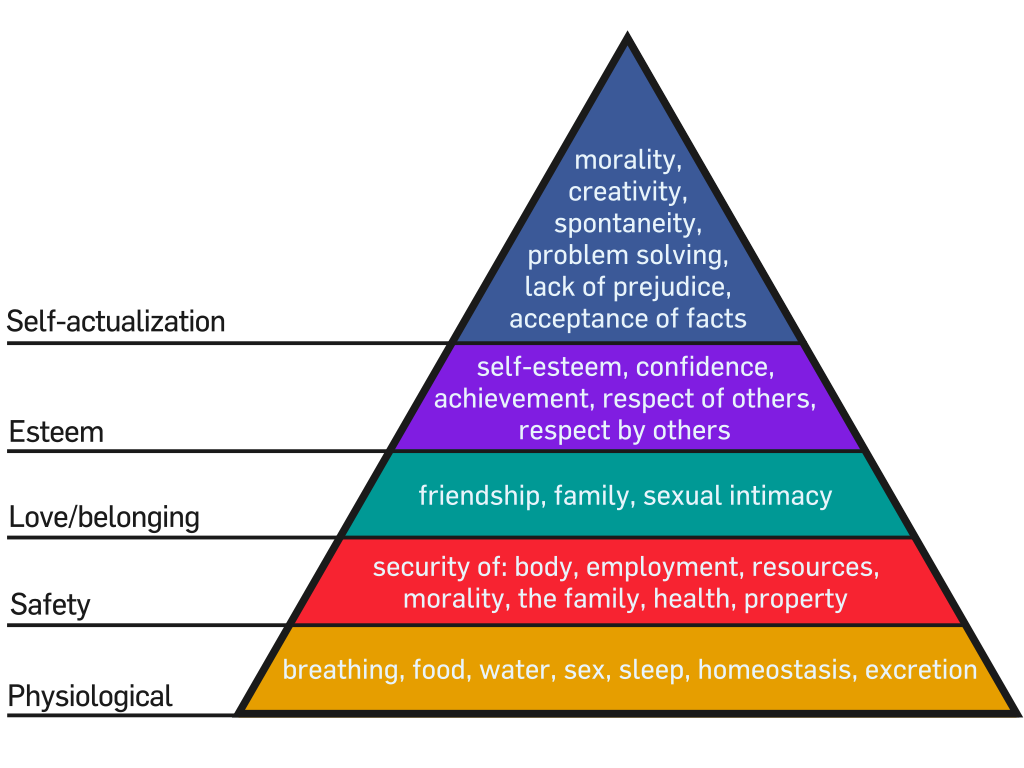
Wikimedia commons

So if we want to motivate people, we have to make sure we’re evoking those basic, animal needs: food, warmth, security, belonging, esteem. A job may supply those things, so promoting the employer’s success can work. Anything that contributes to the bottom line is persuasive to the extent that the audience believes the employer’s success is critical to their own.

The incidence of fraud, identity theft and other crimes facilitated by the Internet proves that people feel IT security is pretty distant from their own needs — until they get stung by some kind of scam.

The path from the IT department’s guidelines to your own security isn’t obvious, but it is real. Our job as communicators is to clear that path.

How to make it matter

Here is a suggested outline you can adapt the next time you have to get a group to buy into something important, but new or abstract to them.
  1. Start with an example — like “Erica bypassed the spam filter and filled out this sensitive information on a website. Then the information was published and her employer fired her.”
  2. Explain the problem and summarize the solution — like “Erica did not verify that the form she filled out was actually on the website of the organization she thought it was. She should have made sure that the URL had a lock symbol and began with https://”
  3. Broaden or generalize the problem — use more examples from the audience’s own workplace or experience. Make them as realistic as possible.
  4. Explain the problem, the consequences and the solutions fully. Keep the language clear and simple. Use active sentences so that the audience can follow the guidelines.
  5. End with more realistic examples — “If you encounter x, do y.” Provide solutions that the audience can use right away.


Make change less scary and difficult

Image courtesy TanveerNaseer.com

Change is hard, because it opens us to the unknown. If you want to persuade an audience to change the way they work — or do anything, for that matter — you have to prove to the audience that it’s important to them (not to you), and you have to make accomplishing a change as easy as possible.

Do you have an experience to share?

Have you been to a seminar or read a document that tried to explain how important something was, but failed because you still didn’t care afterward? Tell us all about it in the Comments.

Thursday, January 17, 2013

NRA proposals: a new low in misdirection

Creative Commons photo by Ed Schipul
“Are the president’s kids more important than yours?” asks the National Rifle Association in its latest video. “Then why is he skeptical about putting armed security in our schools when his kids are protected by armed guards at their school? Mr. Obama demands the wealthy pay their fair share of taxes, but he’s just another elitist hypocrite when it comes to a fair share of security.”

The magician’s secret, the key to a successful trick, is misdirection. Patter, the high-speed, high-energy babble that comes from the trickster’s mouth, is part of that. “Look over here,” the magician says, pointing away from the hand that’s hiding the coin or pulling the card out of the deck. The audience looks away, and the magician shows the illusion. Magic!

The NRA’s video is political and social misdirection. The illusion: that guns are necessary to the American way of life, the survival of the USA as we know it today.

The result: US residents buy huge numbers of firearms, and 55 percent of Americans support the NRA’s proposal to put armed guards in every school.

I’m neither a citizen nor a resident of the US, but it’s a debate that resonates in Canada. I’ll leave aside the criminally negligent absurdity of the NRA’s argument, and focus on the message from a communications perspective.

The context

NRA head Wayn LaPierre: not crazy.
Just bad.
(Photo credit: AP/Alex Brandon)
The argument over increased control of guns in the US is an old and predictable one. After the especially horrible school shooting in Newtown, Connecticut last month, the debate ramped up again. Groups like the Brady Campaign to Prevent Gun Violence, among others, called for more and stricter controls on guns, and the National Rifle Association reiterated its hoary message: “guns don’t kill people — people kill people.” Then, the head of the NRA, Wayne LaPierre, proposed that the solution would be to put armed guards in every school in the US. “If it’s crazy to call for putting police in and securing our schools to protect our children, then call me crazy,” he told NBC News.

That’s not crazy. That’s irresponsibly disingenuous.


The misdirection

As President Obama announced his intentions to more strictly enforce existing gun control laws and pass new laws, the NRA brought out this message equating Secret Service protection with armed security guards in elementary schools, and equating 50-round ammunition magazines with Second Amendment rights.

This is how misdirection works:

Look over here, folks. We have a problem: obviously mentally disturbed people arming themselves with military grade assault weapons and using them against children and other unarmed innocents.

Now, watch this hand: we give everybody the same kinda weapons! Assault rifle here, assault rifle there, concealed handguns over there. Now watch what happens: two days after the Newtown school shootings, a gunman in San Antonio, Texas opened fire in a movie theatre. He was wounded and incapacitated by an armed, off-duty police officer.

See? More guns means more security!

Just don’t look at the body count.

(According to the Journal of Trauma-Injury, Infection, and Critical Care, “before a child in the United States reaches 15 years of age, he or she is…12 times more likely to die a firearm-related death” compared to children in other industrialized countries.)
http://blog.syracuse.com/opinion/2012/12/americas_exceptional_gun_cultu.html
http://www.policyarchive.org/handle/10207/bitstreams/96411.pdf

I’m not going to tear that argument apart. You can see for yourself that the fact that it was a trained law-enforcement person who shot the crazed gunman refutes the argument that arming everyone protects everyone. Nope, I’m not going to say that. You can figure that out for yourself, because you’re reading this blog, and that means you’re smart.
This is how the magicians of the NRA are misdirecting the public involved in the gun control debate:


Problem: if even some categories of firearms are banned, weapons manufacturers’ sales and profits will fall.

Misdirection: The politicians are taking away your freedom! Their servants are armed, their children are protected! You deserve the same thing: stand up for high profits for gun merchants lax or non-existent gun control legislation!


Don’t look at the actual problem: 130 school shootings in the USA that resulted in at least one death of a student or staff member since the Columbine shootings in 1999 (according to FactCheck.org, an apparently right-ish site funded by the Annenberg Public Policy Center. I’ll let you form your own opinion on it: http://factcheck.org/2012/12/gun-rhetoric-vs-gun-facts/)


What they’re not saying

When someone’s trying to convince you about something, you have to ask what’s in it for them.

According to Business Insider magazine, more than half the NRA’s funding comes “in the form of contributions, grants, royalty income, and advertising, much of it originating from gun industry sources.

“Since 2005, the gun industry and its corporate allies have given between $20 million and $52.6 million to it through the NRA Ring of Freedom sponsor program. Donors include firearm companies like Midway USA, Springfield Armory Inc, Pierce Bullet Seal Target Systems, and Beretta USA Corporation. Other supporters from the gun industry include Cabala's, Sturm Rugar & Co, and Smith & Wesson.”


Read more: http://www.businessinsider.com/gun-industry-funds-nra-2013-1#ixzz2IAJ2j6bN
The NRA and its corporate masters sponsors never say that, do they? No, they spend millions of dollars and countless person-hours to maintain the current gun laws, so that they can maintain their sales and profits.

Someone shoots an innocent person.
Response: Don’t let Washington dishonour the Founding Fathers and take away your rights!
What they’re not saying: We love our money much, much more than your kids’ lives.

  What do you think?