Showing posts with label Writing tip. Show all posts

Monday, December 29, 2014

Writing tip: Anniversary — an annual kind of word

As the year end and new year approach, I thought it was a good time to discuss a year-related word and deal with something that has bothered me for a long time.


The word: anniversary.


What bugs me: the way too many people misuse it, as in “first-year anniversary,” or “ten-year anniversary.”

It bothers me because the word “year” in unnecessary in this usage. According to the Oxford dictionary, “anniversary” means
“the yearly return of a date on which an event took place in a previous year.”
According to some cursory and largely unnecessary research—all literate English speakers should know this—it derives from two Latin words: “Annus” meaning “year” and “versus” meaning “turned.” Thus, an anniversary is the turning of a year.

We can speak (or write) correctly of the first, second, tenth or whateverth anniversary of something. To write the “two-year anniversary” means “the two year yearly return of the date.” It’s redundant.

Worse, I hear this misuse from otherwise reputable and well-spoken sources, particularly on the CBC radio. And you know what that could lead to: more and more people picking up on that misuse. As English is a living language, common use becomes accepted and adopted as correct.

Please, join me in this effort: let’s say and write “first anniversary,” “tenth anniversary” and so on, instead of “x-year anniversary”—or worse, “six-month anniversary.”

If we don’t make this effort, this incorrect use will become correct. And I’ll be left irritated by something that used to be wrong, but is now right.

Don’t you hate that?

Have a happy, health and prosperous new year.


Monday, November 17, 2014

Writing tip: Break complex ideas into manageable chunks

Photo: Building Blocks by Myfear on Flickr. Creative Commons licence.
Periodically, my university student sons ask for writing advice for their assignments. Most recently, the elder asked for another word for "prelude" or "precursor."

What the Blond Raven wanted to do was describe how Algeria's experience in the 1990s, when a number of religious groups rebelled against the military government, was similar to the situation today in Syria.

"Why not just say that?" I asked.

"That's not ... fancy enough for a university paper," he said.

"All right," I said, realizing that the situation screamed for improvisation. "Preface your paper with this:
In defiance of the tacit pretentious approach to expression accepted in scholarly journals, henceforth this paper shall be written in style that all readers with an education beyond the sixth grade can understand.

Why is it that academic writing is purposely dense? Incomprehensible? Why does every sentence have to be dissected and reassembled to be taken seriously?

In other words, why can't academic papers attain the same standards of other forms of communication—why can't they be written in clear language?

Or to put it more plainly: why don't academics use clear writing?

How about this one:

As a result of these intermeshing trends, strengthening states through statebuilding programmes has come to be regarded by major donors as a central response to violent conflict and insecurity and a core element of peacebuilding programmes (and of development assistance). In the post-colonial states of the Global South, external peacebuilding operations are often faced  
[Sorry, my fingers got tired there.] 
not only with responding to the effects of vioent institutions coexising with other logics of authority, power, and order (ethnic, tribal, religious, criminal etc.). 
(Source: Tarya Vayrynen, "Gender and Peacebuilding," in Oliver P. RIchmond's Palgrave advances in peacebuilding,University of St. Andrews, UK: Macmillan Palgrave, 2010).

Before you read it again, tell me: what was the beginning of the paragraph about?

How about this winner from an article on nationalism: 
For present purposes, the two relevant cultural systems are the religious community and the dynastic realm. For both of these, in their heydays, were taken-for-granted frames of reverence, very much as nationality is today. It is therefore essential to consider what gave these cultural systems their self-evident plausibility, and at the same time to underline certain key elements in their decomposition.
These two examples could so easily be written more clearly. I have always belived that the audience should be able to understand a text after reading it the first time. But if you cannot remember the beginning of the paragraph byt the time you get to the end, the writing fails. If you get lost in the maze of loosely connected clauses, it means the writer has not followed the first rule of writing: know your audience.

Academic writing often runs into the problem of trying to cram too many ideas into one sentence. Broadely speaking, the job of the researcher is to find patterns and connections between facts and phenomenal. When they find connections and correlations, it's tempting to try to fit them all together in one sentence. The researcher gets excited: "Look how these ideas are connected! It makes so much sense, and together, they mean this!"

We've all been there.

Stop. Breathe in through your nose, and blow out through your mouth. There. Now, you're relaxed.

It's not easy, but the solution is to think through, very carefully, what you're trying to say. Break it down into single sentences and the just write the connections in order, as simply as you can. 

Sometimes, we need to express complex ideas. Sometimes, the connections among causes and effects are complicated. The solution is like project management: break the big, complicated mess up into smaller, manageable chunks. Deal with each one in turn, then move on to the next idea.

Like this: 
The two cultural systems relevant today can be called the religious community and the dynastic realm. Each of these systems dominated different societies at different times in history. Where they did, the people in the societies they dominated took them for granted, in the same way people today take nationality for granted as a basis for states today. What gave these other cultural systems their plausibility? What were the key elements that unravelled them?
The Blond Raven is right. This is far too simple, too clear, for today's scholarly journals. Why, if everyone could understand these articles, why should they bother with expensive post-secondary education?

Thursday, April 03, 2014

Writing tips: Persuade by making it matter to your audience

Image credit: http://www.brandingstrategyinsider.com/2014/03/10-keys-for-brand-persuasion-and-change.html#.UyXBv61dXJ4

You can’t persuade an audience with unproven ideas, nor can you fire one up without appealing to their values.

Read this opening to a seminar on secure information technology practices and then answer this question: do you care?

“Why is security important to us? Because the effectiveness of our programs, activities and services depends on the level of trust our partners have in us. Central to that trust is rigorous stewardship over our digital and physical assets...”

The statement is true, as far as it goes. But for the average worker, it’s not compelling. There are too many steps between the proposition and the audience’s own life.

Image courtest Flixlist 
Someone else, working for an organization that I don’t work for, won’t trust our website as much? Holy spam, Batman! Let’s get to that IT security seminar now!

Better: “Why is IT security important to you? Because without taking these precautions, you risk exposing confidential organizational or even personal information that could be used in fraud.”

Remember what people value

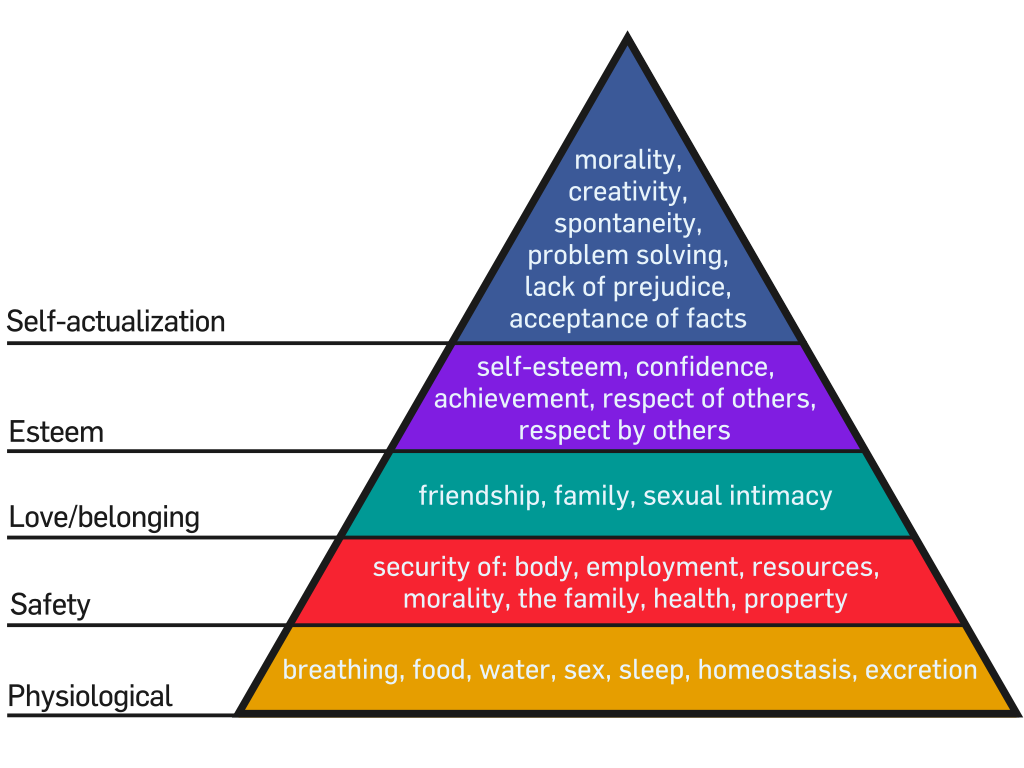
Whenever I have to write something persuasive, I like to recall Maslow’s hierarchy of needs. If you’re not familiar with it, follow the link, but basically, Abraham Maslow studied people and their behaviour, and organized common motivators into a hierarchy. The lower or more basic the desire, the more powerful. Maslow also stated that humans do not, generally, focus on higher needs until they’ve fulfilled the basic ones.
Wikimedia commons

So if we want to motivate people, we have to make sure we’re evoking those basic, animal needs: food, warmth, security, belonging, esteem. A job may supply those things, so promoting the employer’s success can work. Anything that contributes to the bottom line is persuasive to the extent that the audience believes the employer’s success is critical to their own.

The incidence of fraud, identity theft and other crimes facilitated by the Internet proves that people feel IT security is pretty distant from their own needs — until they get stung by some kind of scam.

The path from the IT department’s guidelines to your own security isn’t obvious, but it is real. Our job as communicators is to clear that path.

How to make it matter

Here is a suggested outline you can adapt the next time you have to get a group to buy into something important, but new or abstract to them.
  1. Start with an example — like “Erica bypassed the spam filter and filled out this sensitive information on a website. Then the information was published and her employer fired her.”
  2. Explain the problem and summarize the solution — like “Erica did not verify that the form she filled out was actually on the website of the organization she thought it was. She should have made sure that the URL had a lock symbol and began with https://”
  3. Broaden or generalize the problem — use more examples from the audience’s own workplace or experience. Make them as realistic as possible.
  4. Explain the problem, the consequences and the solutions fully. Keep the language clear and simple. Use active sentences so that the audience can follow the guidelines.
  5. End with more realistic examples — “If you encounter x, do y.” Provide solutions that the audience can use right away.


Make change less scary and difficult
Image courtesy TanveerNaseer.com

Change is hard, because it opens us to the unknown. If you want to persuade an audience to change the way they work — or do anything, for that matter — you have to prove to the audience that it’s important to them (not to you), and you have to make accomplishing a change as easy as possible.

Do you have an experience to share?

Have you been to a seminar or read a document that tried to explain how important something was, but failed because you still didn’t care afterward? Tell us all about it in the Comments.

Thursday, August 29, 2013

How to write a report I will read

My last post focused on fiction: how to write a novel I would enjoy reading.
There are far more people in the world who have to write other kinds of documents: letters, proposals, memos, instructions, report — which may or may not be fictitious.

These writers also need some guidance, at least to judge from many of the reports I have to read. So here are a few tips on how to write a report that I will be able to read.

1.   Start at the end

Get to the point immediately. No one reads reports for pleasure. They want to know “what’s in this for me?”

Start with your more important point: what does this report mean? In other words, the conclusion. State that up front. In fact, write it down first.
Think of writing your report as taking a road trip. What’s the first thing you do? You enter the destination into MapQuest (or Google Maps, or whatever). You find out exactly where it is and you get directions from where you are now.

Your conclusion, which should be the thesis statement of your report, is your destination. Now, you need to work out how to get there.

2.   Get a GRIP

Regular readers will know my copyrighted formula to writing: Goal, Idea, Reader and Plan. 

Goal — Your purpose. Why are you going to your destination? What will you do when you get there? In terms of writing, what result do you want from this report? It could be to change a policy in the workplace, or it could be to inform colleagues about safer working procedures. Whatever it is, have a clear idea about it. If you have trouble clarifying the purpose, answer this question: what do you want the reader(s) to do after they finish reading the report?

Reader — Whom is this report for? Who are they, specifically? What interests them? What motivates them? Why should they care about what you have to say?

Idea — Your main message, your thesis statement, the most important thing you have to say. Sum up your whole report into one grammatically correct sentence. If you can’t do that, you cannot make your point clearly to anyone else.
Image from Jamie Rubin, science-fiction author
http://www.jamierubin.net/2012/08/07/going-paperless-5-tips-for-how-a-paperless-lifestyle-can-better-capture-some-everyday-interactions/

Plan — This is your MapQuest/Google directions to the conclusion. A map has two main points: starting and destination. Now, your audience is uninformed, or at least not as aware of all the information you have. Where you want them to be is responding according to your Goal statement.

Typically, you need to present facts, show the links and relationships among them, and demonstrate to the readers why these are important. Tell the reader how the facts and links affect their job or life. 

For example, if you want to cause change in your organization, you will have to show how the current situation costs more money (or time, which is the same thing) than it has to. You have to demonstrate this is a pressing problem, or imminent threat to safety, employee morale or bottom-line profits. Then you have to demonstrate how your conclusion will solve all those problems.

3.   Write backwards

Write the conclusion first. That will put your destination, your main point, clearly at the top of your mind. And it will show you how to get there.
Then write the persuasive information that will bring your readers there. Follow your outline. Don’t skip anything. Fill in all the information your readers will need to accept your conclusion and take the action you want them to take.
National Museum of Health and Medicine. Educational and non-commercial use only.
Write the introduction last. State the problem (if there is one) and summarize your conclusion.

If you’re going to summarize anything, you have to have the full statement written out first. It’s far more difficult to say something succinctly first, then extend it to a full argument.

It’s like that old statement that’s been attributed to Mark Twain, Samuel Pepys, Oscar Wilde and many more: “Sorry to write you such a long letter; I didn’t have time to write a short one.”

4.   Control quality

Avoid jargon and business terms like “going forward,” “institutional arrangements,” “at the end of the day” or “outside the box.” These are emptyphrases. Just write what you mean.

Eliminate empty words and phrases that don’t add information. Replace noun phrases with verbs. Keep your sentences active (see my post on Writers Get Together).

And before you deliver your report to the audience, edit it. Go over it again. Watch out for clichés and vague thinking, as well as downright mistakes. Was the number supposed to be 51 or 15 cases of ammunition? Did that shipment arrive on February 8 or August 2?

5.   Proofread it one more time

It can’t hurt, and you may just catch something egregious. Better yet, have someone else read it over. You can’t proofread your own stuff.

Follow these guides, and you’ll have a much easier time writing a document that will have the results that you want.

Questions? Ask in the Comments section below.


Good luck!

Thursday, April 25, 2013

Writing tips: Beware the comma splice


Comma butterfly image © Copyright Peter Trimming;
licensed for reuse under Creative Commons.


Commas are probably the most abused punctuation mark in English today, and probably the most overused, too. Here are a few tips to make them easier to use correctly.
Commas separate parts of a sentence:

  • items in a list 
  • phrases
  • clauses.

Don’t leave out commas from your writing. They represent the pauses in speech, and give readers a chance to take a breath — important even if we’re not reading aloud.

However, don’t overuse them, either. I remember one educational film made in the UK in (judging from the awful clothing) the mid-70s, that said overusing commas made text seem like the writer had hiccups!

  • The carpet, when delivered, will be laid by our approved carpet layers, who are, in your area, Thomas and Jones, Inc.

Read that aloud with a pause at every comma, and you’ll hear what I mean.

Think of a comma as a brief pause to make it clear what ideas belong together.

  • Since this is a new responsibility for the agency, based on new legislation ...

Which is different from

  • Since this is a new responsibility, for the agency based on new legislation ...

Image source: Moblog, creative commons

Those splices won’t hold!


Commas are not strong enough to separate complete thoughts. For that, you need a period — or at least a semi-colon. Sometimes, even talented writers will use commas in situations that need periods. This is called the “comma splice.”
Here are some examples from a book I helped to edit a little while ago, doctored somewhat to protect the innocent. I mean, guilty.

  • The woman in the red dress was no common thief, she’d seen too much, taken too much.

That’s two complete thoughts, so it should be two complete sentences. Replace the comma with a period and capitalize “She’d,” and you have a grammatically correct sentence.

The next example has the same problem:

  • Raising the money took priority, nothing could get in the way of that.

  • Sometimes, though, we don’t want to use the full stop, as the Brits like to call the period. There are cases where the period does not express what we are trying to say.

    • Too bad if the marine lived, he had learned long ago that least dangerous soldier was a dead soldier.

    These are two separate thoughts, but in this case, they’re closely related. Replace the comma with a semi-colon. Same with the next example:

    • Not so long ago, he thought Karen would be the only one for him, now barely a thought of her came into his head.

    The simple way to remember it is this: if a group of words has a subject and a verb, it’s a sentence. That means it also needs to begin with a capital letter and end with a period. Even two words can be a complete sentence:

    • Johnny ran.

    An imperative (command) sentence can be one word:

    • Run!

    And that means, end it with a period. Most of the time. You can also use question marks for questions, and occasionally exclamation marks, too. But use those rarely.

    Link related sentences with a semi-colon, but again, go lightly with them. They’re like habanero peppers — terrific when they’re used sparingly.

    For more on sentences, check out my blog post from last November. And if you have a question, put it in the comments, or send me an email or a tweet.

    Thursday, July 19, 2012

    Writing tips: Consistency stinks, but without it, you're sunk

    Skunk in the backyard, courtesy TooKoolDoggies.blogspot.com

    "The skunk in the back yard last night stunk, didn’t it?"

    "No, it stank." 

    Or is stunk right?


    What about this one: “The ship sunk during the storm last night”? Is that correct?


    English. It can be beautiful, powerful, inspiring. It can also be maddeningly confusing and inconsistent.


    There are so many inconsistencies to trip people up, that if languages were shopping malls, English would be closed until it was brought up to code.


    For instance, consider the past tense. English usually indicates an action that occurred in the past by adding an –ed to the end — like in occurred. Then there are all the other verbs that show past tense in other ways, like thrown, or eaten.


    Verbs that end in –ing and –ink give people a lot of trouble. Simple examples pretend to set the pattern:

    Infinitive Past tense            Past participle
    ringranghas rung/was rung
    singsanghas sung/was sung


    Then, English goes and changes the pattern just a little, with –ing verbs that have identical past past participle forms. There doesn’t seem to be any logical distinction. You just have to memorize this.
    cling         clunghas clung
    fling    flung              has flung/was flung
    hanghung "from the
    chimney with care" 
    has hung/was hung

    However, when using hang to mean a form of execution, the past tense and past participle are hanged and was hanged: Billy Bailey was the last person to be hanged in the US.


    Some verbs ending in –ink conform to these patterns, too:
    drink        drank                   has drunk/was drunk
    sinksankhas sunk/was sunk
    slinkslunkhas slunk
    stinkstank or stunkhas stunk

    But not link or ink (as in to put something in ink, or to cover something with ink).


    Of course, there are –ing verbs that follow the more usual pattern of adding –ed for the past tense and participle: ding or ping, for instance.


    Then, there are the most baffling verbs of all:
    bring         brought               has brought/was brought
    thinkthoughthas thought/was thought

    There is almost a logic, but if you can’t have more than two examples that follow the same method to indicate past tense, that doesn’t really make it a system.


    To answer the questions I started with: stunk or stank are both acceptable past tense forms for stink, according to the Oxford Dictionary. However, sank is the correct past tense for sink, while sunk is the past participle.


    What about you? What exceptions give you the most trouble?
    The Titanic sank in the North Atlantic.


    The Titanic was sunk by an iceberg.


    Friday, June 01, 2012

    Just between you and I — I mean, you and me — Edwards is not credible

    John Edwards says God has a plan for him, specifically. If that's not
    hubris, what is?
    John Edwards’ self-serving apology illustrates a lot of things: hubris, political weaseliness, and a very common grammatical mistake. See if you can spot it: “It's me. It is me and me alone."
    Points to those of you who know Edwards should have said “It is I and I alone who is responsible.” There are many bloggers who have other ideas about what Edwards should have said years ago, but this blog’s purpose is not to criticize behaviour or politics. That’s just a side benefit.


    Using your “I” without lenses

    To be fair, most people use “it’s me.” I do, in everyday conversation. But don’t you remember your Grade 7 English teacher trying to explain copula verbs and objects to you? In sum, the verb “to be” does not take objects. I don’t know why — I didn’t invent this twisted language. That means you have to use subjective forms of pronouns to follow “is,” “was,” “am,” and “were.”

    Remember how your proper grandmother tried to get you to answer the phone, “this is she”?

    That rule leads to a lot of confusion. How many of you say or write “just between you and I.”

    I once heard Peter Mansbridge (Canada’s handsomest newscaster, according to the Royal Canadian Air Farce) say that, years ago. But I forgave him because he was talking to Ralph Benmergui.


    Here’s the problem: “between” is a preposition, and prepositions are followed by objects. That means you have to use the objective form of the pronoun — in this case, “me.”

    “Just between you and me, Ralph, John Edwards’ speech about God didn’t do him any good.”

    Another example — which of the following do you think is correct:

    • “Set up the meeting with coffee for the manager and I.” 
    • “Set up the meeting with coffee for the manager and me.”

    The second one is correct.

    Proof

    Don’t believe me? Here’s the way to test it: take out the other noun in the phrase.
    • “Set up the meeting with coffee for the manager and I.” 
    • “Set up the meeting with coffee for I.”
    That doesn’t sound right, does it?

    Let’s watch out for this one. Remember, in a prepositional phrase, use the objective forms of pronouns:
    • for x and me
    • between you and me
    • for Iris and him
    • among Lara, Bogdan and her.
    Still doubtful? Why not put your troubling sentences into a comment, and I’ll work it out for you.

    Looking forward to it!