Showing posts with label genres. Show all posts

Monday, April 07, 2014

Literary genre: haven or prison?

Creative Commons licence.
http://moon.com/2014/03/hiking-and-recreation-in-parque-nacional-torres-del-paine/
A little over a year ago, I wrote a post for the Guild of Dreams blog where I wondered about how important it is for a writer to remain within a genre. Now that I have just sent my third manuscript to an editor, I find myself wondering about that again. Without asking anyone’s permission, I am re-examine that issue.

When you start out writing fantasy — or romance, or science fiction, or mystery, or any other category — do you have to stay within it? Is writing something in another genre akin to crossing a border into a foreign territory?
For a novelist, is the genre a prison or a haven?

It looks like my career as a novelist is turning into an experiment to measure that.

My experience in the fantasy genre

My first published full-length novel qualifies as epic fantasy. I prefer the term “historical magic realism,” because  The Bones of the Earth has realistic, fictional characters alongside real, historical characters. It’s set in a real time and place, and then adds fantastic or magical elements. But for most people, “fantasy” is the shorthand term.

My next novel, One Shade of Red, stepped way out of epic fantasy and history. It’s a comic, erotic parody of Fifty Shades of Gray, and qualifies as romantic erotica. Or erotic romance. NOT porn.

My third novel (to be published) is one I started over 10 years ago, a memoir of my father-in-law’s experience as a draftee into the Soviet Red Army during World War II. So far, I’m calling it Between the Vise Jaws. But that may change.

Return to fantasy

With that done, I am now turning to a contemporary urban paranormal type fantasy, Dark Clouds. I posted the first chapter on this blog a couple of years ago.
Dark Clouds grew out of a pre-Hallowe’en writing challenge, the source of which I cannot remember. But the challenge was to write the scariest opening line I could, and in a humourous mood, I thought of “Matt always knew when his mother was coming over.”
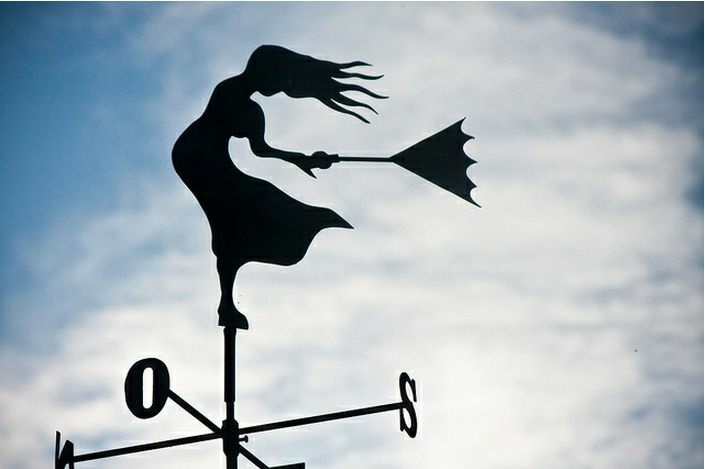
Photo by Garry Knight via Flickr Creative Commons


And I took it from there, making Matt’s mother a witch, then the Queen of all witches. Then I thought “what if Matt, the Witch Queen’s son, was immune to all her spells?”
Once I finished writing the story, I thought it could be the beginning of a novel, or at least a series of stories. So I thought I would call the novel The Mandrake Ruse, in the style of 60s-era spy stories like Man from U.N.C.L.E. And I could write a bunch of novels about The Witch’s Son.

Now that I’ve been toying with the idea for a couple of years, I realize that I have those titles mixed up, so when I do publish the book, it will be called Dark Clouds, and the first chapter will be “The Mandrake Ruse.” It just makes so much more sense.

Does genre-hopping hurt my credibility as an author?

A number of readers, and my family, too, have asked for a sequel to The Bones of the Earth. And as you can see from the cover, it’s “Book One of the Dark Age Trilogy.” I do have rough plot outlines for two more books about Javor and his adventures in the seventh century, but I also have this burning desire to write some other stories, first.

Had I a contract with a publishing company, my publisher, editor and/or agent would gripe about this. “Readers who liked your first book want more of the same!” I can hear one of them saying. “You’ve proven there’s an audience for that story, and they’ll be disappointed if your next book is totally different.”

I think every artist or creative person faces that dilemma: those who liked your first work will come back expecting more in the same vein. Delighting them with something new and completely different is a steeper hill to climb — you’re working against the very expectations that you created.

On the other hand, I am a writer because there are stories that I want to write, and my imagination doesn’t necessarily fit into categories defined by someone else.

I don’t read in just one genre — why should write in just one genre?

The most commercially successful authors stay within the categories they’re known for: John Grisham, Jodi Picoult, Tom Clancy, Dan Brown, Stephenie Meyer … it’s a long, depressing list.

On the other hand, some of the best writers have written in more than one genre, or have succeeded both artistically and commercially when they’ve gone beyond the slot assigned to them at some point in their careers:

Ray Bradbury — known for science fiction, especially Fahrenheit 451 and The Martian Chronicles, Bradbury’s also celebrated for Dandelion Wine, the story of a young boy’s “magical summer.”

Stephen King started with horror and is still best known for It, The Shining and Carrie, but he has successfully transitioned into science fiction, non-fiction and, it could be argued, literary fiction.

Guy Gavriel Kay began writing fantasy fiction with The Fionavar Tapestry series, continued with his almost-historical magic realism, and moved to historical fiction with Ysabel in 2007.

Margaret Atwood went the other way. Established since the 60s as a main force in current literature, she surprised the book world with the dystopian science-fiction The Handmaid’s Tale, more recently Oryx and Crake — although she denies they’re science fiction.

The big question

What will this do to future sales prospects? Will readers of The Bones of the Earth who check my new publication be disappointed or delighted by Between the Vise Jaws?

Will fans of One Shade of Red be totally turned off by a war memoir?

Or will my hopes be realized: that writing in different genres will spread my appeal to new audiences?

What do you think? Leave a comment!


Friday, December 21, 2012

Wodke Hawkinson on style


With six books, dozens of short stories and two blogs, the writing team of Wodke Hawkinson is widely recognized as a force in the independent author community.
Wodke Hawkinson is actually the writing team of Karen Wodke and PJ Hawkinson, two lifelong writers who, after each publishing a book on her own, teamed up to produce the thriller Betrayed, three collections of short stories, the genre-smashing Tangerine and their latest, Zeke, a novel of suspense and sexual tension.

The team not only writes in different genres, their individual works combine genres, cross genre boundaries and indeed invent whole new kinds of fiction. So naturally, I had to bring them back to Written Words to ask about their writing style.


How would you describe your own writing style?
K  I feel like we have a rather direct style of writing. We like to paint a clear picture of what’s going on (usually) and if we are vague about anything, it’s intentional. We like our books and stories to flow; we don’t want reading them to feel like work.

PJ I agree with Karen. I personally don’t like something that hasn’t been in the story, or is barely mentioned, and then it ends up being a major part of the plot.

Are there any authors whose style you admire? Do you try to emulate them?

K - I admire so many authors; it would be hard to narrow it down. I don’t feel like we consciously emulate anyone, but I’m sure that we’ve been influenced to a degree by some of the great books we’ve read.

PJ - Again, I agree with Karen. While I don’t try to emulate other authors, I think it is nature of the beast that authors can’t help but use someone else’s techniques on occasion. After all, writing is writing, and there are only so many ways to put words to paper.

Are there authors whose writing style you dislike?

K  Without mentioning names, yes. I dislike writing that’s so verbose it’s a chore to wade through. I also dislike pretentious writing or vague writing.

PJ  Also, without mentioning names, I find some writers to be overly descriptive. There’s no reason to beat a dead horse.

How important is your writing style to you? Are you happy with your style, or are there aspects of it you try to change during rewriting or editing?

K PJ and I have very similar writing styles and this makes collaboration easier for us. I’m pleased with our works. That said, we are always looking for ways to improve the story during editing.

PJ Karen mentioned the similarity in our writing style but I’d like to also mention the different ways we have at looking at a situation. While we basically think the same on most things, we have also led completely different lives and thus can each bring our own points of view to the table.

How can readers identify your writing style? Are there particular words or kinds of words that you tend to favour? Sentence structures? Or is it more in the story, the pacing or the characters?

K & PJ  We’re not sure we have a style distinctive enough it could be recognized sans our name. We tend to favor an approach that carries the reader along, with just enough detail to set the scene, and with characters who may not always be likeable but act like real people in believable situations.

Do you think writing with a female protagonist and POV, as opposed to a male POV, changes the style, in terms of word choice, sentence structure or other language elements?

K Yes. Absolutely.

Karen Wodke, left, and
PJ Hawkinson
PJ  I think it depends upon the character you are writing about. Not all females act like one and nor do all males act masculine. Writing style, word choice, and sentence structure all come together with the character, not with the gender. And in my case, I worked with mainly men for many years and believe I can see, at least to a point, their way of thinking.

Do you think your audience responds to your writing style, consciously or unconsciously?

K & PJ  It depends on the book. With a couple of our books, Zeke and Betrayed, audiences tend to have a strong response, either positive or negative. But we believe that has to do with the content (violence) more than our writing style. Not all of our works are suspense/thrillers, but the ones in that genre garner more passionate reviews.

How important do you think writing style is to an author's commercial success?

K & PJ  It could be very important. We feel that style is defined by the way an author handles the telling of the story. That would include many elements. If you gave the same exact plot to ten different writers, the tale would be told in ten entirely different ways. So style does matter. But we also have to say that sometimes the story itself is what matters. Some stories are so compelling they are able to transcend poor writing and appeal to a wide audience.

About Wodke Hawkinson and their books:

Wodke Hawkinson is the name under which writing duo PJ Hawkinson and Karen Wodke produce their collaborated works. The authors have been friends since high school, and began their co-writing partnership in 2009. Before combining forces, each completed a solo project in addition to publishing various short stories and/or articles. PJ published Half Bitten, a novel of vampire revenge and teen angst, and Karen completed her book for young readers, James Willis Makes a Million.


Both PJ and Karen attended school in Kansas. PJ graduated from Hutchinson Community College, and Karen attended HCC and Kansas Wesleyan University. Both reside in different Midwestern towns, and do much of their collaboration via telephone and the Internet. However, they have been known to discuss ideas while casting their lines at a quiet lake, as they both enjoy fishing.

Along with several short story singles, the books they have published as a team include:

Tangerine  Romance and intrigue in a future where space travel is commonplace and aliens a part of everyday life.

Betrayed  Brooklyn is taken captive during a botched carjacking. And so her nightmare begins.

Betrayed  Alternate Ending  Written especially for readers of Betrayed, this publication begins at chapter 49 of the original novel and takes the story in a completely different direction.

Zeke  A dark novel of sexual obsession and psychological suspense. How could a man who looks so good be this wicked?

Catch Her in the Rye  Selected Short Stories Volume One  Thirty-one short tales from various genres.

Blue  Selected Short Stories Volume Two  Eighteen short stories, three of which are novelette-sized. A cross-genre reading experience.

Alone  Selected Short Stories Volume Three Eighteen genre-spanning works of short fiction that include drama, humor, sci-fi, and paranormal.

Website: http://wodke-hawkinson.com/

Readers' and fellow indie authors' site: http://findagoodbooktoread.com/

Amazon Author Page: http://www.amazon.com/Wodke-Hawkinson/e/B00572KLX2/ref=ntt_athr_dp_pel_1

Smashwords author page: http://www.smashwords.com/profile/view/wodkehawkinson

Barnes & Noble page: http://www.barnesandnoble.com/c/wodke-hawkinson

Yahoo Contributor profile: http://contributor.yahoo.com/user/1167577/wodke_hawkinson.html

Twitter ID: @WodkeHawkinson

On Facebook: http://www.facebook.com/wodke.hawkinson