Wednesday, September 11, 2013

Conveying emotion while avoiding cliché: Rachel Thompson on style


This edition of Written Words turns to Rachel Thompson, author of A Walk in the Snark, The Mancode: Exposed and most recently, Broken Pieces. She has graciously agreed to answer my pesky questions about writing style.

How would you describe your own writing style?

I've always been fascinated by writers who can express themselves with the least amount of words, yet still lyrically. That's why I'm such a fan of Hemingway. I tend to write in shorter sentences, with as few words as possible. 

You made a major shift between your first two books, The Mancode Exposed and A Walk in the Snark, and your third, Broken Pieces, in terms of subject matter and tone. Do you also think you wrote differently? Do you think your use of language changed?

The topics of male/female relationships are still there, and I'm still nonfiction, but yes, the tone is radically different. After writing the first two humor books, I found myself returning again and again to the childhood sexual abuse I experienced as a child and had never spoken or written about. It just seemed like it was time.

Are there any authors whose style you admire? Do you try to emulate them?

I hated Hemingway when I was younger, but very much appreciate his style now. I admire Hanuki Murakami immensely. John Irving and Pat Conroy also, for their ability to tell wonderful stories with rich characters. I'm enjoying more poetry now, especially by Dylan Thomas and Pablo Neruda. I enjoy David Sedaris very much. I'm also a huge advocate for women, and read as many female writers as I can. Those who influence me are Virginia Wolff, Lorrie Moore, Anne Rice's earlier works and Margaret Atwood — love her work. And indie authors like Christine Nolfi, Steena Holmes, and Terri Guiliano Long are extremely talented. 

Are there authors whose writing style you dislike?

It's interesting — I've attempted to read House of Leaves (by Mark Z. Danielewski) several times and just can't get through it. I'm very process-oriented and linear. That book is crazy. It's on my To Do list, though. :) 

How important is your writing style to you? Are you happy with your style, or are there aspects of it you try to change during rewriting or editing?

I do like my style. I find I work best with a loose structural outline (for example, “trust” or “love” as topics) and then I just let my mind go. It seems to work well with poetic structure in particular. I'm playing with sonnets right now. I tend to write in past tense more than I'd like. 

How can readers identify your writing style? Are there particular words or kinds of words that you tend to favour? Sentence structures? Or is it more in the story, the pacing or the characters?

As a nonfiction writer, I'm fascinated endlessly by the psychology of relationships, so I tend to use words that convey emotion, while avoiding clichés (e.g. heart, soul), which can be difficult! Avoiding cliché is a huge deal for me. With regard to pacing, in this past book I was struggling with the structure and how it lent itself to pacing. My brilliant editor, Jessica Swift, suggested I don't get mired in the structure while I was writing — rather, allow the pieces to go where they led me. This ended up working quite well and it's how we ended up structuring the book.

Meaning, it's not: essay, poem, prose; essay, poem, prose. It's whatever felt right for each section.

Do you think your audience responds to your writing style, consciously or unconsciously?

I do. We're taught to be chronological thinkers, but emotions don't conveniently fit into that neat little timeline. So with this book, I present it in pieces (as the title implies) so the reader will feel the same discomfort I did as I lived them. Even a 1-star review that complains about disliking the “disjointedness” of the book's structure is a win for me since that’s exactly what I wanted.

How important do you think writing style is to an author's commercial success?

I wish I had an easy answer. I had no idea people would respond to this book the way they have. Sometimes I read a NYTimes bestseller and think, “really?” So I suppose my answer is that yes, style does contribute, but we as authors also have to connect with readers at an emotional level for the work to resonate.


Where do you see yourself going creatively next? Tell us about your work in progress. What can your readers expect from RachelintheOC?

My social media book for authors (Let's Deconstruct! is the tentative title) is with my editor. We should be done with that process by October and I hope to release in November. I've started writing the next in the Broken series, titled Broken Places. I was hoping to release by December but we shall see — I'm thinking more spring of next year at this point. I don't want to rush it. And I recently signed with Booktrope to create the print version of Broken Pieces. That should be out in October or November also. 

Thanks, Rachel in the oh-see!

Thank you!

Rachel Thompson (aka RachelintheOC) is a bestselling author and social media/author marketing consultant. She is a founding member of the BestSelling Reads association of writers of new fiction.
Her three books, A Walk In The Snark, The Mancode: Exposed and Broken Pieces are all #1 Kindle bestsellers and garner five-star reviews from fans and professional reviewers alike.
When not writing, she helps authors and other professionals with branding and social media through her company, BadRedhead Media. Her articles appear regularly in the San Francisco Book Review (BadRedhead Says…), 12Most.com, bitrebels.com, and BookPromotion.com.
While she did live in “the OC” — Orange County, California, Rachel and family moved to Northern California in 2012 to be closer to family and friends — but really, because her family was tired of her burnt food and Rachel’s mom is a great cook.
She hates walks in the rain, running out of coffee, and coconut.

Find Rachel Thompson online: 

Email RachelintheOC(at)gmail.com
Website: rachelintheoc.com
Consulting company: BadRedhead Media 


Facebook 

Twitter 
Rachel: @RachelintheOC
Business: @BadRedheadMedia

LinkedIn

Goodreads  


Thursday, September 05, 2013

Progress report: The state of the blog — and a thank-you

I’m excited: pageviews on this blog broke through the 200,000 count a couple of days ago.

In other words, people from literally around the world have clicked their way to at least open their browsers on Written Words over 200,000 times — most of them in the past three years.

I like to think that viewers come back frequently — and with under 40 email subscribers who have signed onto the feedburner, and 247 Google “members,” I think I’m safe to say that the same people come back repeatedly.

A slow launch

This picture of the all-time history of pageviews looks like a cross-section of Alberta, looking south: the prairies almost perfectly flat until BOOM! a steep rise that really look like mountains.

I launched this blog in 2006, but I did everything wrong for the first four years: rare updates, mostly text, unsupported by any other promotion other than a few emails.

Then I got serious. When I was getting close to publishing my first novel, The Bones of the Earth, I started reading about publishing and promoting your own work. “Build a platform,” was a common theme from many advisors. A platform, went the common wisdom, comprised a website, a blog, a Facebook page and a Twitter feed.

I went to work and started writing blog posts more frequently in April 2011 — eight posts that month, but then fell back to just three in May and only one in all of June.

Getting serious

By August 2011, though, after a vacation, I really got serious and started posting two or three times a week. And I’ve managed to keep that up, too.
At about that time (as far as my Swiss-cheese-like memory can recall), I started using Twitter, and (as many of you know), most of my tweets link back to this blog. That’s probably how you got here in the first place.

That was when the visits really took off. My Twitter feed grew pretty quickly, to over 2,000 followers in the first year. It’s leveled off since then, but it’s pretty clear that tweets bring viewers to the blog.

I have done a few experiments. I use Hootsuite to schedule my tweets, usually a day or so in advance. (I also interactively add other tweets, and retweet stuff when I can.) If I reduce the frequency of tweets, my daily pageviews decrease, as well. I hope that I am not wearing out my Twitter welcome (Twelcome?) with such frequent use of the medium, but as long as my pageviews keep rising, I’ll assume I haven’t.

The next plateau?

These days, the average number of pageviews is around 400 a day; a marketing expert I know told me that he’s read reports that that is a very healthy number for a blog. That adds up to over 12,000 per month. While the two measures are not comparable, 12,000 readers of a trade magazine in Canada was once considered strong.

If this keeps up, that total pageview number will reach 300,000 in less than a year.

Who is to blame for this? You are, dear readers — you who keep coming back to see what’s on the blog.

Thank you.

Thursday, August 29, 2013

How to write a report I will read

My last post focused on fiction: how to write a novel I would enjoy reading.
There are far more people in the world who have to write other kinds of documents: letters, proposals, memos, instructions, report — which may or may not be fictitious.

These writers also need some guidance, at least to judge from many of the reports I have to read. So here are a few tips on how to write a report that I will be able to read.

1.   Start at the end

Get to the point immediately. No one reads reports for pleasure. They want to know “what’s in this for me?”

Start with your more important point: what does this report mean? In other words, the conclusion. State that up front. In fact, write it down first.
Think of writing your report as taking a road trip. What’s the first thing you do? You enter the destination into MapQuest (or Google Maps, or whatever). You find out exactly where it is and you get directions from where you are now.

Your conclusion, which should be the thesis statement of your report, is your destination. Now, you need to work out how to get there.

2.   Get a GRIP

Regular readers will know my copyrighted formula to writing: Goal, Idea, Reader and Plan

Goal — Your purpose. Why are you going to your destination? What will you do when you get there? In terms of writing, what result do you want from this report? It could be to change a policy in the workplace, or it could be to inform colleagues about safer working procedures. Whatever it is, have a clear idea about it. If you have trouble clarifying the purpose, answer this question: what do you want the reader(s) to do after they finish reading the report?

Reader — Whom is this report for? Who are they, specifically? What interests them? What motivates them? Why should they care about what you have to say?

Idea — Your main message, your thesis statement, the most important thing you have to say. Sum up your whole report into one grammatically correct sentence. If you can’t do that, you cannot make your point clearly to anyone else.
Image from Jamie Rubin, science-fiction author
http://www.jamierubin.net/2012/08/07/going-paperless-5-tips-for-how-a-paperless-lifestyle-can-better-capture-some-everyday-interactions/

Plan — This is your MapQuest/Google directions to the conclusion. A map has two main points: starting and destination. Now, your audience is uninformed, or at least not as aware of all the information you have. Where you want them to be is responding according to your Goal statement.

Typically, you need to present facts, show the links and relationships among them, and demonstrate to the readers why these are important. Tell the reader how the facts and links affect their job or life. 

For example, if you want to cause change in your organization, you will have to show how the current situation costs more money (or time, which is the same thing) than it has to. You have to demonstrate this is a pressing problem, or imminent threat to safety, employee morale or bottom-line profits. Then you have to demonstrate how your conclusion will solve all those problems.

3.   Write backwards

Write the conclusion first. That will put your destination, your main point, clearly at the top of your mind. And it will show you how to get there.
Then write the persuasive information that will bring your readers there. Follow your outline. Don’t skip anything. Fill in all the information your readers will need to accept your conclusion and take the action you want them to take.

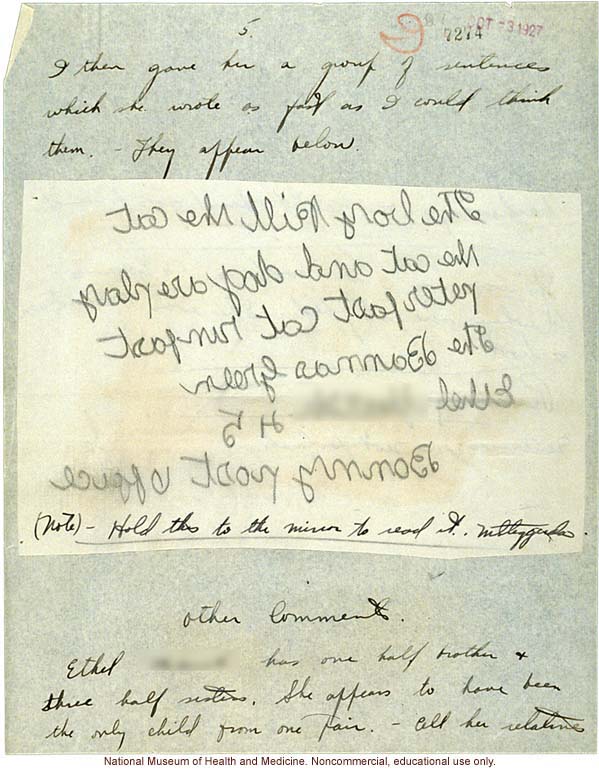
National Museum of Health and Medicine. Educational and non-commercial use only.
Write the introduction last. State the problem (if there is one) and summarize your conclusion.

If you’re going to summarize anything, you have to have the full statement written out first. It’s far more difficult to say something succinctly first, then extend it to a full argument.

It’s like that old statement that’s been attributed to Mark Twain, Samuel Pepys, Oscar Wilde and many more: “Sorry to write you such a long letter; I didn’t have time to write a short one.”

4.   Control quality

Avoid jargon and business terms like “going forward,” “institutional arrangements,” “at the end of the day” or “outside the box.” These are emptyphrases. Just write what you mean.

Eliminate empty words and phrases that don’t add information. Replace noun phrases with verbs. Keep your sentences active (see my post on Writers Get Together).

And before you deliver your report to the audience, edit it. Go over it again. Watch out for clichés and vague thinking, as well as downright mistakes. Was the number supposed to be 51 or 15 cases of ammunition? Did that shipment arrive on February 8 or August 2?

5.   Proofread it one more time

It can’t hurt, and you may just catch something egregious. Better yet, have someone else read it over. You can’t proofread your own stuff.

Follow these guides, and you’ll have a much easier time writing a document that will have the results that you want.

Questions? Ask in the Comments section below.


Good luck!

Saturday, August 24, 2013

How to write a book I will like

Image "3D judges gavel" by Chris Potter (Flickr: 3D Judges Gavel) via Wikimedia Commons
I have reviewed a number of books by independent authors lately: Rachel Thompson, Bruce Blake, Seb Kirby, Doug Dorow, Chris Ward and of course RS Guthrie. All the reviews that I have published on this blog have been very positive: four or five stars out of five.

I thought I would now explain how I arrive at that judgement. Just in case you were wondering “What is it you want from a book, anyway, Scott?”

First, before you dismiss me as a the kind of reviewer who gushes over every book he reads, I have to tell you that I do not publish a review of every book I read.

About a year ago, I published a negative review of a book that I thought was bad: badly written and not edited even once. I gave it a one-star review.

I expected the author to react badly. What I did not expect was for her friends on Goodreads to rate my books poorly without reading them, in some kind of lame revenge.

From that point, I decided to publish a review only if I liked the book and felt justified in rating it at four or five out of five.

That doesn’t mean that if I do not publish a review of your book that I didn’t like it! I may not have gotten around to reading it yet, and even if I have, I may just not have had time to write a review, yet. And not every blog post is a book review. But if I really like a book, I will write a review of it, eventually.

Tell us what you  like, then!

Okay, okay. I was getting to that.

First, I demand that a writer knows what he or she is doing: writing in English. That means the writer has to know the rules of the English language: grammar, spelling, punctuation.

And the writer has to be able to string together sentences that are interesting without seeming forced. The words have to flow naturally.

I don’t want a writer to show off his or her vocabulary of archaic expressions. Far too many fantasy stories are full of words like “countenance” and “vouchsafed.”

Books written entirely in slang are tiresome, too. Yes, a cop has to speak some cop jargon, but that risks losing the audience.

Writers, don’t show off your way with words. Tell the story.

Don’t waste pages setting the scene or telling the character’s back-story — or  explain how the fantasy world came to be and how the secret orders of wizards or knights or whatever are holding things together.

Instead, let the explanation flow out of the plot. Show the consequences when the good witch dies,  don’t tell me about the danger.

And don’t get bogged down in details. I don’t need to hear the organization of MI6, how a Sig Sauer handgun works, or the relativistic underpinnings of your time machine. If it’s necessary to the plot, have one character explain it to another.

Details can make a scene come alive for the reader, but too much bogs the story down. Keep the story moving forward, and add details necessary for the action to make sense. If someone falls into a lake, the water temperature may be important to her survival. But the size of the lake or the colour of her shoes probably are not.

Characters

As readers of my reviews may guess, I like believable characters, even in unbelievable situations. Think Life of Pi.

Believable characters are like people you know: complex, with strengths and weaknesses. Even someone you love dearly must have some characteristics you find objectionable, if now downright obnoxious.

Look at yourself: what are your weaknesses? Where are your inconsistencies?
I have little patience anymore for the sharpshooting superspy who speaks 11 languages, takes out multiple bad guys with a combination of every martial art ever developed, flies jet fighters 15 feet above the city streets without hurting any bystanders and goes home to whip up a soufflé.

I prefer heroes I can identify with. The flawed ones. The guys who arrive at work with a stain on their pants and forget to pick up the eggs on the way home. Women who have to juggle families, jobs and career aspirations and don’t have time to learn a twelfth language.

It’s a lot more interesting to me if the hero has to figure out how to beat the bad guy. Think of even the action movies you’ve seen: isn’t it a lot more satisfying when the hero defeats someone who is far stronger and more capable?

It’s also a lot more interesting when the main character has to overcome one of her main weaknesses. That provides something else I look for in a story: character growth.

People do change. We age, we learn new things, we fall in and out of love.
And people who don’t change? They’re not interesting at all.

It’s the story

Ultimately, the story has to be engaging. It has to matter to me, and it has to keep moving.

I’m not going to try to prescribe a formula of dos and don’ts. There are enough bloggers and advisors to do that.

And I do not believe that there is a single right way to tell a story, either. The most successful books are those that do something different, even if the quality of the writing or the characterization is lousy.

The Girl with the Dragon Tattoo was an unlikeable, borderline-autistic geek. Twilight introduced sparkly vampires and made teenage female lust for non-humans okay. 50 Shades allowed women to read about kink on public transit.
Do you want me to review your book?  Just make sure it has believable characters, a plot that moves quickly — and an editor.

Wednesday, August 21, 2013

Cover reveal: Martha Bourke's Deadly Call


Deep in the shadows of Boston, Massachusetts, the Order—a secret brotherhood of New Breed warriors—is all that stands between a takeover by shifter supremacists.

Diesel, the most charismatic of the brothers, exudes a love for life all the while carrying a terrible burden. A veteran of the Iraq War, he is haunted by the traumatic events of a single night. Poisoned by shame and certain he is cursed, Diesel fears he is a danger to everyone around him.

Helen, the Order’s stunning and gifted surgeon, has a few demons of her own. Even as she and Diesel give in to the deepest pleasures of the mating call, something still holds her back. Destiny threatens to divide them, until, in the midst of unimaginable tragedy, they must banish the ghosts of the past to save their future.

Deadly Call launches Thursday, August 22.


About the author 

Martha Bourke grew up in Burlington, Vermont, a magical place where street art meets cosmopolitan sensibilities meet nature. She is an accomplished teacher who has spent the last fifteen years creating Spanish-language programs for elementary schools and travelling extensively. For most of her life, she has had a fascination with foreign languages, culture, and mythology – a passion that colours and enriches the world of Jaguar Sun, which now comprises two series, Jaguar Sun and New Breed.

Martha and her husband of fifteen years have carved out their own little piece of Vermont in the Massachusetts countryside. When not writing, she loves spending time with her animals, listening to good music, thrifting, and adding to her Converse collection.

You can see all her books on her website, MarthaBourke.com
follow her on Twitter @Martha_Bourke 
and like her on Facebook: facebook.com/marthabourkeauthor


Sunday, August 18, 2013

The Ninth District: the way thrillers should be written

An independent novel review

I like it when an author sets his book in his home town, especially when it’s a place that doesn’t normally get mentioned in much mass media. The depth of knowledge comes through in the detail and that makes the story that much more realistic. For me, even nicer that it’s a place I visited a number of times, and where the geography is similar to the place where I grew up.

But that’s not the important reason that I liked Doug Dorow’s The Ninth District. It’s a terrific book, a thriller with a unique story and believable characters.

The story:

Minneapollis is the Ninth District of the Federal Reserve, where the US prints its currency; the Federal Reserve has a big, very secure building in that city. No Federal Reserve has ever been robbed, so it must present a huge temptation to robbers — and to writers of heist thrillers.

Dorow succumbed to the temptation and crafted this excellent yarn. It has all the elements required for a heist story: a good plan, cliff-hanging suspense and lots of detail about methods, setting, skills and contingencies. Dorow has clearly done his homework.

He also presents a number of excellent plot twists, particularly in the way the villain anticipates the hero’s action. The book opens with the hero, Jack Miller, watching a security video that shows a bank robber murdering a pregnant woman unnecessarily. The murder and several minor bank robberies are all part of the villain’s (whom the cops have dubbed “the Governor” for his habit of wearing a face mask of a former governor of Minnesota) plan.

Strong characters

The hero is FBI agent Jack Miller. He’s a sympathetic character. Separated from his wife and child and trying to work on reuniting, he’s also working through the transition from the young hotshot FBI agent to the veteran teaching the new guy the ropes.

Far too often, new thriller authors make their heroes way too heroic: the genius sharpshooter who’s also a martial arts master, speaks ten languages and is irresistibly handsome.

Jack Miller is flawed, fallible and far easier to identify with — and that makes him much more interesting as a character, too. Sure, he’s smart, he knows how to investigate cases, but he also reacts to threats against himself and his family in believable ways.

The protégé, Agent Ross, is also believable. He’s young, smart and eager for action — a little too eager, sometimes, and his mistakes get him badly hurt.

Jack’s wife, Julie, is well presented, as well. I wish, though, that she was a somewhat larger part of the story.

The villain, the Governor, is smart and ruthless, killing innocent women as part of his plan to throw the cops off his planned heist. However, Dorow has possibly tried too hard to make the villain appear mysterious and threatening. I would have liked to see a little more detail about him, his background and his underlying personality.

Smooth, competent style

Dorow is a professional writer of fiction and has earned all those good reviews. He knows how to bring out the characters through words and actions – showing, not telling. He know how to provide lots of detail about the city, the environment and police procedures without bogging the story down – I couldn’t stop turning pages (or swiping my finger across the screen of my iPad).

There’s lots of action and suspense in The Ninth District, and you want the good guys to succeed in not just the case, but their personal quests, as well.

If you like thrillers, download The Ninth District right now.


4*

The Ninth District on Amazon

Friday, August 16, 2013

The Big Lie from a corporate publishing shill

Have you ever noticed how people talk faster and louder when they have to defend a position they know is wrong? Like the Toronto cops defending the officer who shot Sammy Yatim nine times?

A member of the commercial publishing industry is doing the same thing in blog form with statements like this:

There are exceptions to every rule, and I’ll address that in a minute, but for now let me just say, the Indie Market is shit.  It’s a little pile of shit, wrapped up in shit, to make a shit burrito covered in shit sauce.
I wrestled with the idea of dignifying this idiocy with acknowledgement, and I finally decided that readers deserve the argument to be exposed for the vacuous, dishonest nonsense it is. But I will not do the author the favour of a link.

The Big Lie concept


If you want people to believe a patent falsehood, keep repeating it, and denigrate anyone who argues with you. In this case, the big lie — that all independently published books are bad — is backed up by many other lies. The reader who knows better has a difficult time knowing where to start pointing out the lies.

... The unedited, untalented, unresearched drivel that has been rejected by every publishing house
No: I know of many independent authors who spend a lot of time doing research (myself included). And any professional writer gets his or her work edited by a professional editor.

As for a whopper, the guilty blogger admits to fabrication:

On the other side of that you’ll find authors who have never tried the traditional literary market.  I’m going to go out on a limb here and pull this percentage out of my ass…Ahhhhhhh.  96%.  I believe about 96% of those who have never tried the traditional market don’t because they know they’re going to get rejected. 
Speaking of unresearched drivel ...

The blogger then tries to establish some credibility:

I work for a publishing house (and no despite your begging, I will not tell you which one, nor will I give you a recommendation, so please stop asking) so I know what it’s like.

You may think, dear reader, that this justifies the rant. This blogger is a publishing insider, and must know what he or she is writing about, right? That’s part of the Big Lie, too: make up some kind of credential to manufacture credibility. This blogger works for a publishing house — but in what job? Janitor? Boss’s kid who pretends to do “marketing”?

This is the same strategy that advertisers use when they tell you that 9 dentists out of 10 recommend their toothpaste. Remember the cigarette ad that said that doctors prefer their brand?

Now, for the one bit of truth, which you always find in the Big Lie:

Editors are necessary.
Image source: The Bleacher  Report Blog
http://blog.bleacherreport.com/2012/01
/11/advice-for-copy-editors-this-means-you/
Well, duh. Of course. The blogger puts this in not only because the shaky logic of the post demands it, but because one bit of truth helps convince the audience of the truth of the whole lie. It’s like “With milk and a glass of fresh fruit juice, this cereal is part of a good breakfast.”

It’s all to soften you up for the Big Lie:
The truth is, unless your work is good enough to be accepted by a traditional publisher, it shouldn’t be on the market.
I couldn’t let that go. So, I commented, more or less this way:

Well, what can you expect from an industry insider: defence of a moribund industry’s obsolete and dysfunctional business practices.

I have worked in publishing, too, for over 30 years, for book publishers (including one of the Bix), magazine publishers and newspapers. Guess what: their sales are all falling. The traditional publishing business model doesn’t work anymore, and the big publishing corporations cannot keep up with the market, or the zeitgeist, any better than dinosaurs could keep up with climate change.

What irked not just me but, as I write this, 163 commenters, is the blogger’s presumption of superiority. This blog is the first time I have seen anyone from any commercial publisher to say explicitly that only traditionally published books are worthy of publishing.

Every publisher I’ve ever read, or spoken with, admits that there are many excellent manuscripts in their slush pile, and they just don’t have the resources to publish every good book.
Source: Rebecca Berto
Novel Girl
http://rebeccaberto.com/
category/writing-tips/

In fact, most books published do NOT make money, particularly in fiction. The publishing business model works this way: the few successful books, the ones that sell, make enough money to make up for the larger portion that lose money.

E-books and print-on-demand have made that model obsolete.


I’m not the only person who thinks so. There are at least 162 others who commented on the blog, every one of them objecting. Most of them supplied their names or avatars and contact information — unlike the blogger, who remains (cowardly) anonymous.

One commenter, in fact, responded to my comment:

Well said, Scott. I’m self-published but I had a professional cover done and have had my books edited. I also work as an editor and all my clients are, wait for it … self-published authors. Surprise, surprise. Some of us actually do care about quality. We all know there are a lot who don’t, but they won’t stay in the business for long, and because the prospective purchaser of a book can read a sample, well, they can decide for themselves whether the book is up to scratch or not.
Traditional publishers have made a living off authors for a very long time and now that living is threatened. Not only that, contracts are getting worse and so are the editing services some publishers provide. I’ve seen many a traditionally published book that has sub-standard editing. And guess what, Anonymous (at least have the guts to rant with your real identity), a recent survey has shown that readers don’t give a toss about whether the book they’re reading is self-published or traditionally published.
I find [the] rant offensive, ill-informed, self-important and a generalisation. Thankfully, your opinion won’t stop anyone from following their dream to be published. Let the public decide what they like or don’t like. I’m not afraid for readers to have more choice, but I find it interesting that you do. I, for one, won’t let someone else dictate whether I achieve my dream or not :) .
The blogger is a crank — like the old guy who yells at kids on skateboards for going too fast.

Commercial publishing, the way it has been done for the past 500 years, is over. There’s a new reality, and whether you like it or not, independent authors are producing excellent books and gaining market share.

No, the commercial publishers have no monopoly on good writing. You know this, and many of you produce excellent books, too.

It's now time for readers and writers to dismiss cranks, and look at independent writers in the same way they look at independent musicians: as creative people who produce the most interesting work available.

What do you think?

Tuesday, August 13, 2013

Independent novel review: Double Bind by Seb Kirby

“The guy with the bad attitude has been following me all week.”

Seb Kirby gets right into the story in Double Bind. There’s not a wasted word in this book: no background, no world-building, no nonsense. The writing is spare and clean, active yet evocative, told in first-person present tense, which enhances the action and immediacy.

Take this for an example: “Elmington Drive is a wealthy suburban street. Smart gardens, no parked cars, large houses, most with gravel drives and tall shrubs.”

Because he gives readers credit for knowing something, Kirby is able to painted a picture in a few phrases.

In short, Kirby is a true professional writer of fiction.

The story begins with the narrator, successful author Raymond Bridges, meeting his double at a book signing. The double accuses Bridges of stealing his face and identity — and his pen name. Soon, Bridges finds himself in a new body, victim of spreading ripples of identities displaced into new bodies. Double Bind is a science-fiction story presented like a mystery — not an easy assignment for any writer. Kirby has the skill to pull it off.

Kirby makes it all make sense by explaining the process and the science through the characters’ actions. Bridges, who becomes Erin Pascoe (that’s a man’s name in the UK, apparently) gradually learns the details, like one of Raymond Chandler’s detectives.

Kirby makes his characters real through their words and actions more than through verbose descriptions. Bridges is actually not that likeable. He’s a liar, an imposter, someone more than willing to take shortcuts to get what he wants, no matter what they do to others.

Victoria Bletchley, Bridge’s love interest, is one of the most desirable and admirable women I’ve read in fiction lately. An English professor, she’s a long-legged looker, too. She loves “rutting” and reading, more or less in that order, and she’s smart. Even for an English professor.

Here’s my favourite passage featuring Victoria:
Strang [a cop] is sounding impatient ... “Pascoe is a suspect in at least one, possibly two, murders. Keep stalling like this and you’ll leave me with no option but to take you in for obstruction of justice. That’s if I don’t arrest you as an accomplice to murder.” 
I’m wondering how Victoria is going to get out of this when she uses her contextualizing skills to great effect. “OK. I do porn. Looks like I’m well off, but this is my mother’s place and I have expensive tastes.”
Smart, sexy, beautiful, brave and able to think on the spot of something sure to throw a cop off his game — what more could anyone, even a writer, want in a woman?

All the characters are believable, especially the villains, who range from London gangsters to corporate types. Again, Kirby is able to evoke them clearly in the readers’ minds with a minimum of words.

All the way through (it’s not a long book), Kirby keeps us hooked with tantalizing clues and a style that you just cannot put down.

Double Bind may not be Kirby’s best-known book, but if you want a read that won’t let you go, that tells a good story well and doesn't waste your time, download Double Bind now.

5*
Seb Kirby's website and blog

Wednesday, August 07, 2013

It's time for writers to shine light on conspiracy theories

Image borrowed  from Zazzle
In Foucault’s Pendulum, semiotics originator Umberto Eco wrote the argument that should have killed any conspiracy theory involving Templars, Freemasons, Rosicrucians, the Illuminati and any other secret society that manipulated governments, courts, corporations and international organizations. Sadly, the nutbar ranters of the world are not very well read.

I received a spam email apparently from Alfonso Luigi Marra, who it turns out is a member of the European Parliament. The email exhorts unspecified justice systems to prosecute the twin dynasties of Freemasonry, the Rothschilds and the Rockefellers, or “R&Rs.”

The R&Rs who are evident or silent owners of almost all the major banks in the world, or at least they control them and, through them, they have been controlling, for three centuries, the thoughts of the people, their orientations, their tastes in food, sex, sports, music, the gods they believe in, the scientific discoveries to be made known and those that are to be hidden, the laws to be enacted, the fashions, and in short everything that moves or is immobile under the sun, because they control the economy, the media, governments, the judiciary, trade unions, political parties, police, culture, revolutions, wars, Google, Wikipedia, Facebook, and Twitter.
 
Wow. That’s a lot of control. Apparently, my bank controls my thinking. And everything that moves or is immobile under the sun. What does that leave?

Mmm, nutbars.
Image from Creative Commons.

At first glance, this speech is laughable. It reminds me of cheap tracts that would show up inexplicably in my parents’ or grandparents’ home when I was a kid, or the sheets handed out by shaky-handed men in threadbare tweed jackets at bus stops. Can any rational person believe any of this?

Normally, I glance at these things, laugh at the bad writing and chaotic reasoning and throw them out. But now that it’s come as email spam, and in keeping with my recent posts about the comment spam this blog gets, I thought I would present it to you, dear readers, as a warning.

People who believe in deep, dark conspiracies perpetuate damaging stereotypes and promote intolerance. The first sentence is actually chilling, if you consider where the author is going logically:


It is necessary to eliminate the Rothschilds and the Rockefellers (R&Rs) through the justice systems to thus eliminate Freemasonry, which they have used for three centuries to dominate the world with their criminal policies. An invocation to make provisions for the part of the judiciary that is neither Masonic nor pro-Masonic and especially the Italian judiciary and the ECHR (European Court of Human Rights), the last of which sold its role to the Masonic lobbies and reneged the jurisprudence that it had managed to wrest from it in twenty years of trials.


What does the writer mean by “judicially eliminate?”
First of all, however, I think it is necessary to identify the criminal responsibility of the Rothschilds and Rockefellers and strike them personally by arresting them, confiscating their assets, and in countries where it is allowed, condemning them to death.
There you have it. The nuts are still asking for the execution of whole groups of people because they control the world’s banks, industry and media. Remind you of anything?
 
Do we clear-minded people need to worry? On one hand, no. It seems that everybody and everything is part of Marra’s conspiracy of enemies:
The 'Enlightened' who, since they have existed (let’s say from 1723), have always been used, bought and sold, by the Rothschilds and the Rockefellers, in their seignorage strategisms, to promote, infiltrate, corrupt and hijack everything: the French, Russian, Chinese, and Cuban revolutions, the Italian Risorgimento, the unification of Italy, and so on; every movement or event on every continent, the wars of independence, the world wars and politics today. 
What’s left? By Marra’s reasoning, most people in the West are Freemasons, whether we know it or not. Look at his list of secret, if prominent Freemasons:  
Robespierre, Napoleon, Marx, Lenin, Stalin, Cavour, Mazzini, Garibaldi, Einstein, Freud, Roosevelt, Churchill, Allende, Spinelli, Gorbachev, Obama, the UN and the EU.
Similar conspiracy theorists describe the Illuminati as also controlling pop stars like Jay-Z, Beyoncé and Rhanna. The proof: they make triangular symbols with their hands, evoking the image of the eye in the pyramid. 
Image from Lazer Horse: http://lazerhorse.org/2013/05/23/tupac-illuminati-killuminati-conspiracy-theories/

(You can see it on the back of the US dollar bill. Hey, the Illuminati must be behind the repeated failure of the US to bring in a new dollar coin!)

Conspiracy theories can be a lot of fun. There's something seductive about them, too: the fact that they can never be proven supports the theory about their secretive nature. 

I keep telling people, especially those who love books like The DaVinci Code, they have to read Foucault's Pendulum. In it, Eco's heroes, three editors from Milan, prove that the easiest way to create a secret society is to start a rumour that it doesn't exist. Within weeks or even days, some nutbars will start up a wannabe conspiracy.

The down side


Creative Commons
Tracts and speeches like these are symptoms. If Marra believes this drivel, many others who don’t write about also believe it. Where have we heard of this before: there is a secret society of people, prominent among them a Jewish family, that controls banks, media and  governments, and that manipulates art and society?

So what’s the solution? First, let’s not shove these ideas into a dark corner. Let’s bring them out and understand them for what they are (which, given the quality of writing they typically display, can be a challenge). And then, let’s expose the hateful, damaging and just plain wrong reasoning. Let’s start with the obvious falsities, then the illogical reasoning, and finally, the underlying prejudice and racism that feeds on the ignorance and fear that these theories perpetuate.


And Professor Eco, if you read this, any insight would make a huge difference.