Wednesday, February 05, 2014

Independent novel review: An Unlikely Goddess by Mohanalakshmi Rajakumar


Unlike most independent authors, Mohanalakshmi Rajakumar, known on Twitter as @Moha_Doha, eschews genre writing. Her novels include elements of romance, but they do not follow the conventional girl-meets-boy story.

An Unlikely Goddess is mainstream literature, and you can even look at it as part of the stream of books about the Indian immigrant experience, along with Rohinton Mistry and Michael Ondaatje. 

The story

The novel follows Sita from her birth in India. Her mother, Mythili, and the whole family are bitterly disappointed that her first born child is a girl. “What if he leaves me?” is her first thought after seeing her daughter. Mythili’s sister-in-law, Priya, drops the new-born on the hospital floor.

Sita’s life doesn’t get better after that. Her parents, Mythili and Sundar, never fail to remind Sita of how much she disappoints them throughout her life. This gets worse after Mythili gives birth to a boy, Manoj. 

When Mythili is still a young child, the family emigrates to Florida, of all places, where Sundar gets a perpetually temporary job as a researcher in a university. But Sundar never manages to get a promotion or even a permanent position, so he is never able to afford much of a lifestyle. He and his family can only look enviously at the success and socio-economic climb of other Indian immigrants as they move to large suburban homes and buy expensive cars.

What I liked

Characterization is the main strength of An Unlikely Goddess. Not only do we see the action through Sita’s eyes, Rajakumar’s prose enables us to experience an entire world through Sita — especially her conflicted feelings toward her parents.

The secondary characters are also well-developed, and they grow believably, too. Mythili gradually becomes aware of the subservience she’d been socialized to accept, and begins to develop some independence from her husband. Sundar goes through several stages of anger and resentment, blaming his family for his own career failures, but finally begins to mellow and even accept his daughter’s untraditional desires.

The only weak part is the last love interest, Richard. He’s just too good to be true — but then, after everything that the author has put her main character through, she deserves a really great guy.

Professional style

Mohanalakshmi Rajakumar is a prolific and professional independent author. An Unlikely Goddess is her eighth book, and her bibliography includes novels, story collections, anthologies and non-fiction.

An Unlikely Goddess is well written, well edited and has a professionally designed cover. The author’s style is clean and easy to read. Rajakumar is another independent author who reinforces the point that the commercial publishers have no monopoly on quality.

5*****

Find An Unlikely Goddess on Amazon

Visit her website and blog

Sunday, February 02, 2014

Where have all the newspapers gone?

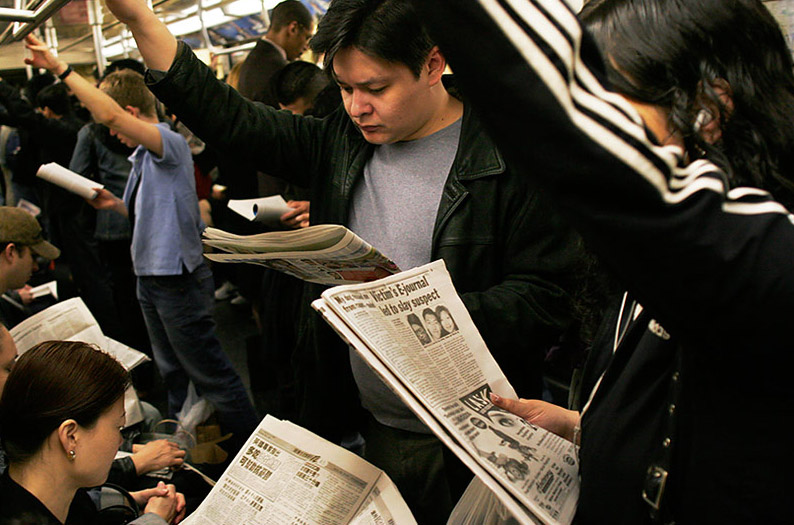
You just don't see this anymore. Photo by Travis Ruse, cropped by Gallifreyan Postman at en.wikipedi
a
licensed under Creative Commons
It's fascinating to see a long-range social and economic transformation take place before your eyes. Particularly in as mundane a place as a city bus. 

I believe in public transit, and I've used it regularly for years. Decades, actually. Yes, I'm old. Twenty years ago, even ten, a newspaper was a common sight on buses, metros and commuter trains. In the 80s and 90, when I lived in Toronto, a newspaper was a requirement for any commuter who wanted to be taken seriously. And any professional with any kind of social ability knew to read the Globe and Mail, or if you really wanted to make an impression, the Wall Street Journal.

Today on the busses in Ottawa, I rarely see a newspaper. If I do, it's probably Metro or another of the free circulation, newswire-copying rags. And while those were somewhat popular a year ago, these days I almost never see anyone even carrying one of those. I don't even see them discarded on the bus seats anymore.

The only newspapers that seem to be hanging on or
growing their circulation are the free daily commuter
papers, like the London Evening Standard or, in
Canada, Metro and 24 Hours. And 24 Hour cancelled
its Ottawa edition last year. Photo courtesy Adam
Tinworth, OneManAndHisBlog.com
This is just my personal view of the huge socio-economic transformation, the decline of the newspaper in the West. In Canada, the US and the UK, newspaper circulations have fallen steadily in the past five or six years, up to 30 percent or more. Newspapers are closing down or merging. Community newspapers have become nothing more than reprinters of centrally-produced fluff.

These trends may not seem new to you, but consider the size of the newspaper industry just two decades ago. The Internet was just starting to scare the traditional media industries, but newspapers and magazines, too, were fat and getting fatter. 

The recession of the early 90s killed off a lot of magazines and page counts of all print publications stated a decline that never recovered. The 2008 economic crash killed five magazines that I used to contribute to regularly. Another symptom of this transformation. 

And its name is ...
The Internet, of course, but particularly, mobile communications. The snide comeback of the print professional to the Internet used to  be that paper is both a reliable storage and display medium, and it's portable — unlike computers. 

And then came the iPad.
On the bus today, I see three people reading books — yes, real paper books, and one of them is a hardcover — and, no surprise, five or six e-readers like Kobos and Kindles. Oh, yes, and my iPad. 

Then there are people looking at their smart phones. Some of them are playing games, but most are going through emails or messages or tweets.

This is usual in 2014. It's a surprise to see anyone reading a paper.

What does it mean?
It means that, at least for commuters from western Ottawa today, the newspaper is irrelevant. Or at least not essential, not like it was two decades ago.

And given newspaper circulation statistics, I suspect the same is true in other modern cities in first world nations.

What do we do?
As communications professionals, we have to recognize that the market has voted for mobile communications and has dropped the newsprint medium, at least for daily news and the kind of specialized information that magazines are good at delivering.

So we have to start to adapt our communications to fit the demands of mobile communications technology — and more to the point, to the audience that uses it.

This is the format we have to work with today. Get used
to it!
Whether we produce fiction, news, non-fiction, technical reports or whatever, we need to be aware that the reader is experiencing it through a small screen — a fairly restrictive medium.

As a writer concerned with craft and the beauty of language, I'm not thrilled about reducing all writing to bullet points and headings. But the reality is that audiences demand, shorter texts, broken into easily consumed chunks. The buzzword today is "consumable information."

And using graphics and motion video really boosts attention, circulation and retention of information. While it may irk you that a twelve-year-old's cat video gets more play than your world-saving treatise, gimmicks have always been effective in any medium.

Look ahead
In ten more years, there will still be newspapers. But they'll be smaller in size and circulation. 

It will be interesting to see what e-books will be like. Will they all include multimedia? I find it hard to believe that motion and graphics will not be standard in text communications.

Nothing is going away. We still have radio. It's just been transformed by all the media that came after it. 
We have another learning slope ahead of us.

Friday, January 31, 2014

BLOG ANNOUNCEMENT: Fantasy Novel Extravaganza!

Starting February 1 through 8, Fantastical Reads is hosting their first Facebook event. Games will give book lovers chances to win an array of prizes. 


Join the fun all week on Fantastical Read's Facebook Event page.  


And visit their blog for a chance to win the paperback of Tolomay’s World and the Pool of Light by M.E. Lorde and The Hunt for Xanadu by Elyse Salpeter through a Goodreads Giveaway


Fantastical Reads— only the best reads and reviews!

Thursday, January 23, 2014

Cover reveal: Revenge — Tube Riders, Book 3

revenge cover

Now this is a striking cover!

Book 3 in Chris Ward's Tube Riders trilogy launches this month, only a couple of months after Ward released the second volume, Exile.

The Tube Riders trilogy is an original idea, set in a decidedly dystopian futuristic, dictatorial society. In Mega Britain's inner cities, gangs of youths seek excitement by riding on the outsides of underground trains. After being pursued by government Huntsmen, they spark a revolution. Revenge is set three years after the action in Exile. 
The Governor of Mega Britain is preparing for war with Europe. In Mega Britain's inner cities, pockets of rebels fight and die in the name of Marta Banks, brave leader of the surviving Tube Riders. 
The Tube Riders themselves, though, have disappeared. With their trail gone cold, the Governor and his deadly Huntsmen have no way to find them. 
That is, until the day the Governor recovers a long lost treasure from his past, an ancient artifact that could crush the rebellion for good.
Marta Banks is about to lose everything.

Look for Revenge this month, and in the meantime, check out Chris Ward's blog, his Amazon author page, and his earlier books, Tube Riders, Tube Riders: Exile, Head of Words, and The Man Who Built the World.

And re-read the review I gave of what he describes as his "best work," Head of Words, here in Written Words.

Friday, January 17, 2014

Tilting against the biggest books of all time: the Bible and Quran

I'm taking a huge chance here.


 Last week, the news media were full of the story about York University in Toronto accommodating a male student’s request not to be put in a study group with women, on religious grounds.

The identity and specific religion of the student are protected under Canada’s privacy laws. Whatever religion it is, this case points to a long-standing problem.

I fully support freedom of religion, and will defend everyone’s right to believe and practice whatever they like, as long as it is not hurting anyone else nor infringing on any else’s rights. But it’s time we all stopped using religion or philosophy to excuse inexcusable behaviour and to justify unjustifiable ideas.

That’s right. I’m telling the world that I do not believe that you can use the Bible, the Quran, Mao’s little red book, the Communist Manifesto or any other book to defend your ideas. I just don’t accept the argument “because God says so.”

You can’t prove that, and the fact that you have a book that’s called “God’s words” does not constitute proof. I can write a book called “God’s Words, too.”
 
See?

The devil is in the details

In September, 2013, sociology professor J. Paul Grayson assigned a mandatory group assignment that required students to work together in person. One student, who was taking the course online, asked Dr. Grayson to exempt him because his religious beliefs forbade him from meeting in public with a group of women.

Dr. Grayson refused the request, and after discussion, the student agreed to participate in the assignment and completed it. However, the university administration ordered Dr. Grayson to accommodate the request.

To his credit, Dr. Grayson refused the administration’s order to accommodate this religious request. “What if I said my religion frowns upon my interacting with blacks?” he wrote. This accommodate would set a precedent, he said, and make him an “accessory to sexism.”

The public reaction was telling and uplifting. I could not find a single person or opinion in the media that supported the religious accommodation. And rightfully so.

(The Dean of Arts at York University defended his action partly because the student asked to be able to complete the assignment in another way, and another online student who was situated outside the country was allowed another way to do the work.)

The media reaction

Every political leader in the country decried the university’s accommodation order. Every opinion speaker and writer I heard or read likewise sided with the professor. Every online comment also supported the professor, and pointed out that this type of religious accommodation damages women’s sexual equality rights, hard-won over the last century.

This is an example where the right of freedom to practice your religion conflicts with gender equality rights. Many Canadian schools provide prayer rooms, segregated by gender, as part of their “religious accommodation.” Canadian institutions — funded by Canadian taxpayers — accommodate religious practices that defy the Canadian Charter of Rights and Freedoms — part of the law that supposedly governs those institutions.

Religious versus human rights
I repeat, I support your right to believe and practice any religion you like. But I do not support anyone’s attempt to infringe on anyone else’s human rights. And equality of women and men is one of the most important.

I thought it was telling that CBC radio’s program, The Current, introduced this story with a clip of televangelist Pat Robertson saying that according to the Bible, men and women are not equal.

According to this logic, religion justifies unequal treatment and unequal rights between the sexes. It says so in the Bible.

I’m not trying to criticize any particular religion here, nor am I trying to open a general debate about crime and punishment. All I want to do is to point out the hypocrisy of the argument that goes: “I must do this/I cannot do that because the Bible/Quran/whatever other text I hold out as justification for every ridiculous idea that comes out of my mouth, says so.”
Crazy idea icon by mehagopijiji.
Licenced under Creative Commons.

Otherwise rational people are afraid to criticize religious beliefs and practices because they fear being branded as intolerant, racist, or xenophobic. Well, I’m none of those things, but I will say this: I don’t accept the “It’s God’s will” argument, because the people who use it don’t accept it, either.

Nobody actually follows the entire Bible, even though they say they do. Not even Pat Robertson. How many people sacrifice cattle to God? Does Pat Robertson? Yet Leviticus, the Biblical book that instructs believers in how to live every minute of their lives, tells readers to sacrifice bulls just about every day.

Have you ever seen a televangelist making that kind of sacrifice, or indeed, any kind of sacrifice of his own property?

Do religious leaders in Canada promote the death penalty for adultery? How many religious people think that’s okay? Should Canada accommodate religious sects that want to put adulterers to death?

From Leviticus, Chapter 20. Source: ReadBibleOnline.net
The Bible also tells believers to put homosexuals to death. I’m pretty sure that Canadian law does not accommodate this practice.

The Quran tells a husband to beat his wife — mildly, yes, but definitely to use force — if she defies his authority. Would Canadian law accommodate this? Would US law? I hope not.

No one follows any scriptures absolutely. No one in Canada can put adulterers or homosexuals to death. If they do, the law will punish them.

The point is that even the most religious choose among obligations to follow, adhering to some and ignoring others. It’s a human decision.

Not a divine one.

Basing all your life actions on an ancient book is an unsupportable idea. Every religious person chooses the scriptures he or she will follow, because no one follows all of them. No one can.

I won’t argue whether the Bible and Quran were divinely inspired, because I cannot change anyone’s belief on that point in a blog. But how about if I add this: God told me to write this post.


Prove to me that He (or She, or Whatever) did not.

Thursday, January 09, 2014

The whole story and nothing but the story

Photo: Satiray in Flickr. Creative Commons License
While I post book reviews regularly on this blog, I decided years ago not to publish a negative review of a book by an independent author. I also promised never to publish a positive review unless I really meant it. My reviews are candid, and while I hope to promote independent authors, I won’t lie about a book’s quality. I just will not review a book I don’t think is good. I don’t see the point in tearing down a book by an author who is probably struggling as hard as I am to sell books. I would rather spend my time promoting deserving authors.

While I have read many excellent author-published books, the one I’m currently reading, which I will call “the book” for the rest of this post, disappoints me. It was written by a best-selling, independent author who has done a lot to promote the credibility self-published authors.

I expected an engaging story, but instead, I found a frustrating one. Getting through this story is like wading knee-deep through adjectival phrases, similes and adverbs.

Take this example (with key words changed to disguise the identity):
Bernard von Bauben saw her before he was halfway across the lobby. Mary Lynn was sitting in an overstuffed lavender chair beside the Baby Grand Piano, dressed in mauve and lace, smiling at him. Von Bauben walked immediately to her, and she stood and kissed his cheek. Her lips were warm, and von Bauben saw a fire burning deep within the coloration of her eyes.

Or this one:
The Elite Apartments were cloaked in peace and solitude as they were advertised to be. From the outside, only a dozen or so lights were visible in the windows, and the faint sound of a radio playing Scott Joplin’s ragtime disrupted the stilted silence of a day fading into night. 
As he climbed out of the car, Brent Haymire thought he glimpsed a nervous rustle of curtains on the third floor, and he wondered if someone was up there watching him. In his line of work, there were eyes everywhere. General Tom Regan often accused him of being stricken with an acute case of paranoia. Maybe he was imagining things. Maybe not. The mind did have a habit of playing tricks sometimes. But the subconscious was also the best warning system that man possessed, and Haymire knew that, thus far, his paranoia, real or imagined, had managed to keep him clear of those sordid things, legal and ominous, that go bump in the night.
 Good grief! Anyone with the slimmest grasp of English could cut those passages in half without losing any information.

Combine that with the number of times the author dedicates two paragraphs to describing a scene or a feeling, then does it again three pages later, and you can imagine my reaction:

“Get on with the story!”

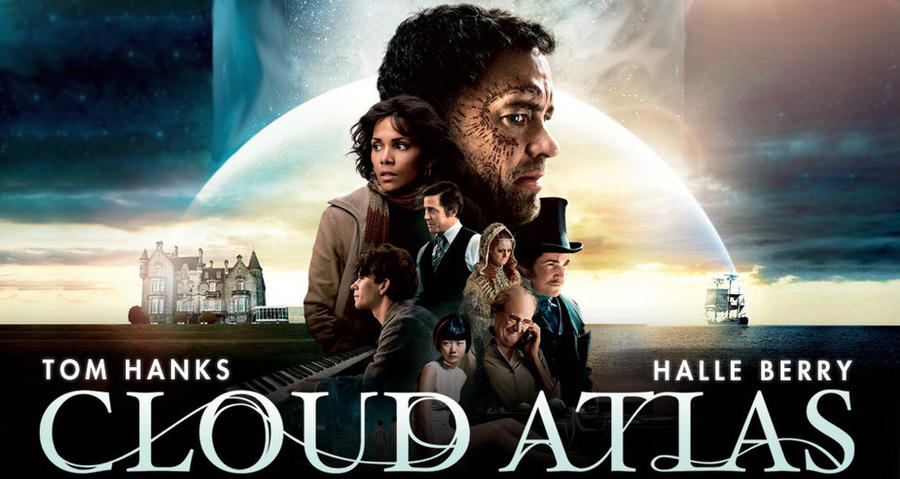
Coincidentally, I watched Cloud Atlas on DVD last night. (Okay, so I still use obsolete technology. I also listen to a transistor radio when I work out.) That movie disappointed me, too, for a similar reason: the writers were more focused on their own writing cleverness than on telling the story.

Cloud Atlas banner by CochiseMFC
Cloud Atlas was based on a novel with a great reputation (I haven’t read it, and I don’t think I will, now) and had a strong cast, but failed to tell the story. The novel features six “nested” stories that begin in the south Pacific in 1850, move through the 20th century to a dystopian and post-apocalyptic future, then goes back to the beginning. Each story is interrupted at a crucial point by the next story, which picks up a character or an object from the previous one. It was a clever idea that earned the author a lot of praise for his writing skills.

I think that the movie’s writers tried to be as clever, and ended up creating something so complex as to be baffling. Instead of nesting six different stories, the movie jumps around from story to story quickly, with no apparent reason and no apparent pattern, other than beginning and ending with the post-apocalyptic story of Zachry — in effect, turning the novel’s structure inside-out.

The cast, which included Tom Hanks, David Broadbent, Halle Berry, Hugh Grant, Hugo Weaving and Susan Sarandon, had roles in most, if not all of the stories. This was more of a distraction than an addition, especially with actors changing gender or race — Halle Berry as a Jewish refugee in 1935, or Doona Bae as a Korean clone in 2144 as well  the daughter of an American slaver in 1850. I found myself saying “Oh, that’s Tom Hanks with a skin wig and a beard and heavy makeup!” or “Hey, that’s no lady! That’s Hugo Weaving in drag and a blond wig!” Worst, I had to look up the cast on my iPad. “Is that Roger Daltrey? No, it’s Hugh Grant with a curly wig and old-guy makeup!”

Nearly three hours later, I could not see the movie’s point. I think the directors and writers tried to make a statement with the actors playing different roles in different stories, but what that statement was, I cannot tell.

The most important part of any story: the audience
The filmmakers behind Cloud Atlas and the author of the book that disappoints me spent far too much time admiring their own abilities, and not enough asking whether they’ve connected with their audience.
Image courtesy Creative Commons

What do you think? Did you watch Cloud Atlas? Did you read the novel? Have you ever read a book that seemed to have more to do with showing off the writer’s abilities than telling a story to a reader? Tell us all about it in the comments.

Friday, January 03, 2014

Book launch: The Darkness Comes by Bruce Blake

Am I ready to kill?

A cloud of swirling mist sighed out between Kuneprius’ lips, rising into the night to smear the glow of the winter moon. He watched it dissipate, then exhaled another long plume, blowing it out the way he’d seen the Brothers do when they smoked their pipes filled with sweetweed. Instead of swirling the wreaths he’d watched them create, his breath came out a ragged column. 

Shh.” 

Kuneprius cocked his head toward the urgent sound, an apology teetering on the tip of his tongue. At the last instant, he remembered himself and said nothing, pressing himself flatter against the side of the hill. Fildrian lay less than ten man-lengths away, but the Brother’s black hood and robe hid him in the darkness; despite his proximity, empty loneliness ached in Kuneprius’ chest. 

The lad grasped the short sword’s hilt tighter, testing its uncomfortable weight. Though he’d seen the seasons turn but twelve times, he’d trained with this very sword for six of them. The temple blacksmith formed it with him in mind, the grip molded to the shape of his fingers. Its length and weight had proved too much for him when he first held it, but he’d grown into it, its size ideal for a boy of his age. He shifted minutely, searching for comfort and understanding that the prospect of swinging the weapon to wound rather than in practice caused his unease, not the sword itself. 

Will I be able to wield it when the time comes? Can I kill if I need to? 

He’d never been sent on a hunt, so the sword’s edge hadn’t tasted blood other than his own when he got clumsy or distracted while sharpening the blade. He shifted his grip on the leather-wrapped hilt, hand slipping with the slickness of the sweat on his palm. For so many seasons, he’d trained for this moment; he knew he’d kill if the need arose. 

I hope it doesn’t. 

The rattle-clunk of wooden wheels on dirt track rolled along the shallow valley and up the hill to Kuneprius’ ears. Soon, he’d need wonder no more. 

The apprentice angled his head to peer down the weed-clogged road, squinting as he attempted to pick out the wagons in the darkness. The lanterns hanging at the front of each, bobbing and swinging with the horses’ gaits, made it easy. He counted them silently. 

One, two, three…four? 

His heart lurched. Brother Fildrian had said to expect three—two carts and a covered wagon. Kuneprius’ gaze flickered to the spot where he expected to find the expedition leader’s dark shape, but he saw nothing. He glanced back to the track, the horse-drawn vehicles drawing closer and, in the glow of their lanterns, he counted two covered wagons. 

Which one?

The second volume in Bruce Blake's Small Gods series is now out. The Darkness Comes picks up where When Shadows Fall leaves off. 

What's it about?


When shadows fall, the darkness comes...

 A disgraced Goddess Mother wanders blind and alone, praying for her agony to end. When a helpful apostle finds her, could it truly by salvation, or does worse torment lie ahead? A sister struggles to understand a prophecy that may not be meant for her while her brother fights for his life. If the firstborn child of the rightful king dies, will it spell the end for everyone? Darkness and shadow creep across the land in the form of a fierce clay golem animated by its sculptor's blood. It seeks a mythical creature who's sacrifice portends the return of ancient evil banished from the world long ago. With its return will come the fall of man. As the game unfolds, the Small Gods watch from the sky, waiting for their time to come and their chance to rise again. They wait for the fall of shadows, the coming of the darkness. They wait for night to descend.
Bruce Blake continues his incredible productivity, releasing the second volume in this brilliantly executed only a couple of months after the first volume, and he promises the third book soon. I don't doubt it for a second.

Now that you've read the sample, get the book from your choice of vendors.


The Darkness Comes: 
B&N: http://www.barnesandnoble.com/w/the-darkness-comes-bruce-blake/1117886146

But before you read the second book in the Small Gods series, you have to read the first. When Shadows Fall is on sale for 99 cents for the rest of the week. 


Wednesday, January 01, 2014

New Year’s Day, 2014


The new year came to Ottawa with a high, clear sky, a pale winter sun refracting off smooth expanses of pristine white snow. With the temperature around minus 30 C in the morning, the packed snow on the pavements squeaked. 

By afternoon, the temperature has warmed to the minus 20 C range. The radio meteorologists say the wind chill is even colder, but I haven’t noticed much wind. To me, this is ideal, the perfect temperature for enjoying the world. You have to be dressed for it, of course, but I love the look of dark green spruce trees against a pale blue sky and pure white snow, the feeling of cold air on my face and in my nose while my body is warm inside my clothes.


A perfect Canadian New Year’s Day! Welcome, 2014!

Tuesday, December 31, 2013

Photo credit: nimAdestiny, Flickr, Creative Commons

HAPPY NEW YEAR!

My best wishes to all for a healthy, safe, peaceful, productive and prosperous 2014.

Scott Bury
The Written Word

Friday, December 27, 2013

Book launch: Tube Riders 2 — Exile

Cover image tube riders 2: exile

Book 2 in Chris Ward's original and excellent Tube Riders trilogy has just launched.

Earlier this year, I gave five stars to Ward's stand-alone novel, Head of Words. It's a deep and dark psychological story that shows Ward's talent and professionalism as a writer.

Now, I'm telling everyone I can to pay attention to this original writer's steampunk-inspired Tube Riders series, which achieves the same standard of excellence.


What are Tube Riders?


Set in Britain in 2075, the Tube Riders are a gang of young people who defy a brutal dictatorship by playing a dangerous game of riding on the outside of London's Underground trains.


Book 2, Exile
Having narrowly escaped the Governor's savage Huntsmen, Marta Banks and the other surviving Tube Riders are on the run in northern France. Trapped inside a government-assigned quarantine zone, they search for a way out of a bleak countryside littered with abandoned worker robots and haunted by sinister monks, while at the same time a far deadlier threat than any they have faced before is searching for a way in ... 
From the towering spires of Mont St Michel through the dark horrors of the Paris Catacombs to the treacherous peaks of the French Alps, The Tube Riders: Exile is an epic continuation of Chris Ward's Tube Riders series. 
Chris Ward is from the UK but currently lives and works in Japan. In addition to the Tube Riders Trilogy, his work includes a number of short stories (available on Amazon) and the stand alone novel The Man Who Built the World as well as Head of Words.

What inspired the story?

"For the whole of my novel-writing life, I always wanted to write in different genres, try different styles and push myself as a writer and an artist. I had a rule that no two novels could be the same. In around 2009 I decided I wanted to write a big sci-fi dystopia. While my novels had always ranged from horror to comedy, my short stories had usually been in the speculative fiction vein, because they were easy to write and relatively easy to sell to magazines. Looking for ideas, I came across an old story I wrote in 2002 about a group of kids who hung off the sides of trains for fun getting into trouble with a rival gang. And hour and two sheets of A3 paper later, the Huntsmen, Dreggo, the Governor and the dark world of Mega Britain was born.

"I once promised myself to never write a sequel, but by the time I had written all 165,000 words of the first draft of the Tube Riders, I realised that it was really just the first part of one long story. Now, with Revenge, that story has reached its end.

"It felt strange to leave the Tube Riders behind, but while the main story is done there is a likelihood that there will be prequels or possible novels set within the three years between Exile and Revenge, mostly focusing on side or minor characters."

Exile launched on December 16, and book 3, Revenge, will appear in January. Watch Written Words for a cover preview!

Where to get it:


Visit Chris Ward's Amazon author page to see all his published work.
Visit Chris Ward's blog, A Million Miles from Anywhere.

Tuesday, December 24, 2013

Merry Christmas to all


I wish all a peaceful, healthy and happy Christmas season.

Scott Bury
The Written Word


Drawing by HIKINGARTIST.COM via Flickr, licensed under Creative Commons attribution.
http://www.flickr.com/photos/hikingartist/

Friday, December 20, 2013

What makes a good read? Two best-sellers join the debate

Photo by Documentally / Christian Payne, found on Flickr, licensed through Creative Commons.
 
Writers are always struggling with advice from disparate sources on how to improve their writing. That’s why I turned to some best-selling authors and asked them what made certain books their favourites. What makes a good read? 

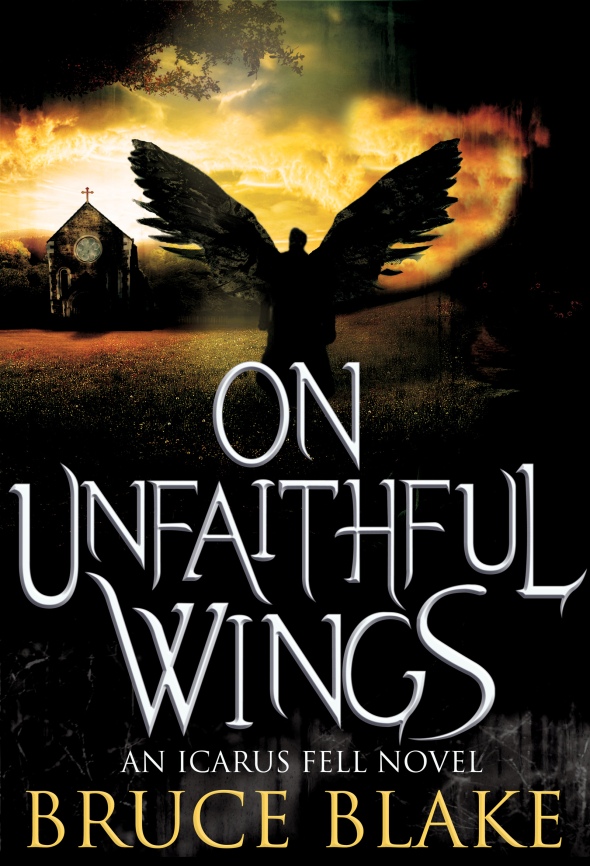
Weighing in this week are DelSheree Gladden, best-selling author of the Destroyer trilogy (Inquest, Secret of Betrayal and Darkening Chaos) and the Twin Souls saga, and Bruce Blake, the prolific author of the Icarus Fell series (On Unfaithful Wings, All Who Wander are Lost and Secrets of the Hanged Man), Khirro’s Journey trilogy (Blood of the King, Spirit of the King and Heart of the King) and the new Small Gods series (When Shadows Fall). With his wife, Rosie Bitts, he is the co-author of the Lady Corsairs series. 

Name three characteristics of books that you like. What makes you keep reading a book? What are some books that you weren't able to put down until you finished them?

DelSheree Gladden: 
Strong characters, well thought out storyline, and an emotional element to the story readers can connect with. What makes me keep reading a book is the characters. I have to connect with the characters and care about them and their struggles. It can be a fascinating storyline, but if the characters are only so-so, I’m not going to be hooked.  
The Mistborn Trilogy by Brandon Sanderson is one of my all-time favourites. I was absolutely riveted by his books. The complexity of the storyline was amazing, yet it never seemed overcomplicated or convoluted. His characters came alive from the first page and he did what is sometimes the hardest thing for a writer to do. He let the story go where it needed to go even if that meant losing characters and writing what I can imagine he didn’t want to write. 
Bruce Blake:
Three things that I look for in a good book are writing style, engaging characters, and originality. It can be difficult to find the combination of all three in the same book, but when I do, I can't stop reading. 
The most recent example for me is Best Served Cold by Joe Abercrombie. The voices of each character are so distinct and he has an interesting way of turning a phrase. Vicious Circle by Mike Carey, To Kill a Mockingbird by Harper Lee and many of Stephen King's early books make my list, too.

What other books have these characteristics?

DelSheree Gladden
Some of the other books that I will always love are books like The Dresden Files and Aleran Codex from Jim Butcher, The Wheel of Time series by Jordan and Sanderson, The Dalemark Quartet by Dianna Wynne Jones, and pretty much any of Raymond E. Feist’s books. 

Bruce Blake
Anything by Stephen King up to “It." George Martin's first two books in the Song of Ice and Fire series. Ender's Game and Speaker for the Dead by Orson Scott Card. Neil Gaiman's American Gods.

Do you consciously try to emulate these books? If so, what form does that take: plot, structure, characters, settings, author's voice and word choice?

DelSheree Gladden
There are aspects of all my favourite books that I try to emulate. Sanderson’s plots are always flawless. I can never find even the tiniest hole. I will debate, rewrite, outline, make a dozen sticky notes, whatever it takes to try and make sure I’m not leaving unanswered questions for my readers. What I’ve tried most to emulate is creating good characters my readers will fall in love with. Butcher’s characters always have a great deal of depth. You can’t help but get sucked into their lives, even those characters who are only briefly in the book. His characters always have a defining inner struggle that impacts every aspect of their story. I want my characters to be that unique and real when I write as well.

Bruce Blake

Sometimes, but not always. I mean, Joe Abercrombie's use of unique
voices for each character definitely inspired my conscious choice to try something similar in my latest book, When Shadows Fall. On the other hand, without me really thinking about it, any good writing style challenges me to keep a close eye on my word choices. Stephen King’s depth of characterization gave me something to strive for and George Martin's detailed world and cultures were another inspiration.

Thank you, DelSheree and Bruce!

Visit DelSheree Gladden's website
Visit Bruce A. Blake's website

Thursday, December 12, 2013

Good reading: Two best-selling authors tell what they like to read

Creative Commons
What makes a book a good read? Three more independent authors give me their perspective: 

Mohana Rajakumar is author of So You Want to Sell a Million Copies?, Love Comes Later and a number of other books. Her latest is An Unlikely Goddess.


Name three characteristics of books that you like. What makes you keep reading a book? 

Mohanda Rajakumar: I love the characters or at least want to know what happens next. Books where the writer takes me into a world totally other than my own and I learn something new. And I talk to other people about what's happening in the world of the story — it's that compelling.

Jesi Lea Ryan: I like books with unique characters who don't irritate the crap out of me.
Plot is important, but it is becoming emotionally invested in the characters
that keep me interested. Richelle Mead's books (yes, all of them) are my
best example of this. Her books are action packed and filled with intrigue
and adventure, but she has such an amazing way of tying me in emotionally
that I feel like I am in the book. It's amazing! 

I also like books that run at a faster pace. I don't like a lot of pointless
musing. I'm a firm believer in what doesn't add to your story should be cut.
I can give you about fifty bad examples of this, but where I find it most is
in erotica. Good erotica uses sex scenes to further the character or plot.
Bad erotica has little plot or character and things it can survive on
gratuitous sex. It's annoying. 

What are some books that you weren't able to put down until you finished them? 

Mohana Rajakumar
Mohana Rajakumar: Gone Girl, The Vanishing Act of Esme Lennox, and The Night Circus.

Jesi Lea Ryan: Stacia Kane's Downside series have really unique characters, beautifully flawed.
  
What makes you keep reading a book? 
Mohana Rajakumar: To see what happens next and how we get where we are going.


Do you consciously try to emulate these books? 

Mohana Rajakumar: I do try to take readers into worlds they don't know because that's what drew me into reading as a child. And into writing as an adult. There were so many things to think about, I wanted to get out and share them with others. In terms of keeping the reading guessing, suspense I struggle with as a writer but character development I have much more confidence in my ability to deliver. 

Jesi Lea Ryan: I don't consciously emulate other books, but I'm sure they influence me to some extent. I read over 250 novels a year, and I don't have a stellar
memory.  I can't quote even from my favorite books. Part of this is because
I rarely read the same book more than once. I can tell you that I
consciously try not to write the things that irritate me. For example, I
detest indecisive heroines. And god, there is so much of that in YA and NA
romance.  Makes me want to hurl books across the room.  Indecisiveness does
not create plot tension, it creates reader tension, and that's not a good
thing!  So I don't drag things out too much in my books.  If the heroine
needs to make a decision, she's generally quick to act on it.