Showing posts with label communications technology. Show all posts

Monday, December 15, 2014

Technology weirdness: a warning and a tip


Written Words has whined about technological bugs before, but here’s a warning: don’t always believe the network when it tells you it does not recognize your password.

I have gone through this problem periodically: I come down to the computer in the morning, try to check my email, and get a message that either the password is incorrect or that the server does not recognize my outgoing (smtp) password.

This always mystifies me, because the email had been working perfectly the night before. When this has happened in the past, I have logged into the self-service site of the affected ISP and updated my password. Then I have to go to all my devices that can access email and change them, too. Then I have to update my secure, written list of all my passwords, because there are only so many words that combine letters, numbers and special characters, and don’t reference names of family, friends, pets or places I’ve lived, and are easy to remember.

It’s a process bound to create confusion. When the problem occurs again, and I have to enter the old passwords and then a new password.

And it begs the question: why did the server no longer recognize the password? I did not change it. It worked the night before, but stopped the next morning.

The latest time this happened, I tried re-entering the password, which did not solve the problem. I logged into the webmail program, and that worked fine. So I called my service provider. After waiting on hold, listening to lame music and enduring the repeated “We apologize for any inconvenience” recording, I explained the situation to the technician.

I looked at the email client, and an email had come in while I was on hold. But clicking Get Mail still gave me the error message that the server did not recognize my password.

“I don’t see any problem on my end,” the technician said. “Let me check something else.” She put me on hold for another five minutes. When she came back, she suggested I try sending a test email. “But don’t put ‘test’ into the message or subject line. We sometimes get problems with that.”

I did. And guess what? The message went through.

I did not change any settings. I did not reset the passwords.

“We are migrating our servers. Perhaps that caused a glitch,” the technician suggested.

Then, as if by magic, the email clients on all my devices connected with the email server, and messages started coming in.

Tip

So here’s my tip: when you get an error message that your email account information is wrong, and you know you didn’t change anything, don’t go through the process of changing all your email passwords on all your devices and remote connections. Call your ISP and just wait for a while. See if an hour’s wait doesn’t solve the problem. Changing all your passwords should be a last resort.

What about you techies? Do you have an explanation for this, or alternative solutions?

Sunday, February 02, 2014

Where have all the newspapers gone?

You just don't see this anymore. Photo by Travis Ruse, cropped by Gallifreyan Postman at en.wikipedi
a
licensed under Creative Commons
It's fascinating to see a long-range social and economic transformation take place before your eyes. Particularly in as mundane a place as a city bus. 

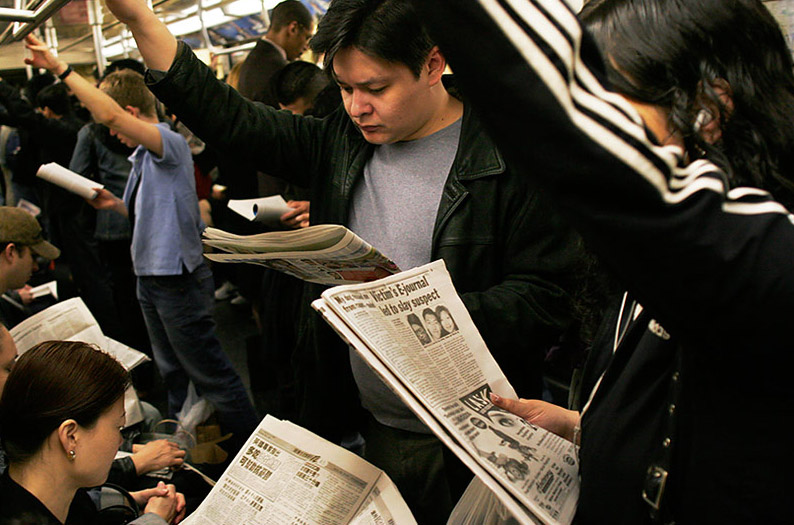
I believe in public transit, and I've used it regularly for years. Decades, actually. Yes, I'm old. Twenty years ago, even ten, a newspaper was a common sight on buses, metros and commuter trains. In the 80s and 90, when I lived in Toronto, a newspaper was a requirement for any commuter who wanted to be taken seriously. And any professional with any kind of social ability knew to read the Globe and Mail, or if you really wanted to make an impression, the Wall Street Journal.

Today on the busses in Ottawa, I rarely see a newspaper. If I do, it's probably Metro or another of the free circulation, newswire-copying rags. And while those were somewhat popular a year ago, these days I almost never see anyone even carrying one of those. I don't even see them discarded on the bus seats anymore.

The only newspapers that seem to be hanging on or
growing their circulation are the free daily commuter
papers, like the London Evening Standard or, in
Canada, Metro and 24 Hours. And 24 Hour cancelled
its Ottawa edition last year. Photo courtesy Adam
Tinworth, OneManAndHisBlog.com
This is just my personal view of the huge socio-economic transformation, the decline of the newspaper in the West. In Canada, the US and the UK, newspaper circulations have fallen steadily in the past five or six years, up to 30 percent or more. Newspapers are closing down or merging. Community newspapers have become nothing more than reprinters of centrally-produced fluff.

These trends may not seem new to you, but consider the size of the newspaper industry just two decades ago. The Internet was just starting to scare the traditional media industries, but newspapers and magazines, too, were fat and getting fatter. 

The recession of the early 90s killed off a lot of magazines and page counts of all print publications stated a decline that never recovered. The 2008 economic crash killed five magazines that I used to contribute to regularly. Another symptom of this transformation. 

And its name is ...
The Internet, of course, but particularly, mobile communications. The snide comeback of the print professional to the Internet used to  be that paper is both a reliable storage and display medium, and it's portable — unlike computers. 

And then came the iPad.
On the bus today, I see three people reading books — yes, real paper books, and one of them is a hardcover — and, no surprise, five or six e-readers like Kobos and Kindles. Oh, yes, and my iPad. 

Then there are people looking at their smart phones. Some of them are playing games, but most are going through emails or messages or tweets.

This is usual in 2014. It's a surprise to see anyone reading a paper.

What does it mean?
It means that, at least for commuters from western Ottawa today, the newspaper is irrelevant. Or at least not essential, not like it was two decades ago.

And given newspaper circulation statistics, I suspect the same is true in other modern cities in first world nations.

What do we do?
As communications professionals, we have to recognize that the market has voted for mobile communications and has dropped the newsprint medium, at least for daily news and the kind of specialized information that magazines are good at delivering.

So we have to start to adapt our communications to fit the demands of mobile communications technology — and more to the point, to the audience that uses it.

This is the format we have to work with today. Get used
to it!
Whether we produce fiction, news, non-fiction, technical reports or whatever, we need to be aware that the reader is experiencing it through a small screen — a fairly restrictive medium.

As a writer concerned with craft and the beauty of language, I'm not thrilled about reducing all writing to bullet points and headings. But the reality is that audiences demand, shorter texts, broken into easily consumed chunks. The buzzword today is "consumable information."

And using graphics and motion video really boosts attention, circulation and retention of information. While it may irk you that a twelve-year-old's cat video gets more play than your world-saving treatise, gimmicks have always been effective in any medium.

Look ahead
In ten more years, there will still be newspapers. But they'll be smaller in size and circulation. 

It will be interesting to see what e-books will be like. Will they all include multimedia? I find it hard to believe that motion and graphics will not be standard in text communications.

Nothing is going away. We still have radio. It's just been transformed by all the media that came after it. 
We have another learning slope ahead of us.

Saturday, November 23, 2013

My electronics are crazy

Who can tell me where to turn off the setting on the computer for “Cause random problems” or “Unpredictably shut off critical functions”?

Have you ever noticed that your electronics will suddenly stop doing what they have been doing, more or less reliably, for months or years, when you haven’t changed any settings? My earbuds for my iPhone do that. I’ve had the thing for almost a year now, and most of the time it works fine. But then, for no reason that I can discern, one day the little control on the right-hand wire will cease to function. Yesterday, for example, I was listening to music on my iPhone when it rang. I pressed the button, which in this circumstance, should switch it from music to phone mode and answer the call. 

Nothing happened.

Neither did the volume control on the earbud wire work. To adjust the volume, I have to use the on-screen controls or the buttons on the side of the handset. This may not seem like a big deal, but it is inconvenient when you have to put your book away, re-sling your briefcase on your shoulder and dig the phone out of your jacket pocket. Of course, by the time you do that, the call has gone to voice-mail.

This same thing happened last spring. I noticed that the control button on the wire didn’t work to adjust the volume or skip to the next song as I was listening while riding my bike to work. I thought perhaps that I had damaged the wire by taking the iPhone on my bike, although the phone had never suffered an impact. But after a couple of weeks, the button began working again of its own accord.

This happened a number of times over the spring and summer, but by August or so, the functionality seemed to settle down and just work as it should. Until yesterday.

This same self-discombobulation happens other electronics, too. My DVD player gets grumpy when I press the buttons too quickly, and then seizes up. I have to unplug it to clear it. 

At unpredictable intervals, my printers will cease to function — without any changes to the system, settings or options.

Yesterday, I printed a letter I wrote on my desktop computer, no problem. Today, my son tried to print a report for a university assignment, and got an error message that said his computer couldn’t find the printer.

In that two-day interval, no one made any changes to the settings or the operating system. But in a span of two days, repeating the same instruction once brought two different results. 

Einstein supposedly said that the definition of insanity is doing the same actions and expecting different results. Einstein, obviously, never had to put up with microcomputers.


Naturally, I welcome any suggestions to solve these problems. 

Tuesday, June 18, 2013

Quit being a dumb app: Guest post by Lloyd Corder, PhD.


I've followed communications professional Lloyd Corder's email newsletter, C-Note$, for years. It's always full of clear, useful advice—the kind that makes you say, "Of course—why didn't I see that before?"   I asked Lloyd to weigh in on how today's communications technology, including social media, e-newsletters (like his), blogs and so on have changed the way he communicates. As usual, he came back with some useful, clear advice. And as usual, I reacted with "Of course. Why didin't I think of that before?"
 

How to keep your smart phone from screwing up your relationships

Lloyd Corder, Ph.D.
 
Recently, I got this note from an entrepreneurial client and friend of mine who started a metal powders company that makes high tech parts for spaceflight companies like Amazon founder Jeff Bezos’ Blue Origin:  
I have to tell you, that I think of you more than you realize I'm sure. Every time I'm going into a meeting with someone, I pull my phone out and turn it off or to vibrate. You did that one time we met and I never forgot how I felt "Wow, he's taking this very serious and only wants to concentrate on me while we're meeting." Very powerful stuff.
That made my day.

 
I’ve spent my professional career helping others become better communicators. It may be called marketing research, ad testing, strategic marketing planning, leadership communications or even university teaching, but it boils down to figuring out how you can be better today than you were yesterday. Slight, continuous improvements lead to big results over time.
 
In working with hundreds of clients over the last 25 years, I’ve come to believe that the most profound gift you can give someone is your time and complete attention.
 
Within in your grasp—every day and at multiple times—you have the power to show you truly care…you are a great listener…you can accept someone for who and where they are in their life…you can show and be loved…and—most importantly—you can make someone’s life better.
 
But giving your time and complete attention is darned near impossible if you’re spending all your time fiddling with your phone.
 
Don’t get me wrong. I love my smart phone. I can reply to clients faster. I can delegate projects instantaneously. I can update my social media status like no body’s business.
 
But smart phones have a dark side, too: 

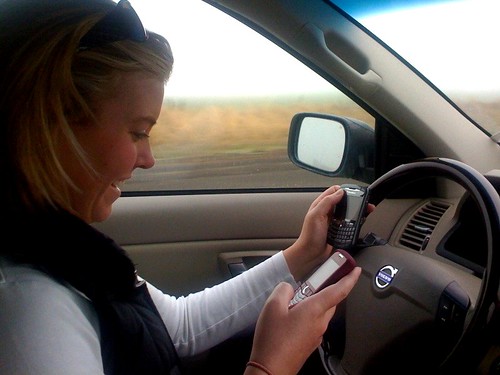
  • Smart phones are the single biggest distraction in our lives. For many of us, instead of us being “all in” when we’re meeting with someone we know is important—like our friends, family members, coworkers and others—we are only partly paying attention. We may be there physically, but mentally and emotionally we’re thinking about emails, texting someone miles away, surfing the Internet or wondering how many likes we’ll get from our latest post. Our smart phones make it seem like we are afflicted with some form of attention deficit disorder.
  • Smart phones mess up our eye contact. We trust people who look at us. It’s tough to read someone when they are constantly looking away or at their phone. It suggests they would rather be somewhere else or doing something different. Smart phones are seductive. They trick us into thinking that I’ll just look away for a moment, and then I’ll be able to refocus. Forget it. You’ll want to check your phone every few minutes. It will become such a force of habit that you won’t even realize you’re doing it.
  • Smart phones make us feel like we have more control, but we actually don’t. We have so many new communications tools available to us. But are we any better communicators? Are your relationships better now than they were five years ago? Does it really matter to you that you now know the minutia of other peoples’ lives through their barrage of posts? Wouldn’t you rather understand the big picture of the people you care about?
Well, what should you do about all of this? Especially if you’re younger and have spent your entire life online, taking a break from your phone may be an out-of-body experience for you.
 
From my vantage point, you have two basic options.
 
First, you can go on letting your smart phone be the boss of your life. Bring it everywhere you go. Never turn it off. Let it distract, seduce and control you to your heart’s content. If you chose this path, don’t worry. A lot of people are on it. You’ll blend in fine and most people won’t notice the difference anyway—since they will be on their smart phones doing the same thing.
 
Or, if you dare, you could decide that maybe part of the purpose of your life is to help make the world you’re living in a little better place, if just for one moment or one minute or one hour or one day.
 
You can do that by sharing your time and complete attention with the people you’re in front of. Forget about your smart phone for a minute. Silence it and put it away. Be totally in the moment.
 
If you’re in a business meeting, require that everyone put their “screens down” and give their attention to topic at hand…especially if you’ve spent a fortune getting them to the meeting.
 
What I’m suggesting may sound like it’s easy to do, but it’s easier not to do. You will struggle. Your smart phone will tempt you to pay more attention to it than who you’re meeting with. But don’t you do it!
 
Just try getting through one meeting without your phone. If you falter, forgive yourself and try again with your second meeting. Like any important change in your life, it will take two or three weeks of diligent effort, then it will start to seem totally natural to put away your phone and get focused on the conversation at hand.
 
You will also quickly find yourself in the top five percent, separated from your competitors and everyone else…and being noticed by important people and people who are important to you. You’ll seem like a natural winner.
 
And at that point, you may just find that your influence, impact and life are exponentially better than they were when you were playing with that dumb phone all the time! __________
 
Lloyd Corder, Ph.D. is founder and CEO of strategic marketing research firm CorCom, Inc. and teaches at the Tepper School of Business at Carnegie Mellon University. He is a frequent keynote, convention and motivational speaker, and he has appeared on business-oriented radio and television programs. Corder’s studies have been published in more than 500 magazines and newspapers. For additional information and resources, please visit www.corcom-inc.com or contact him at corder@corcom-inc.com.