Showing posts with label politics. Show all posts

Monday, October 27, 2014

Narrative and the necessity to stand up for our rights

by andrianart
I’ve been having an interesting discussion over Facebook with author Robert Bidinotto around the importance of narrative in our society. It all started with a discussion about Ayn Rand. Robert’s contention was that, no matter whether you agree with Rand or not, she changed the popular narrative of her time.

It’s an idea that struck me after the events here in Ottawa on Wednesday.

The first item on the 10:00 am. CBC news was that a soldier had just been shot at the War Memorial. I told others in the office where I work. We were all shocked—it was just a few blocks away. We all thought of the same things: about Warrant Officer Patrice Vincent being killed in a deliberate hit-and-run last Monday, and the supposed ISIS/ISIL message exhorting sympathizers to strike against Canadian civilians for our warplanes being sent to the Middle East.

The human mind is wired to see connections and patterns. It’s an evolutionary advantage. So it’s to be expected that we’d very quickly try to fit the events of last Monday and Wednesday into a pattern—and one already lives in the zeitgeist, the narrative most spectacularly exemplified on 9-11: the industrialized, democratic West is under attack by Islamic terrorists around the world. Now, we have a new idea added to that narrative because of the Islamic State formerly known as the Islamic State in Iraq and the Levant formerly known as the Islamic State in Iraq and Syria: there are supporters embedded in Western societies around the world—even here in uber-peaceful Canada—who will strike unexpectedly, viciously and effectively.

The facts do not support that narrative, however. Just as the facts of our world do not support Rand’s narrative.

The Ottawa shooting does not fit the terrorism narrative.

When I compare these events to other terror attacks, it makes no sense. If it were a terrorist attack, it would have to be, thankfully, a remarkably ineffectual one. One fine man is dead, and that’s a tragedy.

But look at other terrorism attacks in the West since 2001: New York, Madrid, London, which killed dozens or even thousands of people. What good it do anyone to shoot an unarmed soldier standing honour guard? What hope could Bibeau have had to advance any cause by acting alone, if as violently as he did?

But when you look at this through the lens of mental illness, it makes a lot more sense.


As more facts about Michael Zehaf Bibeau emerge, it seems his mental state had a lot more to do with his motivation. He has a history of mental illness and drug abuse. He was homeless and unemployed. He tried to get incarcerated in Vancouver.

A day after the Ottawa attack there was a multiple shooting in a school Washington — not linked to terrorism, ISIS/ISIL or anything else. And none of the analysis of it linked it to terror. Instead, and rightly, in my opinion, the talk orbits the debate over gun control.

Maybe if we look at “home-grown terrorism” from the perspective of mental illness, we can begin to get a handle on how to deal with it. Why don’t we ask these questions:
  • How did Bibeau get a rifle? 
  • Where did he buy it? 
  • What if there were some kind of, I don’t know, a list or a database of long guns so we could track who’s buying and selling them, so that if one is used in a crime, we could work out how the criminal obtained the weapon and then take steps to prevent recurrence. Crazy idea, I know, but still—worth thinking about.

Maybe that’s how we can account for the appeal of an organization like IS/ISIL/ISIS to new converts to Islam in the West: they have personal histories involving isolation, loneliness, mental illness and/or substance abuse. And maybe, just maybe, if we addressed those problems before they manifested as violence, we’d have a less violent world. 

Our government is trying to use the events to advance their own agenda.
The Conservative government lost no time in fitting the attack into their own narrative and using it to advance their own agenda. At 8:00 p.m. on Wednesday, Prime Minister Stephen Harper said, “Any attack on our soldiers or our institutions by definition is an attack on our country and our values.” And the next day in Parliament, he said “our laws and police powers need to be strengthened in the area of surveillance, detention and arrest." (CBC news)

Even Opposition leader Tom Mulcair said the attack was “driven by hatred, and designed to make us hate others.”

Sorry, Tom: there was no evidence of that on Wednesday. Only on Sunday did the investigators mention the existence of a video that supposedly reveals Bibeau's political and ideological motivations. And so far, no one outside the investigation team has seen it.

What there is evidence of is this: the Conservative government wants more power to observe us, and thereby control us. To detect dissent, in other words. To find those of us who diverge from their narrative.

We do need to stand on guard. We need to protect ourselves and our rights. But what we need to guard against is not necessarily found overseas. Often, we find it much closer.

Canadians and thinkers of the world: do not fall for the false narrative. We are all we have to protect our freedom of thought and expression.

Monday, October 06, 2014

How to lose Friends without getting upset about it

I’m still running away” by Flickr user Vincepal, used under a Creative CommonsAttribution-Noncommercial-Share Alike 2.0 license.
I have noticed a shift in my Facebook news feed: there are now fewer ridiculous rants against Obama and pro-gun-rights posts, fewer Creationists going on with spurious proofs of their improvable ideas, and thankfully fewer racists with equally implausible, unsupportable ideas.

I wonder why

The only reason I can figure is that the creationists, gun advocates and racists who “friended” and followed me have since unfriended and unfollowed me. There probably is a way to see who has unfriended you, but I don’t bother with that. I’ll just go with noticing the absence of names and faces that I used to see quite regularly.

One is a Facebook Friend of a Friend who called me an “asshole” because I questioned his argument that Obama sucks. I asked for some solid examples of how Obama’s policies had made their lives worse in some concrete way.

Another right-winger dropped me after I questioned logical holes in his statements and arguments about gun rights and foreign policy. Maybe he just got tired of being shot down so many times. But even Snoopy gets back in the air after being shot down by the Red Baron.

I don’t see many creationists anymore, either. There’s one I haven’t seen after she asserted “it takes a lot more faith to believe in evolution than in creation.” I suggested she look up “faith” in a dictionary, and then open another book that’s not the bible.

(By the way, Oxford defines it as “firm belief, esp. without logical proof.”)

Okay, maybe my retort was kind of snarky, but it’s not insulting.

I miss those people—and not just because they're so easy

I think one of the purposes of Facebook was to engage in a healthy debate. Sure, it’s also a great way to catch up with old friends and far-flung family, to coordinate group activities and to share cool photographs, but I also enjoy respectful debates. I point out logical holes, question assumptions and conclusions, and have been questioned and corrected myself. I accepted corrections when I made errors, and I never sank to the level of insults. I never swore at people (okay, I used a few salty words to describe things and actions, but never the people I was arguing with).

For the most part, I did not get a lot of abuse. As I said, one person called me an “asshole” for questioning his argument about Obama. Another insulted me for arguing for higher corporate taxes and against the idea that corporations should be able to spend on political communications without limit. A number of people called me a “liberal” as if it were insulting. I told a few of them to look up the word, too, and once got insulted for explaining that the understanding of the word “liberal” in the US is different from its original political meaning, and that in Europe, neo-liberal is equivalent to neo-conservative in the US. I don’t understand why that was threatening or problematic, but it did bother some people.

But the people who were most committed to the right-wing side of many debates—guns, abortion, evolution, taxation, health care—have run away.

What are they afraid of?

I’m not going to shy away from expressing myself. I am a writer, after all. If someone disagrees with me, that’s fine. I encourage that.

Bringing poles closer

Image courtesy Dark Matters a Lot
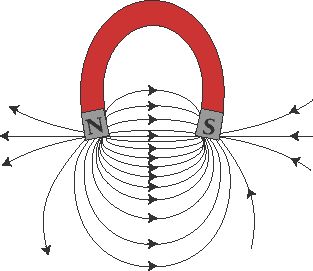
We need to be able to discuss our differences respectfully. I don’t delude myself that I’ll ever change anyone’s deepest beliefs, but if we don’t share opposing ideas, we only increase the polarization that is already growing in the world. Extremism is growing on all sides of every debate, and we can see this with ISIS/ISIL, Christian/creationist groups, the Tea Party, resurgent communism in Russia. And that kind of extremism doesn’t make the world a better place.

So come back, right wing! Engage me. If you think I’m wrong, let me know. Just remember my rule of engagement: if you use personal insults, you lose.


Monday, September 22, 2014

We are entering the Negative Zone

Annihilus, copyright Marvel Comics
Parliament has reconvened in Ottawa, and the buzz is already about the next election—which could be more than a year away.
I’m bracing myself for a year of public negativity to come. In Canada, all the parties are already in full campaign mode. And in the US, the presidential election process will get going in 2015 for the 2016 election.
I know. It’s waaaayyyyy too long.
But that’s not the worst part. Worse is the tsunami of negative messaging that comes with elections these days. Politicos in the 21 century seem to believe that it’s a lot more effective to criticize your opponent than it is to put forward your own ideas. So we can expect a lot of messages like these:
·         “All my opponent’s programs have failed.”
·         “That’s socialist!”
·         “That’s fascist!”
·         “That’s against the spirit of the constitution.”
·         “That’s contrary to our shared values.”
·         “That’s tax-and-spend.”
·         “That’s catering to the corporate elites.”
Image courtesy Canadian Press
And even worse than that is the tendency to get personal. Then, it’s not even about policies that you disagree with: it’s a worse-than-useless, distracting pseudo-debate about “character”:
·         “My opponent is a lightweight.”
·         “My opponent has been in office too long.”
·         “He/she’s a dreamer.”
·         “She/he is corrupt.”
To me, that’s not politics, it’s a middle-school screaming match.

The negativity dilemma

Most people I have spoken to, and most political commentators I have read, say they do not like negative messages. Yet, they must work, because all political parties use them. Some use them even when there’s no election campaign going on.
I find this whole process aggravating. It does not help me to decide whom to vote for. Sure, I may admire one candidate’s character, loathe another politician’s personality, but since I’ve never met them, I don’t think that’s any basis on which to judge a person.
But I’m unusual. It seems most people don’t make political decisions rationally. Well, we humans don’t make many decisions rationally. We “go with our gut,” fall in love and respond to a huge number of non-rational (not the same as irrational) impulses when making a decision.

Last week, I listened to a call-in radio program about Rob Ford stepping away from the mayoralty race in Toronto, and his brother Doug taking his place as a candidate for mayor. Callers were both in favour of and opposed to this series of events, but one caller in particular stood out for me. She said she favoured Doug Ford’s candidacy, because the actions of the two brothers showed the Fords are a “family that supports one another.” This spoke to their character, and apparently, means these are the kinds of people she wanted to be her city’s mayor.

What’s even more surprising was that this caller said she previously opposed Rob Ford, based on his policies. Her one-hundred-eighty degree turn was based on an emotional response to a candidate falling ill, dropping out of a political race and his brother taking on the role.

Image Creative Commons
It makes a romantic story: one man stricken by disease has to step away from a contest, so his brother steps into his place.

Personally, I try to make my political decisions rationally, based on the issues I believe important in the day, and which way the candidates will move on those issues.

I know. That makes me weird.


Wednesday, May 01, 2013

Word of the week: positive

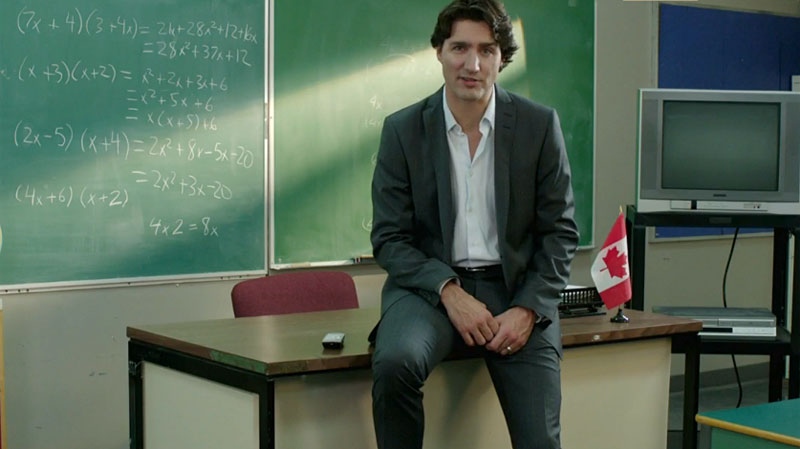
Congratulations, Mr. Trudeau, for expressing the antidote to negative political advertising we've been asking politician for, for decades now.

When Justin Trudeau was elected leader of the federal Liberal party in Canada a couple of weeks ago, the Conservative party launched negative attack ads against him personally within a couple of days. They already had the ads ready, it turned out.

"Is he ready to be Prime Minister?" asked the ads.

"He's in way over his head."

Newspapers have opined that the ads, depicting an old picture of Trudeau before a backdrop of stardust, impugn his masculinity.

Who designs these ads, a thirteen-year-old?

The response

On Mad Men last week, the character Peggy Olson said, "If you don't like what your opponent is saying about you, change the conversation."

That's exactly what Justin Trudeau did. Instead of denying or countering the allegations, spurious as they are, he and his team of writers (all praise to writers!) came back with a positive statement. "I'm going to work hard to earn your trust."

Of course, the Liberals could not resist the temptation to come back on the Conservative insults with one of their own, but anyone could understand and forgive that. "We can keep mistrusting and finding flaws in each other, or we can pull together and get to work," says Trudeau.

This is exactly what politics needs. For far too long, we — the voters — have allowed negative attack ads to work. Negative communications, which only say "My opponent is bad," is ultimately destructive to democracy. It distracts voters from what the electorate should be working on.

Unimaginative commentators and political writers have said for far too long that negative ads require negative responses. That's a juvenile reaction. Have our political leaders really learned nothing after grade 6?

Justin Trudeau, or his advisors, or someone in the federal Liberal party, have finally done the smart thing: responded to negative communications with positive communications. "Canadians deserve better."

Damn right, we do. We deserve a better, informed, factual debate. We deserve better leadership. We deserve to have our voices heard. We deserve to hear facts from our scientists, especially the ones we pay through our taxes.

We deserve something better than negative communications. We deserve to hear from our politicians what they plan to do about our real problems.

We deserve not to be manipulated.

The most dangerous game

Mr. Trudeau, you have opened a very dangerous game: you have raised our expectations. Now, we'll all be looking closely to see whether you live up to them.

And I, for one, will continue to look at the messages and how all the parties communicate. It's the least I can do.