Showing posts with label writing. Show all posts

Monday, March 23, 2015

Onboarding, buying-in and re-skinning: Gerunds gone wild

Image courtesy NBC
Today’s hottest buzzword is: “onboarding.”

A group of corporate Internet professionals has “onboarding” an official part of a major, inter-departmental project, as in “The onboarding phase will continue until buy-in has been obtained from a significant majority of players in this space.”

Do you see what they’ve done here: defined one buzzword with another in a passive sentence that avoids telling the reader who or what is responsible for the action.

After I pulled my attention away from that disaster of a sentence, my next thought was “What’s the difference between ‘onboarding’ and ‘boarding’?”

Onboarding—also known as “on-boarding”—means committing to a process. If someone needs others to “onboard,” it means the success of the process or project depends on the commitment of those involved. In other words, you cannot just accept what’s going on—you have to contribute some effort to make the process work. 

You become a part of the process when you onboard. It suggests something more active than “buy-in.”

Buy-in has been a trending buzzword for a few years, now. “We have to obtain buy-in to the new paradigm.” I still prefer “accept” or “agree.” But of course, when you buy in—or even better, when you get someone else to buy in, you’re talking or writing like one of the cool kids.

But the best new jargon term I heard has to be “re-skinning.” It means changing the visual appearance of a website or Web page so that it matches an established look. The word revives the concept of “skins” from at least 10 years back—I remember being able to choose different skins, or combinations of colours and icons for various websites or programs.

The most interesting thing about “re-skinning” is that the current meaning is the opposite of the original meaning of the root word. “Re-skinning” means putting a new look, or “skin” over an underlying structure, while not so long ago, to “skin” something meant removing the skin, or outer layer.

So what’s wrong with buzzwords?

The trouble with buzzwords is that they lead to confusion. Usually, most people can glean the meaning of any new buzzword. However, someone whose first language is not English can get the wrong idea, especially with a word like “re-skinning” that reverses the original meaning. 

Worse, though, is the creeping application of buzzwords to new things. Take the term “off-line.” It means “disconnected,” typically from the Internet and other electronic media. At one time, it meant not operating, as a paper mill being off-line. But in meetings, people will often say “Let’s take that off-line” to mean “Let’s talk about those details just between the two of us, and not bog down this meeting for all these other folks.”

“Re-skinning” is an example, where to “skin” something is being applied to more and more things. I can understand using it to describe covering or decorating a physical product, but today it’s more often used for websites and apps.

And when a buzzword creeps into more uses, it gets used everywhere. Remember “busters” in the 1980s? After the movie Ghostbusters became a hit, dustbusters started advertising more and more. Then snack advertisers described their treats as “hunger busters.” The nadir always comes when politicians get involved, and the Progressive Conservative party in Ontario called themselves “Grit busters,” referring to the nickname for the Liberal party, “grits.”


I just dread the day when people tell me they’re on-boarding to getting re-skinned at the outlet mall.

Monday, March 02, 2015

The anti-sex brigade lies again, hurrah, hurrah — the Ontario sex ed curriculum

Last week, the Ontario government published its revised health and physical education curriculum, which includes updated sexual education content.

Image courtesy energeticcity.ca
The update is actually titled The Ontario Curriculum, Grades 1–8: Health and Physical Education. There is a separate curriculum for high school, grades 9 to 12. It covers much more than sex, in fact, all forms of health, including safety, physical activity and hygiene. 

The sexual component elicited opposition from the usual groups. The most prominent groups in this opposition use the Big Lie strategy to get more attention and rope uninformed people into joining their side.

For example, Charles McVety of the Institute for Canadian Values call the curriculum “nothing more than an indoctrination vehicle to teach children a new way of thinking about gender.”

Campaign Life—whose main goal is to stop abortion—is worried about teaching grade 1 students the proper names of body parts. This is what it says on its website as a problem with the curriculum, which is not all that different from the draft brought out in 2010:
Below are some shocking excerpts from the 2010 curriculum that the Education Ministry had posted online…Graphic lesson on sexual body parts including ‘penis’, ‘testicles’, ‘vagina’, ‘vulva’ and more.”
This is what the curriculum actually says: 
Specific expectationsC1. Understanding Health ConceptsBy the end of Grade 1, students will: …Human Development and Sexual HealthC1.3 identify body parts, including genitalia (e.g., penis, testicles, vagina, vulva), using correct terminology [PS]Teacher prompt: “We talk about all body parts with respect. Why is it important to know about your own body, and use correct names for the parts of your body?”Student: “All parts of my body are a part of me, and I need to know how to take care of and talk about my own body. If I’m urt or need help, and I know the right words, other people will know what I’m talking about.”

I don’t know about you, but I don’t see a problem with that. And “penis” and “vagina” are words we can hear regularly on prime-time TV today.

Campaign Life are also concerned that the curriculum 
Will normalize homosexual family structures and homosexual ‘marriage’ in the minds of 8-year-olds, without regard for the religious/moral beliefs of families.”
This is what the curriculum actually says about homosexual relationships for grade 3 students, who are 8 or 9 years old:

By the end of Grade 3, students will: …C1.3 identify the characteristics of health relationships (e.g. accepting differences, being inclusive, communicating openly, listening, showing mutual respect and caring, being honest) and describe ways of overcoming challenges (e.g. bullying, exclusion, peer pressure, abuse) in a relationship [IS] Teacher prompt: “Consider different types of relationships — with friends, siblings, parents, other adults — and think about the kinds of behavior that help to make those relationships healthier. What can you do if you are having problems with a relationship?”

Importantly, in Grade 1, the curriculum also aims to teach kids this concept:
demonstrate the ability to recognize caring behaviours (e.g., listening with respect, giving positive reinforcement, being helpful) and exploitive behaviours (e.g., inappropriate touching, verbal or physical abuse, bullying), and describe the feelings associated with each [IS]

Let’s look at the curriculum:

C3.3 describe how visible differences (e.g., skin, hair, and eye colour, facial features, body size and shape, physical aids or different physical abilities, clothing, possessions) and invisible differences (e.g., learning abilities, skills and talents, personal or cultural values and beliefs, gender identity, sexual orientation, family background, personal preferences, allergies and sensitivities) make each person unique, and identify ways of showing respect for differences in others [PS, IS]

Campaign Life says that part of the curriculum means Ontario schools 
will teach the disputed theory of ‘gender identity’ as if it were fact. This is the notion that whether you're a boy or a girl does not necessarily relate to your physical anatomy. It is merely a ‘social construct’. Gender is ‘fluid’ according to this theory, and any little boy can decide that he is actually a girl, if that's the way he feels in his mind, or vice-versa.  
Note: The potential for causing serious sexual confusion in the minds of children is very real with this teaching.”


Of course, Campaign Life does not point out that there is no evidence for the theory that teaching children the theory of fluid gender identity harms them in any way.

Another thing that this organizations do not point out in their protests against the curriculum is their own agenda. They’re very conservative, stridently anti-gay and against any sexual content in any education. In fact, reading their material, I get the strong sense they’d be happier if no one ever talked about sex, ever.

Another big lie: no parents were consulted on the development of the new curriculum. In fact, consultations with parents, students, teachers, faculties of education, universities, colleges and other groups started in 2007. Granted, most of that was prior to the 2010 draft, but there isn’t much difference. And there have been consultations since.

Parents have had a lot of opportunity to weigh in on the issue. And in the meantime, the world has moved on and become even more sexually explicit.

Here’s another big lie: Brian Lilley of the conservative website TheRebel says that “in grade 6, they want to start teaching masturbation.” Those were Lilley’s words: “they want to start teaching masturbation.” Not “about masturbation.”

Lie.

Lilley deliberately constructed his sentence that way. He is trying to create an image in his audience’s minds of a teacher teaching grade 6 students, 11- and 12-year-olds, how to masturbate.

Don’t worry. They already know how. And so do you, Lilley.

The concept of masturbation occurs once in the curriculum. This is what the Grade 6 curriculum says about it:
“Things like wet dreams or vaginal lubrication are normal and happen as a result of physical changes with puberty. Exploring one’s body by touching or masturbating is something that many people do and find pleasurable. It is common and is not harmful and is one way of learning about your body.”

Have a problem with that, Lilley?

Big lies. Expect the anti-sex brigade to keep repeating them, because we all know the Big Lie strategy works.

Even in this sexually explicit age, we’re still squeamish about sex.

“I know sex is either boring or dirty.”
— I’m An Adult Now, The Pursuit of Happiness, 1986

Sex’s dirtiness and the shame imposed on my generation around sex — and earlier generations, too — fuels the titillation, fascination and explicitness over sex. Despite the sexual revolution of decades past, we’re still squeamish about it. Especially religious communities, who cannot get away from telling people about the kind of sex they should have.

By the way, as a parent, I really resent groups like the Institute of Canadian Values presuming to dictate to my kids whom they can marry. As far as values go, I think these are Canadian values: accepting differences, being inclusive, communicating openly, listening, showing mutual respect and caring, being honest. Where did I see those? Oh, yes — in the Ontario Health and Physical Education Curriculum for Grade 1.

What age is appropriate?

With every other topic, we teach people information before they start the activity, so they know what to expect and can take the right steps to protect themselves against inadvertent harm. We teach kids safe behavior near water before we teach them to swim. We teach teens the rules of the road in a classroom before we let them get behind the wheel of a car. So why should we not teach facts about sex before they’re of an age to be sexually active?

I remember when my kids came home from their first sex-education classes, in grade 3 or 4 — I can’t remember, offhand, which it was. Their reaction? “Gross!”

No danger that they were going to indulge in premature sexual activity in school.

The biggest lie is that, without sexual education in school, parents can “protect” their children against harm by keeping ideas and expressions about sex away from them. The reality is that our society is awash in sexual messages. The biggest movie is Fifty Shades of Gray, based on the book that broke all kinds of sales records of its own. Every time I go to the grocery store, the magazines at the check-outs invariably bear at least one headline about having “mind-blowing sex.”

And kids in school have all sorts of wrong ideas about sex, ideas that can be harmful. Many high school-age people believe that by having only oral and anal sex, they’ll remain virgins. Some believe that oral sex cannot expose you to sexually transmitted diseases. We owe our kids clear, correct information about health, which, despite anyone’s squeamishness, includes sex.

I don’t think children are harmed by facts.


They’re harmed when facts are hidden from them. For centuries, abusers have gotten away with sexually exploiting children partly because the shame that their victims felt prevented them from talking about it, from reporting it.

If we can talk openly and honestly about sex, without shame, the same way we talk about any other health topic — the way we talk about healthy food, for example — then maybe the next generation will have fewer sexual problems and healthier lives.

Denying facts won’t help that.

What do you think?


Monday, February 09, 2015

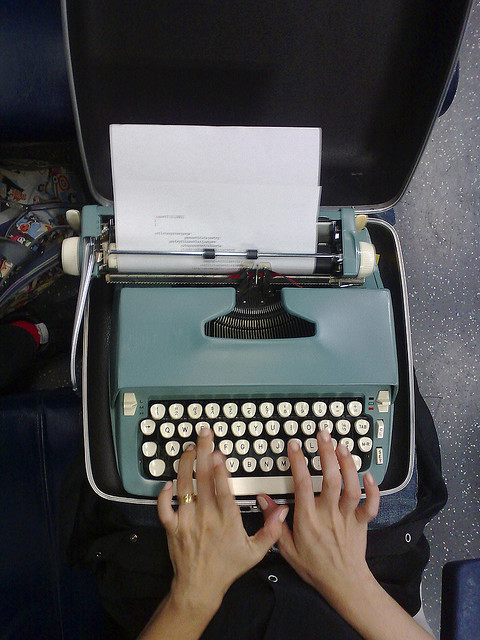
Do on-screen keyboards change the way we write?

Image via Flickr Creative Commons
(Caleb Roenigk) 
Image via Wikimedia under by Creative Commons
by  Matt Buchanan.
 Originally posted to Flickr

On the bus last week, I was standing behind someone typing on a tablet. She was using the on-screen touchpad keyboard. Not that I was spying or anything (honest!), I watched how she typed an accented é: she touched the e “key” for an slightly extended time—less than a second—until a menu of accented characters appeared on the screen above the keypad, then slid her finger to her choice.

Seeing it in action started me thinking: is on-screen typing, as done on touch-screen computers, changing the way we write?

We all learn to write, or print, with a stylus directly marking a surface: pencil on paper, crayon on colouring book, brush on parchment. 

Since the invention of the typewriter in the 1860s, the technology of writing has been a kind of remote control, separating the action of our fingers from the results. Press a key on a typewriter, and the attached type bar strikes the ribbon and impresses it onto the paper. 

Since then, typing technological development has progressively increased the distance between actions and results. To create this post, I am tapping my fingers on a wireless keyboard. I can’t imagine how many digital transformations occur to make the characters I am typing appear on the screen in front of my eyes. It’s only after I hit the Print button that the printer, two metres from the keyboard, puts marks on paper.

But I won’t print this particular essay. I’ll edit and proofread it on-screen, and then post it on this blog, hosted on a server hundreds or thousands of kilometres from this screen and keyboard. Or maybe it’s next door—I have no way of knowing. 

Image via Flickr Creative Commons
(Stan Wiechers)
Closing the gap between action and consequence
Typing on a touch screen brings actions closer to results. There is still a separation, of course, as the keypad is at the bottom of the screen and the words may be at the top, but still, it’s closer than the typewriter allowed.

Standing on the bus in rush hour, I was fascinated by the woman typing on the touch-screen. I wondered: is her writing experience different?

Personally, I don’t like typing on a touch screen. There is no physical or kinetic feedback from a touch screen, unlike with a keyboard, where I can feel the key depress and spring back. 

Also, using the touch pad on my iPad shrinks the display of the writing I’m doing. I like to be able to see the words I’ve written. So I have a Bluetooth keyboard to write with my iPad, re-establishing that remote action of the old-fashioned typewriter.

An area to research
Does bringing the result, the mark on the writing surface, closer to the motion of our fingers make typing on a touch screen closer to writing with a pencil on paper?

And if it does, will that have an effect on the way that we write? Will it affect the words we choose, the way we construct phrases and sentences?

Will we be able to tell a book written on a touch-screen from a book created with a typewriter?

I can imagine someone getting a doctoral degree on this by analyzing documents written with a stylus on paper with those created on a computer using a standard word processor, and others written using a touch screen. And I’d be fascinated to see the results.

What do you think? If you use a touch screen for anything, do you find the writing experience different? Do you like typing on a touch screen?

Do you think that the touch screen changes the way you write?

Monday, January 19, 2015

It’s prognostication season


Creative Commons
Every January, pundits put on their Janus masks to look back and forward at the same time and make predictions about the year to come. They try to give their words as much gravity as they can, but if we look at history, we see they’re somewhat less reliable than the weather.
Some of the most prominent, and repeated predictions I have read for this year:
  • Interest rates will finally go up after a decade at near zero. The prevailing prediction is that the Federal Reserve, the central bank of the US, will raise its rates in the second quarter—but maybe sooner, depending on the performance of the US economy—which will prompt the Bank of Canada to move its rate up at its regular rate-setting, which it hasn’t done for the past 34 rate-setting meetings, or seven years. I have lost count of the number of times some economist or pundit has predicted that “interest rates have to go up sooner or later.”

  • On the other hand, big, bad investment bank Morgan Stanley has just announced there’s a “subjective probability of one in three that the Bank of Canada cuts interest rates in 2015. That terminology is interesting: a “subjective probability.” The closest translation to clear language I can come up with is it’s the writer’s personal feeling.

  • Oil prices may keep falling and there’s no telling when they’ll stop. Over the past couple of months, we’ve been treated to successive economists in expensive suits saying “if the price of a barrel of crude goes below $80—$70—$60…” It’s now under $50, and the latest prediction is that the floor will be $43 before prices start to go up again. Of course, this comes from the same expensive suits, Morgan Stanley, who put forth their “subjective probability” about Canadian interest rates.

The falling price of oil will have far-reaching effects on economies around the world. In Canada, the conservative government has delayed its budget for at least a month to give it more time to “gather data.” This after eight years of betting the economy on oil and other raw resource extraction industries, at the expense of manufacturing industries. Talk about all your eggs in one basket. 


How is it they didn’t see this coming?

Economists have poor track record when it comes to short-range predictions, especially for the coming year. The price of oil is the best example. It has followed a classic bubble pattern: a steep rise followed by steeper decline. It’s happened so many times in the past, in so many other sectors, that it astounds me that no one saw this coming.


Predictions? Maybe they’re useless, when it comes to the economy. From now on, when I read another prediction about the economy, I’m just going to laugh.

Monday, December 08, 2014

Narrative is important for fiction, but bad for reality


Exodus, Christmas and other mythic narratives

I’ve been reading a lot about “narrative” in news and social media lately. Not as in literature, as in a story arc, but narrative applied to public discourse about current events. The narrative of global warming, for example, is now being derided by climate change deniers.

In other words, “narrative” is a story that we use as a context to understand the world around us.

The prospect of using a narrative appeals to a writer like me. Stories are my bread and wine. And a narrative, a consistent story arc, is essential to a work of fiction. A narrative is particularly important to genre fiction, as it helps provide background information: the underpaid detective who lives on his own because his work prevents him from having a family life; the distant love interest who spurns attachment because of a past trauma; boy-meets-girl; the odd couple; revenge. There are only seven plots, said the ancient Greeks, and every story follows one, or more of these basic seven narratives.

But I’m going to put it to you today, oh my wonderful and valued readers, that narrative as a way to understand the real world around us is caustic. Destructive.

Some common narratives today

I realize that I have grown up accepting a lot of narratives. The Christmas story, for one. Jesus Christ, the Son of God, was born on December 25 in a manger in Bethlehem. It’s a powerful story, one that drives so much of our culture and activity. But it has its flaws. Historians who have looked at the story rationally point out that lambs are born in spring, not in the winter, for example.

Still, it’s a powerful narrative—obviously.

The Exodus narrative is the foundational story of the Hebrew people and to a large extent of the modern state of Israel. It’s another powerful narrative: God led the Hebrews out of Egypt to the Promised Land.

According to the Bible, hundreds of thousands of Jews, along with all their livestock, left Egypt somewhere around 3,000 years ago, and after 40 years settled in Canaan, the Promised Land, after being pursued by Pharoah.

Except that there is absolutely NO architectural or other corroborating evidence of such a monumental event. It’s a nice story, though.

Caustic narratives

Post-traumatic stress disorder, or PTSD—all soldiers returning from Afghanistan, or Iraq, or any conflict, are permanently psychologically damaged. For a distressingly large number, this is true, but it’s not universal.

Get tough on crime—governments in the US and in Canada like to use this one. According to the narrative, lax criminal law enforcement, luxurious prisons and short jail sentences only encourage crime, while long sentences and jails that are not desirable places to be will discourage criminals from committing crimes. Except that experience has demonstrated the opposite. If society’s goal is to reduce crime, then programs that teach poor people skills and provide jobs, food and mental health care have proven to be much more effective than being tough on crime.

Tax cuts—none of their proponents call it “trickle down economics” anymore, but the idea is the same: cutting taxes for corporations and the wealthiest people will make them spend more, and thus create jobs for the working and middle classes. Except this has never been demonstrated to happen. If you remember, in the 2008 economic crisis, the banks, those epitomes of the capitalist philosophy, demanded and got government intervention to prevent their failing. The crisis and the TARP were examples of Keynsian, interventionist economic policy at work, and the repudiation of Milton Friedman’s hands-off ideas.

Narratives are great for fiction, for novels. But they’re counterproductive as a way to look at the real world. Instead of looking for a narrative, why don't we look at the world the way it really is? Look for facts, look for actual causes and effects. 

How is narrative a problem? Let's consider one narrative that most people (not all) have abandoned: that humanity was created in one special moment and did not evolve from an earlier, different species of animal. A century and a half ago, the idea of evolution was largely rejected because it did not fit into the narrative most people had accepted because they'd been taught it as children by adults they respected. To accept the idea of evolution, the authorities and teachers said, was to disrespect those authorities.

And yet, many years later, we have (mostly) accepted the fact of evolution, and those institutions that strove against the idea, the churches and schools and authorities, are still with us. Yes, they've changed; some have weakened, others have become stronger.  

But adhering to a narrative causes us to ignore facts that don't fit into it, and encourages choices that cause harm.

Yes, narrative is important. But it's important to construct the narrative to fit reality, and when we learn new things, to change the narrative. 

Narrative is a story, and as all writers know, the story can always change.
-