Showing posts with label communication. Show all posts

Monday, March 09, 2015

The Phantom Menace: Don't start with background


Title: A proposal to supply Acme Corp. with Blagfly Macroscopic Flange 
Background: In 20187, Ignati and Wilhelmina Lightblack noticed the diminishing return on investment of industrial-size household powersource applications for lightsabres. The siblings engaged upon a ten-year research project into the optimal application of flange technology in lightsabres. A side enquiry into the efficiency of something something something dark side ...

That's what was wrong with The Phantom Menace — Chapter One of the Star Wars epic. It was all background.

No one wants to read background. If they do read it, it's because they thought they had to.

One element that made the first Star Wars movie work (Episode Four, "A New Hope") was that it started with action and immediately put the audience into a fully realized universe. That's also part of the appeal of The Hobbit (the book) and George RR Martin's A Song of Ice and Fire series. The authors have developed complete, consistent worlds, and all the elements they present fit together consistently.

In other words, the author has done the background research, but doesn't force it on the audience.

This principle applies just as well to non-fiction and business communications like proposals and reports. No one wants to wade through background information. They want the point, first. 

Luke Skywalker did not stop to read the history of the Trade Federation, the blockade of Naboo, the destruction of the Jedi Order and the establishment of the Empire. No. His reaction to Princess Leia's message was "She's beautiful. I have to help her by finding Obi-Wan Kenobi." 


Thesis first, background later

Recently, I received a number of reports and proposals that begin with extensive background. 
Page after page of background. 
The authors felt that the audience could not understand the thesis without knowing the background. That's intuitively correct, but the idea falls apart on the quickest analysis.

No matter what the document is, it's competing for its audience's time and attention not just with other documents and reports, but with other media (including Facebook). Before anyone decides whether to invest time in reading a report, no matter how long or short —in fact, before they decide to invest time in anything — they do a quick return-on-investment calculation: will this be worth it? 

Before they start reading, the audience needs to know why they should, and the only way they can make that calculation is if you tell them what their payoff will be. 

Start with the point — the end of your argument. "Your company needs our flanges." Then provide the reasoning that backs it up.

Like Princess Leia: "You have to help us, Obi-Wan Kenobi. You're our last hope." Thesis statement first, then the reasoning.  


Problem, solution

"But what about the problem-solution approach?" you ask. "Isn't that a good way to structure a proposal?"

Thanks for asking. Indeed, it is a good way to set up a proposal, as well as many other kinds of documents. Even a novel. But you should not front-load it with a long description of the problem. Show the oppression, quickly describe why it's a problem, and then show the reader the promised land.
Problem: We cannot tell who is coming to our website, nor what they look at most.
Solution: Lungbreath web analytics software will track who comes to the site, from where, and specifically which pages they spend the most time on. This will allow us to target sales messages and ultimately increase revenue.
Problem: Dirty Bill's restaurants have far too many rats in the kitchen. Not only will the health department shut us down if we cannot get the rat count below municipal standards by next month, the rats are eating so much of our inventory, we are losing money.
Solution: Batta's Better Mouse-Traps® will reduce the rat population in the kitchen by 50 percent in the first month, which will bring the restaurants within Health Department standards. Thus, we will stay in business! 

Write it in reverse

I often find that the best way to do this is to write the introduction last. As the writer, you may find it easier to write the background first. This helps you to understand the situation and its context. For example, you could describe how you first noticed the problem, explain how big a problem it is, and outline what would be the long-term impacts of not addressing the problem. 

You could introduce statistics that show the history of the problem, perhaps linking it to causes and factors that have an impact.

But this comes in the main body of your report. From that analysis, you can write an analysis of the impact of the problem. In business terms, this means how much it costs. Then you could present alternative solutions, and describe their potential impacts and costs. 

Finally, you describe the best solution, in your considered and researched opinion, and make a recommendation. That's called the conclusion. 

After you have finished writing the conclusion, you can write the introduction. Summarize the conclusion. State the solution first, then the problem and the cost of the problem.
Batta Corp.'s Better Mouse-Traps® will solve the increasing rat problem that the Dirty Bill restaurant chain has been experiencing this past year. This modest investment will not only save each location $2,000 per month in food inventory, it will prevent the Public Health Department from closing us down.

That gets the readers' attention. They'll want to read more after that. 

Monday, March 02, 2015

The anti-sex brigade lies again, hurrah, hurrah — the Ontario sex ed curriculum

Last week, the Ontario government published its revised health and physical education curriculum, which includes updated sexual education content.

Image courtesy energeticcity.ca
The update is actually titled The Ontario Curriculum, Grades 1–8: Health and Physical Education. There is a separate curriculum for high school, grades 9 to 12. It covers much more than sex, in fact, all forms of health, including safety, physical activity and hygiene. 

The sexual component elicited opposition from the usual groups. The most prominent groups in this opposition use the Big Lie strategy to get more attention and rope uninformed people into joining their side.

For example, Charles McVety of the Institute for Canadian Values call the curriculum “nothing more than an indoctrination vehicle to teach children a new way of thinking about gender.”

Campaign Life—whose main goal is to stop abortion—is worried about teaching grade 1 students the proper names of body parts. This is what it says on its website as a problem with the curriculum, which is not all that different from the draft brought out in 2010:
Below are some shocking excerpts from the 2010 curriculum that the Education Ministry had posted online…Graphic lesson on sexual body parts including ‘penis’, ‘testicles’, ‘vagina’, ‘vulva’ and more.”
This is what the curriculum actually says: 
Specific expectationsC1. Understanding Health ConceptsBy the end of Grade 1, students will: …Human Development and Sexual HealthC1.3 identify body parts, including genitalia (e.g., penis, testicles, vagina, vulva), using correct terminology [PS]Teacher prompt: “We talk about all body parts with respect. Why is it important to know about your own body, and use correct names for the parts of your body?”Student: “All parts of my body are a part of me, and I need to know how to take care of and talk about my own body. If I’m urt or need help, and I know the right words, other people will know what I’m talking about.”

I don’t know about you, but I don’t see a problem with that. And “penis” and “vagina” are words we can hear regularly on prime-time TV today.

Campaign Life are also concerned that the curriculum 
Will normalize homosexual family structures and homosexual ‘marriage’ in the minds of 8-year-olds, without regard for the religious/moral beliefs of families.”
This is what the curriculum actually says about homosexual relationships for grade 3 students, who are 8 or 9 years old:

By the end of Grade 3, students will: …C1.3 identify the characteristics of health relationships (e.g. accepting differences, being inclusive, communicating openly, listening, showing mutual respect and caring, being honest) and describe ways of overcoming challenges (e.g. bullying, exclusion, peer pressure, abuse) in a relationship [IS] Teacher prompt: “Consider different types of relationships — with friends, siblings, parents, other adults — and think about the kinds of behavior that help to make those relationships healthier. What can you do if you are having problems with a relationship?”

Importantly, in Grade 1, the curriculum also aims to teach kids this concept:
demonstrate the ability to recognize caring behaviours (e.g., listening with respect, giving positive reinforcement, being helpful) and exploitive behaviours (e.g., inappropriate touching, verbal or physical abuse, bullying), and describe the feelings associated with each [IS]

Let’s look at the curriculum:

C3.3 describe how visible differences (e.g., skin, hair, and eye colour, facial features, body size and shape, physical aids or different physical abilities, clothing, possessions) and invisible differences (e.g., learning abilities, skills and talents, personal or cultural values and beliefs, gender identity, sexual orientation, family background, personal preferences, allergies and sensitivities) make each person unique, and identify ways of showing respect for differences in others [PS, IS]

Campaign Life says that part of the curriculum means Ontario schools 
will teach the disputed theory of ‘gender identity’ as if it were fact. This is the notion that whether you're a boy or a girl does not necessarily relate to your physical anatomy. It is merely a ‘social construct’. Gender is ‘fluid’ according to this theory, and any little boy can decide that he is actually a girl, if that's the way he feels in his mind, or vice-versa.  
Note: The potential for causing serious sexual confusion in the minds of children is very real with this teaching.”


Of course, Campaign Life does not point out that there is no evidence for the theory that teaching children the theory of fluid gender identity harms them in any way.

Another thing that this organizations do not point out in their protests against the curriculum is their own agenda. They’re very conservative, stridently anti-gay and against any sexual content in any education. In fact, reading their material, I get the strong sense they’d be happier if no one ever talked about sex, ever.

Another big lie: no parents were consulted on the development of the new curriculum. In fact, consultations with parents, students, teachers, faculties of education, universities, colleges and other groups started in 2007. Granted, most of that was prior to the 2010 draft, but there isn’t much difference. And there have been consultations since.

Parents have had a lot of opportunity to weigh in on the issue. And in the meantime, the world has moved on and become even more sexually explicit.

Here’s another big lie: Brian Lilley of the conservative website TheRebel says that “in grade 6, they want to start teaching masturbation.” Those were Lilley’s words: “they want to start teaching masturbation.” Not “about masturbation.”

Lie.

Lilley deliberately constructed his sentence that way. He is trying to create an image in his audience’s minds of a teacher teaching grade 6 students, 11- and 12-year-olds, how to masturbate.

Don’t worry. They already know how. And so do you, Lilley.

The concept of masturbation occurs once in the curriculum. This is what the Grade 6 curriculum says about it:
“Things like wet dreams or vaginal lubrication are normal and happen as a result of physical changes with puberty. Exploring one’s body by touching or masturbating is something that many people do and find pleasurable. It is common and is not harmful and is one way of learning about your body.”

Have a problem with that, Lilley?

Big lies. Expect the anti-sex brigade to keep repeating them, because we all know the Big Lie strategy works.

Even in this sexually explicit age, we’re still squeamish about sex.

“I know sex is either boring or dirty.”
— I’m An Adult Now, The Pursuit of Happiness, 1986

Sex’s dirtiness and the shame imposed on my generation around sex — and earlier generations, too — fuels the titillation, fascination and explicitness over sex. Despite the sexual revolution of decades past, we’re still squeamish about it. Especially religious communities, who cannot get away from telling people about the kind of sex they should have.

By the way, as a parent, I really resent groups like the Institute of Canadian Values presuming to dictate to my kids whom they can marry. As far as values go, I think these are Canadian values: accepting differences, being inclusive, communicating openly, listening, showing mutual respect and caring, being honest. Where did I see those? Oh, yes — in the Ontario Health and Physical Education Curriculum for Grade 1.

What age is appropriate?

With every other topic, we teach people information before they start the activity, so they know what to expect and can take the right steps to protect themselves against inadvertent harm. We teach kids safe behavior near water before we teach them to swim. We teach teens the rules of the road in a classroom before we let them get behind the wheel of a car. So why should we not teach facts about sex before they’re of an age to be sexually active?

I remember when my kids came home from their first sex-education classes, in grade 3 or 4 — I can’t remember, offhand, which it was. Their reaction? “Gross!”

No danger that they were going to indulge in premature sexual activity in school.

The biggest lie is that, without sexual education in school, parents can “protect” their children against harm by keeping ideas and expressions about sex away from them. The reality is that our society is awash in sexual messages. The biggest movie is Fifty Shades of Gray, based on the book that broke all kinds of sales records of its own. Every time I go to the grocery store, the magazines at the check-outs invariably bear at least one headline about having “mind-blowing sex.”

And kids in school have all sorts of wrong ideas about sex, ideas that can be harmful. Many high school-age people believe that by having only oral and anal sex, they’ll remain virgins. Some believe that oral sex cannot expose you to sexually transmitted diseases. We owe our kids clear, correct information about health, which, despite anyone’s squeamishness, includes sex.

I don’t think children are harmed by facts.


They’re harmed when facts are hidden from them. For centuries, abusers have gotten away with sexually exploiting children partly because the shame that their victims felt prevented them from talking about it, from reporting it.

If we can talk openly and honestly about sex, without shame, the same way we talk about any other health topic — the way we talk about healthy food, for example — then maybe the next generation will have fewer sexual problems and healthier lives.

Denying facts won’t help that.

What do you think?


Tuesday, October 21, 2014

Words of the month: bubble and loop

The oil bubble is deflating, but the response among economics, business and political leaders has been to get stuck in a logical loop.

The bubble blows

It seems that everyone needs to be reminded of the definition of bubble regularly, because they seem to deceive everyone, including educated and otherwise successful people and those who really ought to know better.

Here’s the definition according to Oxford: “a situation in which investments, sales, etc. increase rapidly and then collapse.”

How is it that the economic leaders of the world forget that definition, when it happens so often?

How did they forget the 2008 crisis, which followed banking deregulation, the bubble in housing prices and the valuation of asset-backed paper? That’s the nature of a financial bubble: people keep buying at ever higher prices because they assume the price increase will go on forever—or at least, until they can sell at a profit.

And when the bubble bursts, these people are caught, scrambling to sell at plummeting prices. They’re surprised every time. Unfortunately, it was mostly working-class and middle-class people who paid the price of the 2008 crisis. Governments bailed out international banks because they were “too big to fail,” resulting in the biggest transfer of public wealth to the upper classes in history.

Now, it’s happening again with oil. Oil prices have been increasing fairly steadily since 2001, when a barrel of crude was around US$25, to a high of $110 in April 2011. Despite short-term fluctuations that can seem dramatic, they’ve eased to the current level of around US$80. And the economists these days are predicting the price is going to keep falling.
Source: Macrotrends 
So, the bubble burst. Going from the charts, it seems to have burst back in 2011. Funny, though, because I remember paying less for a litre of gasoline then than I did last month. Although I am relieved to see the prices at the pumps falling.

Stuck in the loop

But this blog is about communications, not about economics. The communications lesson to take away here is: remember what bubble means the next time you are tempted to buy into something that’s growing fast.

The smart money people got caught again. Sure, there were economists who predicted falling oil prices a year ago or more. But the bursting of the bubble seems to have knocked their logic into a logical rut and they keep repeating the same logic:

  • High oil prices drove exploration and development of higher-cost sources like the tar sands in Canada and shale oil in the US. Now that these are producing, they’re increasing the world supply of oil. 
  • At the same time, more efficient consumption and the development of alternative sources of energy like solar and wind are reducing demand. As a result, prices are falling. 
  • Falling prices makes those new sources of oil—tar and shale—uneconomical. According to the sources I’ve read, at less than US$80 per barrel, fracking is too expensive to be worth it. Tar sands oil costs between US$50 to $90 per barrel, according to a report in the FinancialPost last year. 
  • With lower prices, companies will take fracking and tar sands production off line. Presumably, that will reduce supply and thus increase price. 
  • Falling prices for oil, like any commodity, are bad for the economy—the lower prices for oil on the world market have cause the stock markets to fall in the past month.
  • Falling prices for all fossil fuels makes alternative energy sources less attractive to energy consumers. We are about to enter a deflationary period with falling prices for all commodities, which is going to hurt the economy—in short, it’s going to be bad for the owners of oil and other companies. 
  • “The world economy depends on fossil fuel extraction and consumption,” goes the logic. With falling prices for fossil fuels comes a falling US dollar, stock markets and just about everything else.


If we try to build a new system without fossil fuels, we will be really starting over, because even today’s “renewables” are part of the fossil fuel system.3 We will have to go back to things that can be made directly from wood and other natural products without large amounts of heat, to have truly renewable resources. (Gail Tverberg, Our Finite World)

What these arguments miss, and the logical element that could knock them out of this repeating loop, is the environmental cost of oil versus other forms of power generation. The environmental and public health impacts of fracking and tar sands production have not yet been fully admitted by government nor industry, and I think even their staunchest opponents don’t know the full cost. 

Time to break out of the loop 

It seems the arguments just keep getting repeated: 

  • Fossil fuels are more efficient, more energy-dense, than wind or solar, which are unreliable.
    vs
  • Alternative energy sources would be as efficient if they got as serious development support as fossil fuels do.
    back to 
  • Supplying our energy needs from non-fossil sources would cost too much.
    against
  • Fossil fuel costs are higher than the current price indicates. 


How about moving on by looking at all the facts. A year ago, the Economist magazine called oil "yesterday’s fuel.” 

No matter how you look at it, oil is a finite resource. And wouldn’t we all be healthier without fossil fuel exhaust in the air, water and soil? Wouldn’t we all be better off if we could talk calmly and openly about fossil fuel consumption’s contribution to climate change? 

I hate hearing the same old argument being repeated. It's like listening to your parents have the same fight again. How about this? How about we really consider an alternative to fossil fuels—something that's not poisonous, at least? And then use it as the basis for not only transportation, but our markets, like oil is now. And then move toward it steadily.

At least, talk about that instead of having the same useless argument again.

Wednesday, April 17, 2013

How we respond to tragedy


Image: Creative Commons
 My hopes and prayers go to the families of everyone killed, wounded and hurt, traumatized and terrified by the bombs in Boston on Monday. My sympathies go to everyone who is struggling through the clean-up, the aftermath and the traffic snarls as the city recovers from the cowardly sneak attack.
And for whoever planted the bombs, whoever encouraged and enabled the attack, I have only contempt and condemnation.

Every terrorist attack, every underhanded, gutless affront like this generates a hurricane of media. And when it happens in a major city in the biggest media source in the world, the US, we all know to expect a biblical flood of reportage. And we know that the media’s attention in general will be distracted from all sorts of other subjects, worthwhile of attention and less so, at least until the next shocking event diverts them again.

It’s fitting; this is an event worth our attention. And it’s right that all of us pause, for at least some time, in our normal daily routines.

But what should we put on hold? And for how long?


Getting slagged


Immediately following the bombing, I got a couple of messages from followers of this blog or my Twitter feed saying that I should hold off in my normal advertising because of the bombing and the innocent blood shed. I read that the Kardashians got scolded for continuing to Tweet about their vapid activities as the first news reports continued to trickle through the Web and the broadcast media.

My first reaction was: “Oh, right. Sorry — I’ll get right to correcting my automatic Twitter feed.” Then I thought: “Wait a minute. Why?”

I am not trying to capitalize on this tragedy. No one should ever even try to use it to promote himself or herself, or a product or service. It happened, and we have to acknowledge it, honour the memory of the innocents killed, hurt and scarred.

It’s also right, though, to look at the coverage, to think about and analyze and discuss our reactions. There is a lot to be learned, a lot worth learning from the aftermath.

My first impression of the news coverage of the terrible event was that it was better than what we got after earlier terror attacks on the US and elsewhere in the West. It seems to me that it’s been more rational and cautious with less jumping to conclusions about the perpetrators than after 9/11 or the foiled bombing in Times Square on New Year’s Eve, 2010.


Reaction


Should all of us suspend everything else we’re doing in response to this event? Should we refrain from our usual tweeting? For how long?

The Fox network has reportedly pulled an episode of Family Guy from broadcast and hulu.com because it depicts Peter Griffin running down runners at the Boston Marathon with his car.

I was chastised for tweeting a quote from a review of my novel, The Bones of the Earth, which mentions violence, gore, monsters and more.

I think that’s fair in the immediate aftermath; it does seem insensitive to be promoting fictional gore when most people’s attention is caught by the real-world variety and people are suffering.

On the other hand, that response gives the perpetrators of this crime exactly what they want.

Many years ago, I read a story called “Very Proper Charlies,” about how journalists around the world decided to stop covering any terrorist attacks. No matter what the damage or how many the casualties, the news ignored it. The result was that the terrorists eventually gave up, because attention was the reason they did what they did.

Sure, it was an exaggeration. But it still had a point: terrorism is a tactic to draw attention to a cause that has no other way of getting any. Whether it’s effective in the long term is a different discussion. But when the news media descend on a terrorist strike like crows on a corpse, the criminals are fulfilled.

And the more that we turn away from what we normally do, from the activities that build the world up and make it a better place, the more we hurt ourselves.

Let’s face it, terrorist acts happen all the time. People living in Iraq, Israel, Afghanistan and many other places around the world deal with checkpoints and continuous threat of bombings every single day. No one bashes Kim Kardashian for tweeting about her new sweater when bombs go off elsewhere.

We cannot stop our normal lives, working toward our goals, for every tragedy or crime that happens.

Maybe we should try treating terrorists like very proper charlies. Of course, that would not acknowledge the suffering of the victims.

It’s a difficult question. What do you think we should do? Leave your opinion in the Comments.

Sunday, February 10, 2013

I said I missed winter — and winter came back

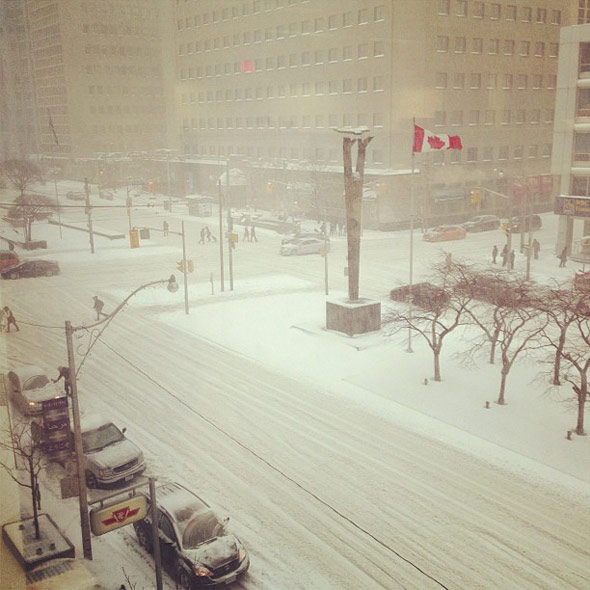
Photo of Toronto in snow by Adam Geezy, blogTO.
 
Ottawa gets hit by snow February 8, 2013
I had no idea the weather gods read my blog. Honestly, I didn’t even think they had a computer, let alone Internet access.

Ottawa on January 6, 2013
Four weeks ago, I wrote on this blog “Imiss winter.” The area where I live was going through an exceptional warm spell in mid-January. We lost a lot of snow, and I love snow. I love winter sports like skiing and skating. I love the feeling of cold air on my face as my body is wrapped in warm winter clothing.

I find a lot of inspiration in winter, too: in falling snow, in ice-covered fields, snow-laden evergreen branches. Winter is powerful, majestic and magical.

So, I wrote “I miss winter.” And winter came back. What does that say about the power of the written word?

The whole family is now enjoying being outside. The ice-sculptures at Ottawa’s Winterlude aren’t melting on the spot, for once.

But to all those digging out after the storm, the combination of an Alberta Clipper and a Texas Low that walloped half of North America on Friday and Saturday; to everyone stranded in an airport, to all who sat in a car or a truck in a traffic jam for hours; to anyone who: I’m sorry.

Next time, I’ll blog about how much I miss winning big in a lottery.

Wednesday, October 03, 2012

Writing and tweeting tips: Hootsuite troubles


Source: Belch.com
 You’d think I’d have learned by now: whenever you try something new, test it to make sure it works. But though I know that rule, I ignore it. I have all sorts of good reasons: lack of time, lack of attention ... and every time, it comes back to bite me in the ass.

The lesson: when you start using a new system, such as one that will automate Tweeting for you, test it before you trust it completely.

I’ve been using Hootsuite for a couple of weeks now to schedule most of my daily tweets, and while it’s pretty easy to use, it was botching the links. For I don’t know how long now, nearly every link I had tweeted through Hootsuite (hooted?) did not work.

But I didn’t check, so I only found out when Twitter followers started notifying me that “the link in your Tweet is broken.”

The first time I saw that, I thought that I had inadvertently deleted one character from the abbreviated link address. The second time, I thought maybe that follower had some kind of browser incompatibility. But when I started getting three or four of these each day, I knew something was wrong. (They don’t call me Sherlock for nothing ... or actually, ever.)

I went to the Scheduled Tweets panel in my Hootsuite screen, and clicked on every URL. None of them worked. Each time, I got an error message that the URL did not exist.

Then I looked at the stream of sent Tweets in Twitter, itself. And I saw something strange. Where I had used Hootsuite to shorten the URL, which results in a link that starts with “ow.ly/”, Twitter showed a Twitter abbreviation that starts with t.co/

Getting to the bottom of it

I’ve been using SocialOomph to schedule Tweets for a few months, now. The system works well: it will shorten URLs like Bit.Ly does, and allow you to write and store tweets in advance. Tweets can include both #hashtags and @Twitter handles.

I’ve found SocialOomph to be reliable and robust: I have not yet found and instance where a tweet I scheduled did not go out, unless it violated some Twitter rule.

But the free version is limited. You cannot send out too many automated tweets with a Twitter handle (@Name) in a short time span. With some experimentation, I found that the time span is about an hour, so I restrict myself to scheduling one Tweet with an @ handle per hour. Also, you cannot repeat the same URL more than once per day. However, I found that I could send to the same URL within 16 hours.

The free trial version does not support creating a spreadsheet to schedule tweets, and I found I was spending a lot of time each day scheduling tweets one at a time. On the other hand, the “Professional” version, which does support mass uploading, costs $35 per month. That’s a little rich for me.

I investigated a couple of other services. Gremln is cute, does the same things as the other services, and it’s relatively cheap at $6 per month for a basic account that allows bulk updates. Hootsuite charges a little more: $9.99 per month, but it takes fewer clicks of the mouse to accomplish the same things. Some of my Twitter friends had run into glitches using Gremln. So, Hootsuite it was.

Solving the problem

It seems that Hootsuite developers have the same mentality as Microsoft Office programmers: they like to help you without letting you know they’re helping you, like the way that Word used to make the entire document bold when you bolded one word.

Hootsuite’s bulk tweet scheduling instructions tell you to create a spreadsheet with all your tweets in advance. You create a .csv (comma-separated values) format document. Each line should have the time, the tweet, and an optional URL link. Each of these fields, say the instructions, must begin and end with double quotation marks.

I use a spreadsheet program (either Microsoft Excel or OpenOffice) to create a .csv file. The program creates a raw text file, putting commas where the cells end. But it seems that the program also adds the quotation marks.

After I create the file, three processes affect it beyond my control: first, the spreadsheet program saves my content and formats it the way it sees fit; then Hootsuite uploads it, analyzes it to ensure it meets its standards, and then sends it to Twitter.

There are at least two conversions happening in this process: spreadsheet to .csv, and Hootsuite to Twitter. There may be more within Hootsuite and Twitter, too. Somewhere, the URLs I abbreviated through Hootsuite software get changed again.

The solution

I removed the quotation marks that I typed in around the Tweet text and the URLs. Then I tested that, scheduling four tweets just a little in advance (Hootsuite requires at least ten minutes notice). That worked — the shortened links took me where I wanted to go.

So the second lesson here is: when you’re creating a .csv file with a spreadsheet program to schedule your tweets for Hootsuite, do not add double quotation marks before and after the Tweet content or the links. If you want a quotation mark within the tweet, use single quotes.

I did leave the double quotation marks around the time, though, and that seems to be working.

Source: Creative Commons
The real lesson: whenever you decide to automate any process, test it first.