Showing posts with label winter. Show all posts

Tuesday, March 12, 2013

Cleaning off winter’s dust


Spring is coming to Ottawa — I can tell because the snow is getting dirty and the birds are starting to chirp (“Hey! We’re freezing out here!”)

Photo by D. Gordon E. Robertson, licensed under Wikipedia Creative Commons.
A change of season always inspires me to take on new projects, and to resolve to complete those half-done tasks like organizing the basement and cleaning the garage. Time to take the skis and skates, shovels and snowblower, and stack them away neatly until next November (if we’re lucky; January if we’re not); time to pull out garden hoses, rakes, gardening tools and rubber boots. Time to take out the bikes, re-inflate the tires, tighten the seat, oil the chain and adjust the brakes. Time to gather up all those little things that I just put down wherever was handy through the winter and put them in their proper places.

Whenever I do things like this, I find so many things that I had thought were lost or that I had forgotten completely. The same is true of my writing: whenever I straighten up the papers scattered around my study (“Not often enough,” my long-suffering, lovely wife adds from offstage.” I’m doing it now!) I find little notes, longer notes, outlines and partial drafts from months or years ago — ideas for stories or novels that I wrote down and forgot about since.

The messy office. Photo by allysa/Creative Commons.
Now that spring is here and my second novel is (mostly) wrapped — at least, the creative part —I feel energized again to move forward and finish my third novel, tentatively titled Walking from the Soviet Union. And the next one, where I’ll be completing Dark Clouds, the first book in an imagined series about the Witch Queen’s Son.

The advantage of finding notes after I’ve forgotten about them is that they lose their baggage in the process. My notes are short forms for my ideas, a few words or phrases to trigger the thoughts I had. But after a number of months, a lot of those ideas are forgotten, lost under the dark waves of what passes for my mind.

But that frees me. Unlike my bicycle or the kids’ basketball net, the passage of time does not leave a thick layer of dust and grime and god-knows-what-its-source-is goo on ideas. They’re more like driftwood, cleansed of clinging assumptions, associations, emotions, stripped down to the true essence of an idea.

I'm expanding Dark Clouds
from a short story to
a novel eventually.
Like this one for Dark Clouds, the novel I seem to be writing in installments timed with special events. I had almost forgotten this little nuance to the back-story: “Matt is immune to magic; he can break or absorb the Witch Queen’s spells, but every time he does so, he must give her a piece of his life-string.”

See? I had thought of a deeper dimension to the story, the idea of a price that the hero has to pay for every favour; every victory he earns furthers his ultimate defeat.

Wow. That sounds great, and looks better on the page. Now, it’s time to buckle down and write!

Your turn: does springtime inspire you to start something new? Or to finish an incomplete project, artistic or otherwise? Tell us all in the comments block below.

Sunday, February 10, 2013

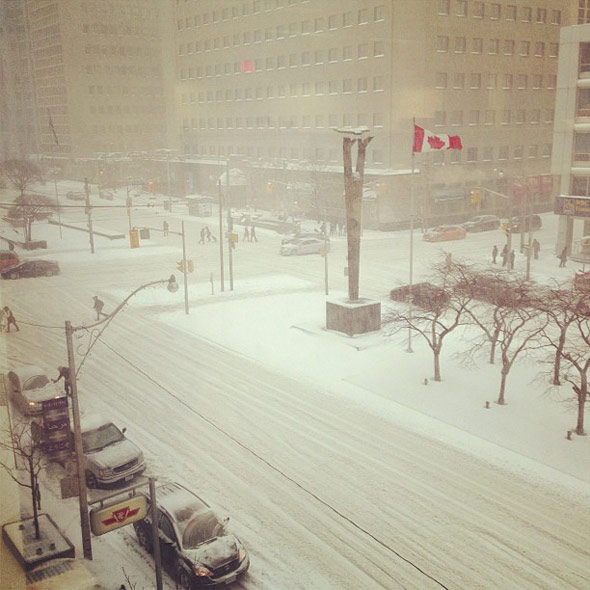
I said I missed winter — and winter came back

Photo of Toronto in snow by Adam Geezy, blogTO.
 
Ottawa gets hit by snow February 8, 2013
I had no idea the weather gods read my blog. Honestly, I didn’t even think they had a computer, let alone Internet access.

Ottawa on January 6, 2013
Four weeks ago, I wrote on this blog “Imiss winter.” The area where I live was going through an exceptional warm spell in mid-January. We lost a lot of snow, and I love snow. I love winter sports like skiing and skating. I love the feeling of cold air on my face as my body is wrapped in warm winter clothing.

I find a lot of inspiration in winter, too: in falling snow, in ice-covered fields, snow-laden evergreen branches. Winter is powerful, majestic and magical.

So, I wrote “I miss winter.” And winter came back. What does that say about the power of the written word?

The whole family is now enjoying being outside. The ice-sculptures at Ottawa’s Winterlude aren’t melting on the spot, for once.

But to all those digging out after the storm, the combination of an Alberta Clipper and a Texas Low that walloped half of North America on Friday and Saturday; to everyone stranded in an airport, to all who sat in a car or a truck in a traffic jam for hours; to anyone who: I’m sorry.

Next time, I’ll blog about how much I miss winning big in a lottery.

Tuesday, January 15, 2013

I miss winter

My house in winter: a source of inspiration.

Ever since I read Mark Helprin’s Winter’s Tale, I’ve wanted to write about the power and majesty of winter. Helprin wrote about images of frozen lakes, mountains of snow, impassable drifts and sharp, bright stars in a sky frozen to crystalline clarity.

I remember similar images from my childhood in Manitoba and Northwestern Ontario: snowbanks high than my head along residential streets; fighting for dominion over hills of snow in the schoolyard until the teachers yelled at us to come down; snow-spray kicked up by my boots as I walked to the bus stop, glowing golden in the light of an approaching car.

I’ve written before about how I find a lot of inspiration from the world around me. I don’t have to create a new world to write fantasy — the world out my window is filled with wonder.

But with global warming, I am losing one of my favourite and most evocative sources of inspiration.

When I was a child, riding in the family car across the prairies in January, the snow covering the prairies would be polished by the wind and shining golden in the slanting winter sunlight.

Today, as I rode along the Ottawa River, the world was gray: lead-coloured sky, soft gray ice on the river, soggy gray slush on the fields, dark gray slush along the sides of the gray roads, gray, leafless trees ...

Winter has no majesty anymore. It’s warm, only minus 4 degree Celsius. (That’s 25 degrees Fahrenheit for US readers.) A couple of days ago, the temperature in Ottawa reached plus 10 degrees (50 Fahrenheit)!

I remember snow squeaking and crunching as I walked outdoors. Now, it slushes and splashes.

Ottawa has a reputation as a winter city; in the American imagination, Canada is home to winter, source of cold winds that freeze the US from December to March.

It’s just not true anymore.


We have lost winter

I know there are some people who think that would be great. The people who moan about every snowfall, who pray for early spring, who prefer January rain to February snow.

But I love winter, and I know I’m not alone. I love the feeling of cold air on my face, the blue that only comes to a cold winter sky. I love winter sports, too: skiing downhill or cross-country, skating on an outdoor rink or frozen river or canal, tobogganing under a starry sky.

There is no blue like a clear winter sky.

I love walking through a snowy forest under the moonlight. Just looking at a snowy yard through my window sparks an urge to write, brings forth images and stories and even sentences. Now, I fear that’s all going away.

My problems may not seem important compared to those of polar bears, which depend on the shrinking Arctic sea ice for their lives, or for countless other species whose habitats are being destroyed by the increasing temperature of the planet.

But the loss of winter as a source of inspiration is indicative. There has been no denying that the world is warming for decades, and now the fact that it has been caused by humans and our industry is just as undeniable.

Except by the humans who perceive that their wealth and short-term livelihood derive from those world-warming industries.

There are solutions, dear readers. If you want to conserve something that shapes the world we know, there are steps we can all take. We can use less energy. And no, it won’t cause an economic collapse.

Let’s face it: we let the people who put economic growth ahead of every other possible consideration, including health, the non-human part of the world and even fiscal responsibility, run the economy and every industry, and they managed to bring about an intractable economic calamity with every tool and freedom they asked for.

Can we let them to the same thing to the world we need to live?