Showing posts with label novel. Show all posts

Sunday, November 30, 2014

iAi cover reveal: The Dark by David C. Cassidy


The multi-talented author David C. Cassidy has completed his third book. He's releasing The Dark, a very creepy, scary and riveting tale on December 15. It's available for pre-order on Amazon right now. 

What's it about?


It knows what you want. It knows what you need.
In denial over his father’s death in a horrific accident, Kelan Lisk has grown fearful and withdrawn. For this meek and bullied child, a burning desire to tame a deadly sledding hill consumes him, drawing him inside a wondrous place where anything is possible … including his father. But as this strange new realm spills into this one, twisting an innocent boy into an agent of evil, the world is forever changed, devoured by an even greater evil—the Dark.

Reviews on Amazon:

“Dean Koontz would be proud of this writer.”“Exceptional writing on a par with Stephen King.”“Readers are at the mercy of a masterful storyteller.”“Eloquent and eerie … this is how a story should be written.”


I'm thrilled about this book and doubly proud of it, because I've been a fan of David Cassidy (the author, photographer and designer, not the teen idol) since I discovered his first book, Velvet Rain, and saw several of his gorgeous cover designs. In fact, I asked David to design the covers of both One Shade of Red and Army of Work Soles.

The other reason I am so proud of The Dark is that I edited the manuscript. I'm very happy with the way that worked out.

So check it out. And if you want a scary, creepy and excellent book to read over the holidays, or if you want to give one as a present, then this is what you're looking for.
 

Thursday, May 01, 2014

First look: My new novel, Army of Worn Soles

A Red Army anti-tank squad in World War II
Photo source: WWII in color http://www.ww2incolor.com/soviet-union/sovietatsquad.html
I'm very excited because my third book is getting closer to publishing! 

I've settled on a title: Army of Worn Soles. Thanks to my good friend Martin Champoux for suggestions that led me to this.

I've just received the second editing pass by my editor, none other than the renowned Rebecca Tsaros-Dickson. So while this may be a little premature, I think the first chapter is pretty close to being done. So, here it is. Let me know what you think in the Comments.

Chapter 1: Prisoner of War

Kharkiv, October 1941


Maurice sat on the ground, put the bottle beside him and took off his shirt. Spreading the officers uniform on the smoothest piece of ground he could find, he lay the bottle near the collar then pushed down and rolled it over the shirt. The lice cracked under the glass. He rolled the bottle back and forth, feeling a dull satisfaction at his first pathetic victory in more than half a year.
Crunch, crunch.
The effort was exhausting. He stopped. His stomach ached and his throat burned with thirst.
He slumped back until he leaned against the barracks. Men in grey uniforms stood or walked across the cobbled courtyard of the ancient castle. One came toward him, a slim man with light brown hair and hazel eyes. He stopped in front of Maurice and leaned down.
Maurice? Is it you? he said.
Breathing required effort. So did looking up. Maurice had not eaten in days, but he still trusted his sight. He knew the man with the light-brown hair and hazel eyes, even in a Wehrmacht uniform. 
Maurice?" the young man said again. "What are you doing here?
He couldnt swallow. His mouth held no moisture. Dying. Im starving to death, Bohdan. Maurice closed his eyes and hung his head.
Bohdan crouched beside him. You got drafted?
Maurice made the effort to look up again at his old friend. The Red Army made me a lieutenant. What the hell are you doing here in a German uniform, Bohdan?
The Germans kicked the Russians out, something we couldnt do. Why shouldnt I join the winning side? And it's Daniel now, not Bohdan. He looked around to make sure no one noticed him, a Wehrmacht officer, talking to a prisoner of war. Im glad you survived, that you were captured instead of killed. The Germans killed a lot of Red soldiers.
I know. I was there.
Bohdan looked around again to make sure no officers were watching him talk with a prisoner. "How did you get here?
Like you said, we were captured, the whole army, outside Kharkiv. They brought us here.
Bohdan shook his head. Are you all right? Ill see if I can bring you anything, but I have to be careful.
Maurice looked into his friends eyes. Get me out of here.
Set a prisoner free? Are you crazy?
Bohdansorry, Daniel, youre my best friend. Or you were. If I ever meant anything to you, get me out.
DanielBohdan, looked left and right again. I cannot let Red soldiers go, he whispered.
Maurice took a dry breath. His strength was almost gone. Daniel, youre an officer in a victorious army. You have the power. You can get me out, me and my boys. You have the power to get us out of here.


Daniel shook his head and stood. Stalin's going to surrender within six months, and then all the prisoners will be freed. Hitler has promised freedom for all nations. Well all be free. Ukraine will be free.
Maurice looked at the ground between his splayed legs. He could no longer lift his head. I cant wait six months. I cant wait two days. If you wait, youll find a corpse. Well all be dead. You have to get us out now.
Daniel, the Ukrainian man in a German uniform, hesitated. He looked around the camp again, but no one paid attention. So the Reds made you an officer, did they? Where are your men? All dead?
Somewhere, Maurice found the strength to stand up again. He staggered to the barracks door, went in and called his odalenye, the unit he commanded. Step over here, boys.
Daniel followed Maurice inside, and Maurice wondered if he wasnt breaking some regulation by entering prisoners quarters unaccompanied by at least one guard. Maurice scanned the room, taking in the injured, starving and defeated men. He realized when they saw Daniel, they saw their captor. 
Daniel stepped out of the barracks and waited for his friend outside the door. Ill see what I can do, Maurice. But youre on the wrong fucking side. He left.
Maurice picked up the bottle on the ground beside him and returned to crushing the lice out of his uniform shirt. It was the only thing he could do to reduce his misery.
He thought about the last time he had seen Bohdan, before he was Daniel. It was in the gymnasium, the pre-university school in Peremyshl. What used to be Poland.
Wikimedia Commons

Watch for Army of Worn Soles on June 1!


Monday, March 31, 2014

A first novel by a skilled writer: An independent review of The Devil of Light by Gae-Lynn Woods


I began reading Gae-Lynn Woods’ The Devil of Light in January, at about the same time I started watching True Detective on HBO, the gritty series starring Woodie Harrelson and Matthew MacConaughey, and was immediately struck by the similarities between the two stories.

Both stories feature victims of ritual murders, corpses found in bizarre poses and clues pointing to occult behaviours. Both stories also hint at a circle of sexual abusers of children, men who use their powerful positions in their communities to cover up their crime and enforce the secrecy of their cults.

And a further connection between the two: True Detective is set in the Louisiana coastal plain, just across the state border from east Texas, where you could find Arcadia, the setting of The Devil of Light.

This novel bears an uncanny resemblance to Project Truth, a police investigation in Cornwall, Ontario of a suspected ring of child abusers, men, including priests, who traded their child victims among themselves.

I was so struck by all the similarities that I even emailed Gae-Lynn Woods, author of The Devil of Light, to tell her about it. She responded that she had not watched True Detective, nor heard of Project Truth, but she was going to look into both.
But this post is a review of the novel by the independent author from east Texas, so let’s concentrate on that.

The story: A complex series of murders

The Devil of Light begins with a drifter, who adopts only the name Hitch, ritualistically killing an unnamed victim at the behest of an “old man.” Cassandra “Cass” Elliot and her partner, Mitch Stone, are assigned the investigation, which is hampered because the body has no identification. They suspect it’s a missing migrant worker, but before they can make much progress, a local businessman and hobby farmer, Lenny Scarborough, is murdered by his long-abused wife in a spectacular, if very rural way — she drives the spikes of a hay loader through his chest.

In Scarborough’s house, the detectives discover the motive of the murder: photographs of men having sex with young girls and with other men. All the shots are very close-up and show no faces; scars in one picture, though, match the murder victim’s body. It seems Angie, Lenny’s long-abused wife, had discovered the photos while Lenny was working in the cow barn, and that was enough to channel the anger from years of physical abuse into driving the specialized fork-lift truck through her husband.

The photographs lead the police to suspect their idyllic town harbours a ring of pedophiles, and the investigation indeed uncovers it — a ring comprising some of the most powerful and respected men in the community.

This being a crime novel, the bodies begin to pile up, as do layers of secrets and conspiracy.

Where a writer’s skill is critical

Woods is a skilled and talented author. She creates detailed and believable characters, people readers can picture and hear. The main character, Cass Elliot — who insists that the coincidence of her name with that of the late singer from the Mamas and the Papas is really nothing more than a coincidence — has an interesting back-story including rape and a scar around her breast, as well as an older brother serving a long jail sentence for something he may not have done. But Woods knows how to keep the back-story from bogging down her plot, and brings out details when they’re needed, just enough to keep us turning pages (or swiping the e-reader screen) to find out more.

Very few weaknesses
There are a lot of characters in this book, and sometimes it’s hard to keep them all straight — especially the younger minor policemen, most of whom seem to be blond and athletic. This is in opposition to most of the baddies, who in addition to sharing a compulsion to sexually abuse young people, share a propensity to obesity.

The family and social links among the police, suspects, victims and those who discover the bodies also get thicker and more tangled, enriching rather than confusing the story.

The main characters are clearly drawn and consistently presented — except for the main bad guy. The author never names him, and provides only enough detail to make us suspect he could be one of two people in Arcadia.

Overall, an enjoyable and thought-provoking novel

While this novel has an enthralling climax and satisfying conclusion, it did not solve the mystery or end the story. Again showing her writing skills, Gae-Lynn Woods leaves us on the last page of The Devil of Light with a reason — no, a need — to buy the sequel, Avengers of Blood.

Well done, Ms. Woods!

5*

Visit Gae-Lynn Woods' website
Find The Devil of Light on Amazon
Find The Devil of Light on Smashwords


Thursday, January 09, 2014

The whole story and nothing but the story

Photo: Satiray in Flickr. Creative Commons License
While I post book reviews regularly on this blog, I decided years ago not to publish a negative review of a book by an independent author. I also promised never to publish a positive review unless I really meant it. My reviews are candid, and while I hope to promote independent authors, I won’t lie about a book’s quality. I just will not review a book I don’t think is good. I don’t see the point in tearing down a book by an author who is probably struggling as hard as I am to sell books. I would rather spend my time promoting deserving authors.

While I have read many excellent author-published books, the one I’m currently reading, which I will call “the book” for the rest of this post, disappoints me. It was written by a best-selling, independent author who has done a lot to promote the credibility self-published authors.

I expected an engaging story, but instead, I found a frustrating one. Getting through this story is like wading knee-deep through adjectival phrases, similes and adverbs.

Take this example (with key words changed to disguise the identity):
Bernard von Bauben saw her before he was halfway across the lobby. Mary Lynn was sitting in an overstuffed lavender chair beside the Baby Grand Piano, dressed in mauve and lace, smiling at him. Von Bauben walked immediately to her, and she stood and kissed his cheek. Her lips were warm, and von Bauben saw a fire burning deep within the coloration of her eyes.

Or this one:
The Elite Apartments were cloaked in peace and solitude as they were advertised to be. From the outside, only a dozen or so lights were visible in the windows, and the faint sound of a radio playing Scott Joplin’s ragtime disrupted the stilted silence of a day fading into night. 
As he climbed out of the car, Brent Haymire thought he glimpsed a nervous rustle of curtains on the third floor, and he wondered if someone was up there watching him. In his line of work, there were eyes everywhere. General Tom Regan often accused him of being stricken with an acute case of paranoia. Maybe he was imagining things. Maybe not. The mind did have a habit of playing tricks sometimes. But the subconscious was also the best warning system that man possessed, and Haymire knew that, thus far, his paranoia, real or imagined, had managed to keep him clear of those sordid things, legal and ominous, that go bump in the night.
 Good grief! Anyone with the slimmest grasp of English could cut those passages in half without losing any information.

Combine that with the number of times the author dedicates two paragraphs to describing a scene or a feeling, then does it again three pages later, and you can imagine my reaction:

“Get on with the story!”

Coincidentally, I watched Cloud Atlas on DVD last night. (Okay, so I still use obsolete technology. I also listen to a transistor radio when I work out.) That movie disappointed me, too, for a similar reason: the writers were more focused on their own writing cleverness than on telling the story.

Cloud Atlas banner by CochiseMFC
Cloud Atlas was based on a novel with a great reputation (I haven’t read it, and I don’t think I will, now) and had a strong cast, but failed to tell the story. The novel features six “nested” stories that begin in the south Pacific in 1850, move through the 20th century to a dystopian and post-apocalyptic future, then goes back to the beginning. Each story is interrupted at a crucial point by the next story, which picks up a character or an object from the previous one. It was a clever idea that earned the author a lot of praise for his writing skills.

I think that the movie’s writers tried to be as clever, and ended up creating something so complex as to be baffling. Instead of nesting six different stories, the movie jumps around from story to story quickly, with no apparent reason and no apparent pattern, other than beginning and ending with the post-apocalyptic story of Zachry — in effect, turning the novel’s structure inside-out.

The cast, which included Tom Hanks, David Broadbent, Halle Berry, Hugh Grant, Hugo Weaving and Susan Sarandon, had roles in most, if not all of the stories. This was more of a distraction than an addition, especially with actors changing gender or race — Halle Berry as a Jewish refugee in 1935, or Doona Bae as a Korean clone in 2144 as well  the daughter of an American slaver in 1850. I found myself saying “Oh, that’s Tom Hanks with a skin wig and a beard and heavy makeup!” or “Hey, that’s no lady! That’s Hugo Weaving in drag and a blond wig!” Worst, I had to look up the cast on my iPad. “Is that Roger Daltrey? No, it’s Hugh Grant with a curly wig and old-guy makeup!”

Nearly three hours later, I could not see the movie’s point. I think the directors and writers tried to make a statement with the actors playing different roles in different stories, but what that statement was, I cannot tell.

The most important part of any story: the audience
The filmmakers behind Cloud Atlas and the author of the book that disappoints me spent far too much time admiring their own abilities, and not enough asking whether they’ve connected with their audience.
Image courtesy Creative Commons

What do you think? Did you watch Cloud Atlas? Did you read the novel? Have you ever read a book that seemed to have more to do with showing off the writer’s abilities than telling a story to a reader? Tell us all about it in the comments.

Friday, January 03, 2014

Book launch: The Darkness Comes by Bruce Blake

Am I ready to kill?

A cloud of swirling mist sighed out between Kuneprius’ lips, rising into the night to smear the glow of the winter moon. He watched it dissipate, then exhaled another long plume, blowing it out the way he’d seen the Brothers do when they smoked their pipes filled with sweetweed. Instead of swirling the wreaths he’d watched them create, his breath came out a ragged column. 

Shh.” 

Kuneprius cocked his head toward the urgent sound, an apology teetering on the tip of his tongue. At the last instant, he remembered himself and said nothing, pressing himself flatter against the side of the hill. Fildrian lay less than ten man-lengths away, but the Brother’s black hood and robe hid him in the darkness; despite his proximity, empty loneliness ached in Kuneprius’ chest. 

The lad grasped the short sword’s hilt tighter, testing its uncomfortable weight. Though he’d seen the seasons turn but twelve times, he’d trained with this very sword for six of them. The temple blacksmith formed it with him in mind, the grip molded to the shape of his fingers. Its length and weight had proved too much for him when he first held it, but he’d grown into it, its size ideal for a boy of his age. He shifted minutely, searching for comfort and understanding that the prospect of swinging the weapon to wound rather than in practice caused his unease, not the sword itself. 

Will I be able to wield it when the time comes? Can I kill if I need to? 

He’d never been sent on a hunt, so the sword’s edge hadn’t tasted blood other than his own when he got clumsy or distracted while sharpening the blade. He shifted his grip on the leather-wrapped hilt, hand slipping with the slickness of the sweat on his palm. For so many seasons, he’d trained for this moment; he knew he’d kill if the need arose. 

I hope it doesn’t. 

The rattle-clunk of wooden wheels on dirt track rolled along the shallow valley and up the hill to Kuneprius’ ears. Soon, he’d need wonder no more. 

The apprentice angled his head to peer down the weed-clogged road, squinting as he attempted to pick out the wagons in the darkness. The lanterns hanging at the front of each, bobbing and swinging with the horses’ gaits, made it easy. He counted them silently. 

One, two, three…four? 

His heart lurched. Brother Fildrian had said to expect three—two carts and a covered wagon. Kuneprius’ gaze flickered to the spot where he expected to find the expedition leader’s dark shape, but he saw nothing. He glanced back to the track, the horse-drawn vehicles drawing closer and, in the glow of their lanterns, he counted two covered wagons. 

Which one?

The second volume in Bruce Blake's Small Gods series is now out. The Darkness Comes picks up where When Shadows Fall leaves off. 

What's it about?


When shadows fall, the darkness comes...

 A disgraced Goddess Mother wanders blind and alone, praying for her agony to end. When a helpful apostle finds her, could it truly by salvation, or does worse torment lie ahead? A sister struggles to understand a prophecy that may not be meant for her while her brother fights for his life. If the firstborn child of the rightful king dies, will it spell the end for everyone? Darkness and shadow creep across the land in the form of a fierce clay golem animated by its sculptor's blood. It seeks a mythical creature who's sacrifice portends the return of ancient evil banished from the world long ago. With its return will come the fall of man. As the game unfolds, the Small Gods watch from the sky, waiting for their time to come and their chance to rise again. They wait for the fall of shadows, the coming of the darkness. They wait for night to descend.
Bruce Blake continues his incredible productivity, releasing the second volume in this brilliantly executed only a couple of months after the first volume, and he promises the third book soon. I don't doubt it for a second.

Now that you've read the sample, get the book from your choice of vendors.


The Darkness Comes: 
B&N: http://www.barnesandnoble.com/w/the-darkness-comes-bruce-blake/1117886146

But before you read the second book in the Small Gods series, you have to read the first. When Shadows Fall is on sale for 99 cents for the rest of the week. 


Friday, December 27, 2013

Book launch: Tube Riders 2 — Exile

Cover image tube riders 2: exile

Book 2 in Chris Ward's original and excellent Tube Riders trilogy has just launched.

Earlier this year, I gave five stars to Ward's stand-alone novel, Head of Words. It's a deep and dark psychological story that shows Ward's talent and professionalism as a writer.

Now, I'm telling everyone I can to pay attention to this original writer's steampunk-inspired Tube Riders series, which achieves the same standard of excellence.


What are Tube Riders?


Set in Britain in 2075, the Tube Riders are a gang of young people who defy a brutal dictatorship by playing a dangerous game of riding on the outside of London's Underground trains.


Book 2, Exile
Having narrowly escaped the Governor's savage Huntsmen, Marta Banks and the other surviving Tube Riders are on the run in northern France. Trapped inside a government-assigned quarantine zone, they search for a way out of a bleak countryside littered with abandoned worker robots and haunted by sinister monks, while at the same time a far deadlier threat than any they have faced before is searching for a way in ... 
From the towering spires of Mont St Michel through the dark horrors of the Paris Catacombs to the treacherous peaks of the French Alps, The Tube Riders: Exile is an epic continuation of Chris Ward's Tube Riders series. 
Chris Ward is from the UK but currently lives and works in Japan. In addition to the Tube Riders Trilogy, his work includes a number of short stories (available on Amazon) and the stand alone novel The Man Who Built the World as well as Head of Words.

What inspired the story?

"For the whole of my novel-writing life, I always wanted to write in different genres, try different styles and push myself as a writer and an artist. I had a rule that no two novels could be the same. In around 2009 I decided I wanted to write a big sci-fi dystopia. While my novels had always ranged from horror to comedy, my short stories had usually been in the speculative fiction vein, because they were easy to write and relatively easy to sell to magazines. Looking for ideas, I came across an old story I wrote in 2002 about a group of kids who hung off the sides of trains for fun getting into trouble with a rival gang. And hour and two sheets of A3 paper later, the Huntsmen, Dreggo, the Governor and the dark world of Mega Britain was born.

"I once promised myself to never write a sequel, but by the time I had written all 165,000 words of the first draft of the Tube Riders, I realised that it was really just the first part of one long story. Now, with Revenge, that story has reached its end.

"It felt strange to leave the Tube Riders behind, but while the main story is done there is a likelihood that there will be prequels or possible novels set within the three years between Exile and Revenge, mostly focusing on side or minor characters."

Exile launched on December 16, and book 3, Revenge, will appear in January. Watch Written Words for a cover preview!

Where to get it:


Visit Chris Ward's Amazon author page to see all his published work.
Visit Chris Ward's blog, A Million Miles from Anywhere.

Thursday, July 18, 2013

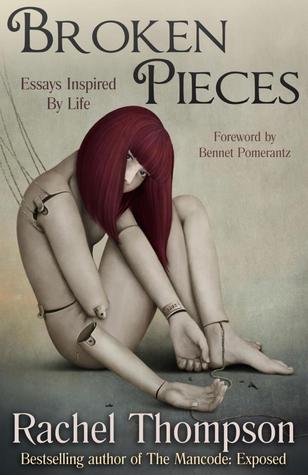
Independent novel review: Broken Pieces by Rachel Thompson

Why do I feel the urge to type “Rachel S. Thompson”?

Broken Pieces breaks the moulds of confessional memoirs and is rightfully ahead in the polling for best non-fiction book of the year among the E-Festival of Words contenders.

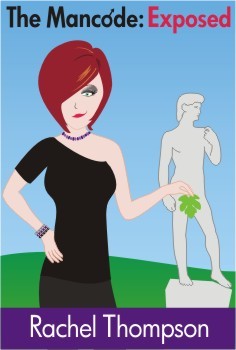
Rachel Thompson is best known for her humourous observations of male-female relationships in her blog, Rachel in the OC, and her previous books, A Walk in the Snark and The Mancode Exposed. These books are short, snappy, definitely snarky. Funny, entertaining and usually dead-on right.
“Husband has t-shirts from before we met. He sees no problem with this fact. “They still fit!” — why should he throw them away? Sigh. #Mancode.
With Broken Pieces, Thompson takes a decidedly more serious turn — a walk on a darker side. The book includes verse and prose poems, as well as extended descriptions of her emotions at different crises or turning points of her life in almost stream-of-consciousness prose.

It begins with descriptions of learning about the suicide of a former lover which happened only hours after she met him following years of separation. With a few well-crafted sentences, Thompson exposes the conflicted emotions that result from the memories of a troubled, inconsistent, thrilling and terrifying relationship.

Broken Pieces is an apt title. The book is very much a collection of essays, odes and prose poems, as well as pieces that are impossible to categorize. There are long passages that describe the author’s up-and-down relationship with her unnamed lover: how his strength made her feel safe, and how that feeling contrasted with his barely-restrained violence and his tendency to tear down her self-esteem. She also contrasts the lover with her eventual (and still) husband.

"Rachel in the OC" Thompson
It’s not all dark: Thompson also writes eloquently about the joys and bemusements of her relationships with her sometimes bumbling husband and their kids. Then, like refractions through a broken window, she turns back to her childhood and the trauma and abuse she experienced.

The pieces are disjointed. But I was never in doubt about which period of her life she had just jumped to. I always knew which man she was writing about on any given page. The book is not an easy read; it’s sometimes disorienting, but it’s compelling writing that tells Rachel’s own story. Broken Pieces shows Thompson as a real person, someone much more sympathetic than she comes across in her earlier books.

You cannot stop reading Broken Pieces once you start.

4*

Get it on Amazon or through Thompson's website.

Sunday, May 26, 2013

Sample Sunday: An argument with the girlfriend

Despite the weather, summer is coming fast. So for this week's Sample Sunday, here's an excerpt from my hot summer novel, One Shade of Red. This one introduces the reader to the hero's long-time girlfriend, the girl next door: Kristen.
 
Image: Angry Girlfriend by jasonippolitoLicensed under Creative Commons


Argument with Kristen

“Well, look who’s here. Hello, stranger.” Kristen’s voice had that clipped sneer in it. She folded her arms across her chest.
I put on my best smile and held out the flowers from the grocery store. “I finally got the bank account straightened out. Wanna have something to eat and hang out?”

It had taken a week of text messages, emails and a fax between me, Nick and the bank before the bank would give me access to the Pool Geeks account. I could deposit the cheques as well as take money out. So, finally, I wasn’t paying for the privilege of working. The first thing I did with the access was take out a hundred bucks to take my girlfriend out.

Kristen couldn’t suppress her smile when I held the flowers under her nose, although she tried to. Finally, she took the bunch and sniffed. “Well, since you brought flowers ... Where are we going?” She looked up at me, blue eyes shining through the flowers. Her mouth slowly spread into a smile.
“Why not Mama Toni’s? And my parents are away for the weekend, so I got a DVD.”

Kristen pretended to think about it for about two seconds. “Let me put these in some water.”

I stepped inside her house — her parents’ house — and waited like I had so many times before. Mrs. Petri came out of the kitchen, wiping her hands on a towel. “Oh, hello Damian,” she said. “Why don’t you sit down?”

My breath caught whenever I saw Mrs. Petri — even after all these years. She was the neighbourhood beauty: tall and fit with bright blue eyes that she had passed on to her daughter. Her hair was done up high, exposing her long neck, and she wore a sleeveless t-shirt and short pants. I wondered why she always showed more skin than her teenaged daughter.

I followed her to the kitchen and sat at the table; I knew from experience not to sit on the “good furniture” in the living room. Mrs. Petri poured me a cup of tea from the pot that was always filled. “Would you like a cookie?”

I took one from the plate in the middle of the table. Mrs. Petri baked regularly, and I loved her cookies. That’s how I first made friends with Kristen. When I was five, I was in a bunch of kids who came over to the Petris’ to play. I went back for the cookies. Through school, Kristen and I alternated coming over to each other’s houses for homework and other activities. I preferred being at her place, sitting at her mother’s kitchen table and munching on cookies. Those cookies were all that got me through long division in Grade 3 and A Separate Peace in high school.

I ate three cookies before Kristen returned from upstairs, dressed in her going-out-for-cheap-dinner clothes: khaki pants, a scoop-neck blouse and sensible shoes. She had tied her long, straight brown hair into a pony-tail. Kristen resembled her mother in her blue eyes and symmetrical, delicate features, but she was smaller, shorter. She was like a pretty doll: perfect and fragile. The prettiest girl in my grade, she was more for looking at than holding.

“Thanks for the cookies, Mrs. Petri,” I said as Kristen pulled me to the front door.
Mr. Petri came in from the garage at that point. “Where are you going?” he asked.

“I’m taking your daughter out for dinner and a movie,” I answered as cheerfully as I could, but I dreaded the response I knew was coming.
“You know you’ll never save money for university if you keep eating in restaurants,” he said. “A boy your age who lives on his own should know how to cook for himself.”

“Oh, Daddy,” Kristen said, pulling me out the front door.

“It’s alright, Mr. Petri,” I said, trying to sound casual and relaxed. Short but with broad shoulders and muscles that rippled in his lower arms, Mr. Petri always made me feel nervous and inadequate. Come to think of it, so did his daughter.
“I just got paid by three different customers.”

I knew what he was going to say next: “You should save that money in a bank. You never know what you might need tomorrow.”

“Oh, Daddy,” Kristen repeated and pulled me out the door.

“Be sure to have her home by midnight!” Mr. Petri called after us. And of course, it took three attempts to get my car started as Kristen’s father watched us from his front porch. By the time I could pull away from the curb, my face was burning.

Kristen and I could never agree on Mama Toni’s restaurant : I thought it was expensive; she thought it was cheap. Of course, she never paid for the food. She thought it was a quaint little place with mementos and pictures from Italy and New York on the walls; I pointed out that it was part of a chain and was owned by a foodservice corporation in Philadelphia. But we both liked the food and I liked to show off just a little by drinking Italian beer — which cost over seven bucks a bottle.

Hell with it: I felt the pool-cleaning cash burning a hole in my pocket.

Kristen ate about a quarter of her plate of pasta; she refused wine on principle and sneered at me every time I took a sip of my Moretti.

“So where are your parents tonight?” she asked while we waited for the bill.
“Up at the cottage for the weekend.”

“Why didn’t you go with them?”

“I don’t live with them anymore, Kristen. I’m a grown-up now. So are you. Besides, this way we have their whole house to ourselves.”

She narrowed her eyes at me. “I thought you said you didn’t live with them anymore.” She sipped her water delicately. Even though she could be judgemental and fucking annoying, she was very pretty in a delicate, little-girl way. A little too thin, maybe. She’d like it if I said that. She worked hard to keep her weight down.

“I do have a key to the front door. So we can watch the 50-inch plasma in full theatre-surround sound.”

She dabbed her lips with her napkin, then folded it carefully to cover the food left on her plate, as if she couldn’t bear to look at it anymore. “What DVD did you get?”

Fight Club.

“What? Why?”

“Hey, it’s the perfect couples movie.” I had been waiting all day to say this. “For the ladies, Brad Pitt gets naked. For the men, big, fat, ugly guys beat him up. What more could you ask for?”

I thought it was pretty funny. I still do.

What did you think? Leave a comment!

One Shade of Red is available on