Showing posts with label editing. Show all posts

Thursday, June 26, 2014

Thanks for the support

Thank you, readers and Internet friends, for all the support through the publishing and launch of my third book, Army of Worn Soles.

Publishing any book is an intense and drawn-out process—a lot of work over a long period. As I said in my post of June 16, I did not accomplish this on my own. First credit has to go to the protagonist and subject of the book, the man who lived the story and somehow survived Operation Barbarossa, scorched earth, capture and starvation, my father-in-law, Maurice Bury. Without his surviving, and later cooperating with me, this book simply would not have happened.

I have to thank my beta-readers for their insight: Literary Gary Henry, Action-writer Alan McDermott and Flawless Frederick Lee Brooke.

Rockin’ Rebecca Tsaros Dickson, as I said, did a fantastic job of bringing out the best I can do as an editor.

I asked a number of people to do advance reviews, and they responded not just with a blurb, but also with suggestions that really improved the book:
Thanks to all the people who posted reviews on Goodreads and Amazon:

And then all the bloggers who agreed to host the cover reveal and/or an excerpt:


Let’s not forget my family: my beautiful and ever-supportive wife, Roxanne, for not only filling in some critical information about her father, but also putting up with me over these past months when I’ve been sitting at my computer, researching or writing or editing or some damn thing instead of fixing things around the house; and my mighty sons, Awesome Evan and Super Nicolas, for enduring their dad’s weirdness.

Oh, yeah, and the won't let me leave out the cats. So thanks, Simba, for howling all morning while I try to write, and Cloudy, for putting your fluffy tail in front of the computer screen when I'm trying to type something. I don't know where I'd be without you.

I’m grateful to you all.

Monday, June 16, 2014

Not self-publishing—independent publishing

Creative Commons
I am not a self-publisher, because I did not publish my books by myself. I was part of a team of talented, dedicated, professional, skilled and very giving people, to whom I am indebted and grateful.

You know by now that my new book, Army of Worn Soles, will publish in e-book form on June 22, 2014—less than a week from the day this post goes up on the blog.

In the past few weeks, I’ve been busy with all sorts of not just last-minute details on the book itself, but also with advance promotion and publicity. I’ve been answering questions, and learning, from those answers. A question that has come up (however, not as frequently as I expected) was about “self publishing.”

I prefer the term “independent publishing,” simply because I think it’s far more accurate. I don’t publish any books by myself.

Publishing any book calls upon a wide range of skills:
  • writing—creating the story or the information for the reader
  • substantive—“story editing,” a review and critique of the overall worth of the manuscript, whether it’s complete, or there’s too much material, and whether the basic ideas make sense
  • copy-editing—ensuring it’s clear, grammatical, logical?
  • proofreading—looking out for spelling, punctuation and grammar mistakes and silly little errors in logic (like setting the opening of a chapter on a spring morning and ending, without indicating any passage of time, with a winter night)
  • design—of the cover as well as the interior
  • layout—setting up the interior according to the design, and making sure that the whole book follows the same design
  • manufacturing—transferring from manuscript to e-book or print format with the highest fidelity to the final manuscript and the highest production quality affordable.
Each of this is a major task requiring specialized knowledge, and no, I don’t attempt it myself. I can do many of them, but not all—not well.

And I have always said, “You can’t edit your own stuff.”

The team

When it comes to publishing my books, I call upon a supportive team. For Army of Worn Soles, that team included:

  • Fred Brooke, Alan McDermott, Russell Blake and Cinta Garcia de la Rosa as pre-readers
  • Rebecca Dickson as my stalwart editor
  • David C. Cassidy as cover designer
  • a large team to help promote the cover and excerpts, whom you are meeting through other posts on this blog.

Army of Worn Soles, like my other books, is a truly collaborative effort.

No, I do not self-publish. Army of Worn Soles, and all books I write, followed a cooperative publishing model, one promoted and supported by Independent Authors International. Like those published by the Big Five commercial publishers, are the result of a team of talented professionals applying developed skills to producing a quality book.


Monday, April 28, 2014

My 15 favourite proofreading tips

Don’t you just hate it when you see a typo in work you’ve just published, posted on a website or sent to a client?

Creative Commons image: Wikihow
Every writer needs to learn how to proofread. As a professional editor for over 30 years, I have a few favourite techniques for effective proofreading. Here are some, plus a few ideas I picked up from some other professionals.

1. Plan for proofreading. Set aside a number of hours in your schedule. Proofreading is a step as essential as researching, outlining or drafting. Never send your work to an audience without checking it over. Set aside enough time to allow you to proofread your work more than once. 

2. Leave it alone. When you re-read your own work, you often don’t see what you actually wrote — you see what you intended to write. Put the document aside overnight, if you have the time. Leaving some time between writing and proofreading will help you spot the keystrokes you  did not intend to make.

3. Post a list over your desk of words you often misspell, and the conventions for the document — whether you’re using Canadian, British or US spelling; acceptable short forms; units of measure; whether you use the Oxford comma or spaces around em dashes, and so on — that could change from one project to the next.

4. Proof once on-screen. Take advantage of the spelling checker function of whatever word processor you use. Look for the wiggly red lines and fix the errors they identify. 

5. Don’t depend on the spelling checker. It can’t tell whether you meant form when you typed from, and it doesn’t always know when you typed its when you should have typed it’s. 


6. Don’t depend on your on-screen proofreading. We don’t read words on screen in the same way that we do on paper, so you’ll find different kinds of errors — and miss different errors, too — depending on which medium you use. Print out your document and read it on paper.

7. Proof BIG. One of my favourite proofreading techniques is to print out the document at large size, twice as big as you would normally. When I was a magazine editor back in the days of waxed paper galleys, we would copy our 8 x 10 inch pages onto double-size ledger paper (11 x 17 inches). The mistakes would practically jump onto your face. If your printer can’t handle large-format paper, you can still print out your document with 18-point type. You’d be amazed at the difference.

8. Use a brightly coloured pen to mark the errors. If you use a graphite pencil, it’s harder to see the corrections you made when you’re entering them into the computer file.

9. Read it backwards. This will take your attention away from the meaning of the text, and reduce the tendency to fill in errors with your intentions.

10. Read it aloud. Hearing the wrong word reinforces reading it.

11. Read headlines and sub-headings in a separate pass. I find that the errors that I miss are often in display text, which seems counter-intuitive, as this is larger and more visible than body copy. After you’ve read and re-read the body, go back and pay close attention to only the display text.

12. Review different elements separately. Take another pass through the document to proofread image captions, tables, page headers and footers, call-out text, etc.

13. Take another pass to review numbers, facts and the spelling of names.

14. Read  it over once more, just to make sure.

15. Get someone else to do it. Someone unfamiliar with the text will find more errors more quickly than the author.

What’s your favourite proofreading technique? What’s your most common error?

Thursday, January 09, 2014

The whole story and nothing but the story

Photo: Satiray in Flickr. Creative Commons License
While I post book reviews regularly on this blog, I decided years ago not to publish a negative review of a book by an independent author. I also promised never to publish a positive review unless I really meant it. My reviews are candid, and while I hope to promote independent authors, I won’t lie about a book’s quality. I just will not review a book I don’t think is good. I don’t see the point in tearing down a book by an author who is probably struggling as hard as I am to sell books. I would rather spend my time promoting deserving authors.

While I have read many excellent author-published books, the one I’m currently reading, which I will call “the book” for the rest of this post, disappoints me. It was written by a best-selling, independent author who has done a lot to promote the credibility self-published authors.

I expected an engaging story, but instead, I found a frustrating one. Getting through this story is like wading knee-deep through adjectival phrases, similes and adverbs.

Take this example (with key words changed to disguise the identity):
Bernard von Bauben saw her before he was halfway across the lobby. Mary Lynn was sitting in an overstuffed lavender chair beside the Baby Grand Piano, dressed in mauve and lace, smiling at him. Von Bauben walked immediately to her, and she stood and kissed his cheek. Her lips were warm, and von Bauben saw a fire burning deep within the coloration of her eyes.

Or this one:
The Elite Apartments were cloaked in peace and solitude as they were advertised to be. From the outside, only a dozen or so lights were visible in the windows, and the faint sound of a radio playing Scott Joplin’s ragtime disrupted the stilted silence of a day fading into night. 
As he climbed out of the car, Brent Haymire thought he glimpsed a nervous rustle of curtains on the third floor, and he wondered if someone was up there watching him. In his line of work, there were eyes everywhere. General Tom Regan often accused him of being stricken with an acute case of paranoia. Maybe he was imagining things. Maybe not. The mind did have a habit of playing tricks sometimes. But the subconscious was also the best warning system that man possessed, and Haymire knew that, thus far, his paranoia, real or imagined, had managed to keep him clear of those sordid things, legal and ominous, that go bump in the night.
 Good grief! Anyone with the slimmest grasp of English could cut those passages in half without losing any information.

Combine that with the number of times the author dedicates two paragraphs to describing a scene or a feeling, then does it again three pages later, and you can imagine my reaction:

“Get on with the story!”

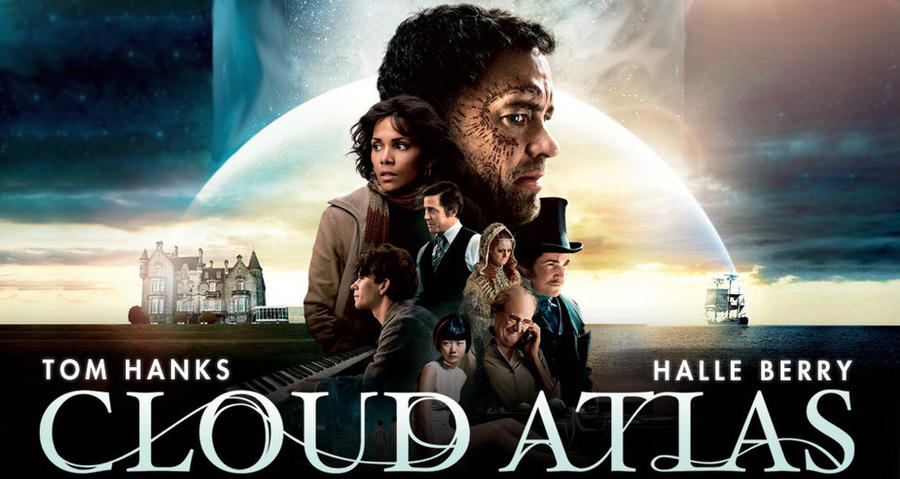
Coincidentally, I watched Cloud Atlas on DVD last night. (Okay, so I still use obsolete technology. I also listen to a transistor radio when I work out.) That movie disappointed me, too, for a similar reason: the writers were more focused on their own writing cleverness than on telling the story.

Cloud Atlas banner by CochiseMFC
Cloud Atlas was based on a novel with a great reputation (I haven’t read it, and I don’t think I will, now) and had a strong cast, but failed to tell the story. The novel features six “nested” stories that begin in the south Pacific in 1850, move through the 20th century to a dystopian and post-apocalyptic future, then goes back to the beginning. Each story is interrupted at a crucial point by the next story, which picks up a character or an object from the previous one. It was a clever idea that earned the author a lot of praise for his writing skills.

I think that the movie’s writers tried to be as clever, and ended up creating something so complex as to be baffling. Instead of nesting six different stories, the movie jumps around from story to story quickly, with no apparent reason and no apparent pattern, other than beginning and ending with the post-apocalyptic story of Zachry — in effect, turning the novel’s structure inside-out.

The cast, which included Tom Hanks, David Broadbent, Halle Berry, Hugh Grant, Hugo Weaving and Susan Sarandon, had roles in most, if not all of the stories. This was more of a distraction than an addition, especially with actors changing gender or race — Halle Berry as a Jewish refugee in 1935, or Doona Bae as a Korean clone in 2144 as well  the daughter of an American slaver in 1850. I found myself saying “Oh, that’s Tom Hanks with a skin wig and a beard and heavy makeup!” or “Hey, that’s no lady! That’s Hugo Weaving in drag and a blond wig!” Worst, I had to look up the cast on my iPad. “Is that Roger Daltrey? No, it’s Hugh Grant with a curly wig and old-guy makeup!”

Nearly three hours later, I could not see the movie’s point. I think the directors and writers tried to make a statement with the actors playing different roles in different stories, but what that statement was, I cannot tell.

The most important part of any story: the audience
The filmmakers behind Cloud Atlas and the author of the book that disappoints me spent far too much time admiring their own abilities, and not enough asking whether they’ve connected with their audience.
Image courtesy Creative Commons

What do you think? Did you watch Cloud Atlas? Did you read the novel? Have you ever read a book that seemed to have more to do with showing off the writer’s abilities than telling a story to a reader? Tell us all about it in the comments.

Friday, April 05, 2013

Writing tips: Words to throw away


“Edit” often is synonymous with “take out.” A lot of the work I do involves highlighting unnecessary text and pressing the Delete key.

It’s a tough job.

In order to make it easier (and you all want my work to be as easy as possible for me, don’t you?), I thought I would warn you against writing those words in the first place. If they aren’t there, I don’t have to cut them.

I have two categories in this post: words and phrases you can just remove without replacing; and phrases you can easily replace with a single word.


Terms to tank

It’s time to ditch some catch-phrases. Maybe the first time you heard them, they sounded cool. But here is my list of words and phrases that no one should say, let alone write down, anymore:


Push the envelope

Outside the box


Going forward, when it means “in the future”


High-level


On the ground, unless you mean something that is actually on the ground


At the end of the day


In the field of


It is to be noted that


The information you requested is below


This report/letter/email is in reference to


In light of this


The month of


In a nutshell


Obese text

Working for a large organization, I read a lot of text written in what I call “corporatese” — a language that obscures and hinders communication of ideas more than facilitating it. Documents filled with extra words and phrases that don’t add information, but just bloat the word count.

The next time you find that you’ve written any of these phrases, replace them with a single verb. Then re-read the text. You’ll be amazed at how much better it reads.

Conduct the evaluation of — replace with “evaluate”

During the period of — “between”


Cognizant of/aware of — “know”


At a later date — “later”


First and foremost — “first”


Due to the fact that — “because”


In reference to — “about”


There are a lot more, but you get the idea. When you see a noun phrase — a group of words that convey the same meaning as a single word — replace their lazy asses with that single hard-working word.

Suggest more terms to tank in the Comments.

Sunday, March 17, 2013

Launch date: April 2, 2013

One Shade of Red

It’s nearly done! My spoof of Fifty Shades of Grey is nearly out.

What began as a lark for National Novel Writing Month in November is nearing the final stages of publishing. I’ve written, re-written and edited it myself, shown portions to established authors in the field, and had it edited by a very skilled writer, Gary Henry (author of American Goddesses and some excellent short stories and poems).

After taking Gary’s advice, I asked another gifted author and editor, Cinta Garcia de la Rosa (The Funny Adventures of Little Nani) to copy-edit it. After making the corrections she pointed out, I turned the manuscript over to my wife, Roxanne, a skilled editor in her own right. Then I asked one more colleague to act as the last set of eyes on the result.

Gary, Cinta, and cover designer David C. Cassidy are all members of Independent Authors International, a cooperative publishing group who share services like reading, editing, design and promotion. In short, all the functions that a traditional publisher performs, while leaving control and revenue in the author's hands. This process is a great example of the vision behind iAi.

Improving quality

I have to admit, One Shade of Red grown in the writing. I thought I would do a straight spoof by taking the concept (if you can call it that) of Fifty Shades and turning it upside-down: instead of an innocent girl being seduced by a slightly older and irresistible man, I have a naive young man being initiated into adulthood by an older, irresistible and sexually voracious woman.

But the characters grew deeper and more complex as I told the story. They took on some life of their own. And then some complications entered the story. So it's a little more than what I started with.

Now, as I try to get some advance publicity and marketing going, I have to pause to say “thank you” to a lot of people who have helped along the way.

First, my wife, Roxanne, and the rest of my family, too, for support and for putting up with distraction, bad moods, anxiety and self-doubt as I worked on the manuscript.

Charity Parkerson, for insight, advice and encouragement at the early stages of the writing process.

Gary Henry, the first author colleague to review the manuscript for pointing out all the little errors not just in grammar or punctuation, but for forcing me to write better.

Cinta Garcia and again my wife, Roxanne, for eagle-eyed copy editing.

David C. Cassidy for an absolutely fantastic cover.

Bruce A. Blake for a final proofread.

Everyone who agreed to participate in the cover reveal over the next two weeks:

CR Hiatt
Rachel Thompson

Cinta Garcia Rosa
Christine Nolfi
Bruce A. Blake
Wodke Hawkinson
Doug Dorow
Linze Brandon


Lisa Jey Davis
David C. Cassidy
Jesi Lea Ryan

I’ll be tweeting and blogging all the links to their blogs over the next couple of weeks, but in the meantime, check them all out today — you’ll be glad you did!

Thursday, February 07, 2013

Fantastic, chatty and readable: Terry Tyler on writing style


How important is writing style for the author and the reader? This week, Terry Tyler, independent author of four (soon to be five) novels that, like most of those I enjoy most, defy genre boundaries.

How would you describe your own writing style?

In some ways this is very difficult to answer, Scott, because I’m so close to it. I can tell you how some readers describe it, ie, chatty and easily readable. A couple of people have said that I write about serious or “heavy” subjects in a light way without trivialising them, which is a compliment I treasure — I’d hate to think I came across as superficial, though I don’t really do overly deep! I suppose I can best describe my style as conversational, even during the narrative parts. Some people find my novels amusing (as opposed to laughable, one hopes!!) — any humour tends to be observational; for instance, in my most recent novel, Dream On, I have a scene where a character is forced to go onto The Jeremy Kyle Show — okay, it comes from years of watching Jeremy Kyle whilst doing the ironing — I’ve never deliberately set out to write a humorous book; sometimes, that can come across as too formulaic, too studied, to be truly funny.

Presumably, Jeremy Kyle, the UK's answer to Jerry Springer.
Image source: Wikipedia

Are there any authors whose style you admire? Do you try to emulate them?

No, I don’t try to emulate anyone (*gets all sniffy* !) — can’t see any point in that! You have to write with your own voice. I admire loads of writers’ styles, in particular Bill Bryson, Dorothy Parker, Kate Atkinson, PJ O’Rourke, Jackie Collins, Evelyn Waugh, Lauren Weisberger, William Boyd — I could go on all day, but they are many and varied, as you can probably see already!

Are there authors whose writing style you dislike?

 Never been able to get on with DH Lawrence, John Grisham, JRR Tolkien or Sebastian Faulks. That Shakespeare bloke, some of his stuff bores me witless, too ... however, I wouldn’t go as far to say that I actually dislike them; they’re just not my cup of tea. The only stuff I actively dislike is the pretentious and the badly written.

How important is your writing style to you? Are you happy with your style, or are there aspects of it you try to change during rewriting or editing?

 I’d never try to change my style; how I write is how I write. I just try to improve it all the time. When I’m rewriting/editing, I’m constantly looking for ways to phrase a sentence more tightly, more succinctly, or more vividly. Obviously there are words and phrases I overuse, for which alternatives have to be found, but I think everyone has those! I’d love to be able to write a historical novel, but I don’t think the way I write would work with such a genre. Anyway, I don’t think I’ve got the patience for the year’s research that might be necessary for writing a good one!

How can readers identify your writing style? Are there particular words or kinds of words that you tend to favour? Sentence structures? Or is it more in the story, the pacing or the characters?

Again, it’s hard to say! But I do tend towards short punchy sentences to make impact, at times, and will, occasionally, begin a sentence with an “and,” a “but” or an “or” if it feels right — so shoot me! I use something that I’ve recently discovered is called “free indirect speech,” which is when the narrative consists of the thoughts of the character, without actually writing “he thought” this and that. It’s just something I’ve always done; I didn’t realise it had a name until I read it on the blog of someone who is doing an MA in creative writing! Most of my books are written in this fashion; I change from one POV to another all the way through them.

As far as the story goes, I write about real people in real situations. All my books are very current, dealing with themes and circumstances that affect so many people today, such as divorce, infidelity, alcohol and drug abuse, diet obsession, tragic accidents, unrequited love, situations one can get into via befriending people on social networking sites, Internet dating, TV talent shows, women who want to “have it all” — you name it!

The feedback I get from most readers of my books is that my characters are like people they know. I’ve read words to this effect in many, many of my reviews, and for that I am eternally grateful. As for kinds of words — I don’t write in flowery language; I think I write in quite a spare fashion. I tend to skip-read long descriptive passages, so I don’t include them in my own work. The dialogue is always appropriate to the person who is speaking, without overdoing it — for instance, in Dream On and its sequel Full Circle I have a Geordie [north-east English — SB] character, and I have to make sure that he doesn’t say “Why aye” and “Howay” too often. I’m allergic to clichés in dialogue, and work hard to make sure that my characters talk realistically — even if it means their language is a bit ripe at times, or that they say things that are not grammatically correct!

Do you think writing with a female protagonist and POV, as opposed to a male POV, changes the style, in terms of word choice, sentence structure or other language elements?

Oh yes, of course, because women think differently from men. I think the mistake some writers make is writing the POV of their character of the opposite sex in the way they would like them to think, not how they actually do think. Have you ever read any Jeffrey Archer? His female characters are completely cardboard! But then, all people think differently, regardless of their sex, don’t they? It’s all about keeping in character when you’re writing that particular person, and not making them say or do something just because it moves the plot to the required place.

How important do you think writing style is to an author's commercial success?

I’d like to say that individual writing style is terrifically important to such, but I suspect that, sadly, this is not true; some books that are imitations of well-known authors sell very well. For instance, I sometimes think that all a writer has to do is stick a cartoon of a girl in high heels on the front cover, along with a cupcake or two and some pink swirly writing, and it doesn’t matter if the style is derivative, it’ll still sell to the huge army of avid chick-lit readers! Then there’s the ever growing erotica market — I suspect the fans of this genre are more interested in the particular area of eroticism with which the book deals than the writing style!

But style as a whole, rather than just individual? Yes, that makes a difference. You see a lot of people tweeting their books thus: “If you like John Grisham (or Sophie Kinsella/Nick Hornby/A N Other Famous Author) you’ll love.... etc etc.” Obviously the comparison with the style of an established author is seen as a way of acquiring new readers. Hey, I’m as guilty of this sort of thing the next person — I don’t compare myself to well-known writers, but if others do I will quote them in a tweet! Aside from anything else, it gives an idea of what the prospective reader might be letting him/herself in for, doesn’t it?

So I suppose my answer is yes, writing style is important to commercial success. Ideally, the writers with a style all of their own will break out and become the most successful. Ideally; but then we don’t live in an ideal world, do we?

Thank you so much for inviting me to appear on your blog, Scott! I hope this interview has been of interest to you and your readers.

Thank you, Terry, for a delightful and inspiring interview!

Terry Tyler lives in the north of England with her husband. She has four novels on Amazon, of the contemporary women's fiction variety, though she is happy to say that men read them too! Her fifth, Full Circle, will be published within the next two months, all going well. She is about to start work on her sixth, which will be explore the subject of stalking, from both the victim and the stalker's point of view, a subject she has touched upon in previous novels.

Terry's books:

You Wish

Amazon USA
Amazon Canada

Nobody's Fault

Amazon UK
Amazon USA
Amazon Canada


The Other Side


Dream On


Saturday, July 07, 2012

Guest blogger: The 5 reasons why I am a failed writer

This week's guest blogger is marketing marvel Jens-Petter, owner of the SlyMarketing blog and company and author of Make Google Love You. He's writing not only about the best and worst he's ever done as a writer, he's giving us some really useful tips on how to market your books. Following is some of the best, most practical advice I've ever read. Over to you, Jens-Petter!

I say that I'm a failed writer because I can't seem to finish what I'm writing.

I am a solo entrepreneur with a marketing business, and I have written a novel and a short story for the Kindle. I am fairly successful in business with several big clients and a popular blog, but I still haven't published my novel or the short story.

I love writing, but my first hurdle was to choose the right language. I write in Norwegian and in English. I am a better writer in Norwegian, because I am Norwegian, but I have a much bigger audience when I write in English. And that's why I started my marketing blog in English.

I am still not sure if it's such a good idea to keep writing in two different languages or if I should focus on one. But since I believe that one of my strengths in marketing and writing is experimenting and I'm not really in a hurry to get things published, I've decided to keep writing in both languages for now.


The 5 reasons I am a failed writer

I have been thinking a lot about why I haven't been able to publish my novel or the short story. I've come up with five main reasons. Let me just tell you the reasons first, and then I'll tell you how I will market my novel and short story.


1. I don't have a goal

I write because I love to write. I want people to read what I have written, and I love feedback. And I work to become a better writer. But I don't have a goal when I write.

I am telling a story. I want it to be entertaining, but do I want my readers to cry, to learn something, or to never forget about the main character?The truth is that I don't know. I just write without having a single goal for the story or how my readers should
react.

I believe writers should have a main goal with everything they write. Do you agree?


2. I don't focus

When I started writing my novel, I thought that I wouldn't do anything but write for a year. I believed that was what authors do. I'd lock myself inside my office and just write.

I did write for a long time, but I kept doing so many other things that were not part of my main projects. And I kept creating new projects, instead of writing and finishing the novel and the short story.

I believe that writers should focus on one project at a time, and finish it before starting new projects. Do you agree?


3. I am terrible at editing

I write from the beginning of the first sentence until I'm finished. That's it. I know that as soon as I've finished writing, I will be really just at the beginning. Most of the time it's all about the editing. And the first draft is more or less just the foundation of the story. But I am having a hard time to remove anything from the story. I can add a lot, but since I have a hard time removing anything, the story becomes more and more complex.

I have come to realize the importance of editing, but removing is still a huge obstacle for me. I'd love your thoughts on this — what part of editing do you struggle with?


4. I write alone

I love the solitude of writing and I love the social part of the online world. My marketing experience is mostly part of the social world, where I have teamed up with lots of brilliant people who are helping me out. I get the experience of people from all over the world, and we share marketing advice. This has been all positive, and I wouldn't have been able to start my business if I didn't have this team of supporters behind me.

I believe that I shouldn't have been doing all my writing alone. I should have teamed up with other writers and I should have told them about my projects, and we should have shared opinions and experience. I am sure it's a myth that authors should be all by themselves when they write. I do my best work when I get feedback and when I am having conversations with people. If I could start all over again, I would find a mentor and a team of like-minded people to help me out. I understand the power of collaboration and I would have done my share.

Do you write alone, or have you teamed up with other writers? I'd love to know if other people are part of your writing process.


5. I write what I love, not what people will buy

One of my friends is a painter. I believe he is a brilliant painter. I love the way he paints, but the reason he doesn't sell any of his paintings is that he only paints what he loves to paint. And at the time I am writing this, he loves to paint aliens and blood. I believe that if he would have looked more at what people are interested in buying rather than what he loves to paint, he would be making a career as a successful painter.

I am not saying that he should only look at the market, but the market should be part of what he's doing. And the same goes for my writing. It took me a long time to adjust my first novel from a story that I wanted to write, because I thought that it would be an interesting project, to a story that would actually sell. I have added elements of both.

Adjusting to the market is important if you're going to make any money from writing. I know that money isn't really the issue, but if we're going to be able to write every single day and make writing part of who we are and what we do, we need buyers. And that brings me to my last point.

How to market fiction books

Every story has a beginning, a middle and an end. I think of marketing fiction books in the same way: it's a three-step process.

The beginning

 Research who your audience is. Find out where they are, and what you should be doing to reach them. It's usually not that hard.
Do a pre-launch phase. Think of how movies are marketed: they've got trailers and movie previews at the movie theatres. Create book trailers and add them to your blog, to YouTube, Facebook, Twitter, etc. The point is that you should build expectations. It's not hard at all. You can hire a brilliant person to do it on Fiverr for only $5. Add some text, and she'll add the effects and the audio.

Use the trailer to drive traffic to your blog, and build an email list of people who are eager to read your book. Let them know that they'll get it before other people, or make a promise that they'll get it cheaper. The pre-launch phase should be no less than 30 days. It takes time to build expectations.

The middle 

 When you're launching your book, you should first send emails to the people on your list. They should be waiting for your book. Write guest posts on related blogs, the blogs your audience reads (which you learned during the research part of the pre-launch phase). You should write many guest posts, and they should be about the process of writing your book. Add things about your new book (you could do this during the pre-launch phase as well). Create press releases and submit them to the local press (it's fairly easy to get reviews in the local press) and to the large PR sites (such as?).

You should get testimonials from people who've read your book. Publish all the testimonials to your blog — the more the better. Ask your readers to publish the testimonials on sites like Amazon.com, which will give your book a higher ranking.

The end

The last part of the launch should be about building relationships with your readers. Relationships are one of the most important parts of marketing. Ask your readers for feedback, and get more testimonials. Build a community. Let them know about you. Tell them how you write, give them more background on the story, and why you wrote it and what your inspiration is.

It's important that you add to your blog regularly, and that you build your newsletter email list. Communicate with your fans and they will spread the word about your awesome books.


Jens P. Berget is a Norwegian author and entrepreneur. He is currently writing his first novel, and he has started his own marketing business, while he continues to live off his passion.

Jens' blog, http://slymarketing.com/, will host my guest blog, as well. Check it out!