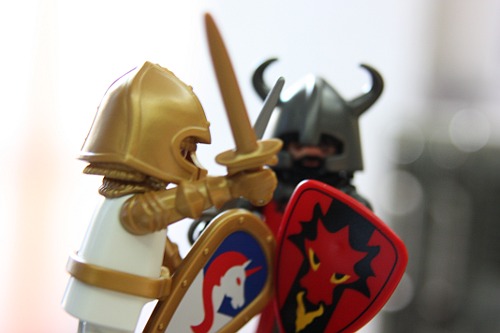
 |
| Image courtest Nicu's Photoblog. Licensed under a Creative Commons Attribution-Share Alike 3.0 License. |
It’s the basis of just about every story: right versus
wrong, good guys against bad guys, the appeal of the bad boy …
Something I’ve been wondering about for a long time is that,
outside of literature, evil-doers don’t seem to consider themselves as committing
evil acts. In fact, most seem to think they’re taking an extreme step in
defence of goodness.
Everybody thinks of himself or herself as a good guy. The
Boko Haram group kidnapped nearly 300 schoolgirls in Nigeria. The group released
a video showing the girls dressed in grey hijabs. It claims to have liberated
them and to have converted some to Islam.

Boko Haram’s name reportedly translates as “Western
education is a sin.” Its stated goals are to impose Islamic law, so clearly its
members see themselves—or at least, pretend to—as having a moral objective.
It uses bombs, murder and kidnapping to achieve that moral
goal.
Following what can be described as a coup in Kyiv that
deposed an elected government, several cities in eastern Ukraine held referenda
last weekend on joining Russia—referenda without clear questions, voting lists
or secret ballots. In supporting the results of those referenda, Russian President
Vladimir Putin claims to support the civil and human rights of Russian speaking
people in eastern Ukraine. On Tuesday, militants ambushed a Ukrainian army
convoy and killed six soldiers.
Who’s on the side of good?
I just finished writing a book about the German invasion of
the USSR in 1941, Army of Worn Soles.
In that conflict, both sides claimed to be on the side of good, as they defined
it. The Germans claimed to be seeking living space; the Soviets were defending
themselves. In the West of 70 years after the fact, we tend to believe the
Soviets were more in the right, but even a little research shows there was
plenty of evil to go around. Nazi Germany and the USSR partitioned Poland
between them. A few months after that, the USSR invaded Finland in the Winter
War to “protect Leningrad.”
I don’t think anyone decides “I’m going to do evil.”
In 2011, Anders Behring Breivik
bombed and shot 77 young people at a camp in Norway. He was sentenced to 21
years in jail. I’m sure all my readers recognize his acts as evil, but Breivik
claimed he did it to defend Norway from a Muslim invasion.
So we come back to religion, which defines good and evil.
Good will get you into heaven, evil will send you to hell. But Islam, Judaism
and Christianity all follow texts that prescribe stoning to death for having sex
outside marriage. Christians fought bloody wars for centuries over (supposedly)
differences in interpretations of religious tenets. The Church burned hundreds
of Cathars to death for believing slightly differently than officially
sanctioned Catholicism.
From a secular perspective, we could define “good” as
improving people’s lives. The oil industry provides good jobs, and has enabled
us to heat our homes and travel, while providing well-paying jobs to some and
huge profits to a very few.
 |
| Syncrude's base mine. The yellow structures are the bases of pyramids made of sulphur - it is not economical for Syncrude to sell the sulphur so it stockpiles it instead. The extraction plant is just to the right of this photograph and most of the mine is to the left. Source: Wikipedia |
On the other hand, the oil industry has spoiled the natural
environment for over a century, choking cities’ air (Mexico City, Los Angeles,
Tokyo, Beijing), poisoning rivers (Kalamazoo, Michigan) and devastating whole
ecosystems (Athabaska River). The oil lobby has prevented meaningful development
of alternative energy forms until very recently, and continues to resist
measures to mitigate climate change.
Is “good” what’s good for me?
The challenge in fiction is to make characters and their
actions believable. Even when we’re writing about vampires, aliens or witches, we—or at least, I—try to create an emotional connection that the reader can identify with.
It’s always fun (strangely) to create a purely evil villain. Dr. Evil. Hannibal Lecter. Sauron. But what makes that person evil? The pursuit of goals, no matter the cost to others? Doesn’t that make 24’s hero Jack Bauer evil?
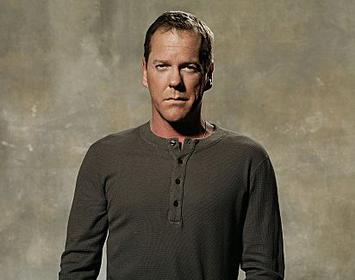 |
| Good or evil? Source: Wikipedia |
Fiction often presents villains as sympathetic characters,
drawn into breaking the law or other evil acts to defend themselves or their
families: think Michael Corleone in The
Godfather, Walter White in Breaking
Bad or Jaime Lannister in A Song of
Ice and Fire (Game of Thrones). They’re naturally good people forced to do
terrible things.
Hamlet poisoned his mother. Brutus stabbed Caesar to protect
the Roman republic.
What’s good? What’s evil? Can we ever really say, or
does it depend what end of the gun you’re on?

