Showing posts with label Cinta Garcia de la Rosa. Show all posts

Thursday, May 30, 2013

Is there still a role for the commercial publisher?


“The global electronic marketplace is rapidly depleting authors’ income streams,” wrote Scott Turow, author and President of the Authors Guild., in an op-ed in the New York Times in April. E-books, pirated copies and changes to copyright laws will cause the “slow death of the American author.”
Photo: Evan Long by Creative Commons
Turow documents the futile efforts of the big publishing companies to control the e-book phenomenon, through doing things like fixing their prices ridiculously high, refusing to sell e-books to libraries and reducing the royalties they pay to authors.
On the other end of the spectrum, Hugh Howey, author of the indie-pub phenomenon Wool, says that the self-publishing future is great for writers: “Those who take their writing seriously, who publish more than one title a year and do this year after year, are finding real success with their art. They are earning hundreds or thousands of dollars a month,” he wrote in Salon
Following these two statements, we have to ask: when readers choose good books without the intermediation of a publisher, is there a market for the gigantic, multinational Big Six — or “Bix” — publishers?
I have written about this on a couple of other blogs: Writers Get Together, the Guild of Dreams and BestSellingReads. Today, I’m bringing the arguments together and suggesting a new solution.

The legendary legacy

E-books are the driving force of publishing these days. Amazon reported that more than half of its sales are of e-books. And David Gaughran estimates that 25 percent of the e-book market is by independent authors.
The Bix claim to be agents of quality control: they find the best manuscripts, edit them rigourously, design and lay them out to be legible, print and distribute them so that readers enjoy reading them and promote them to bring them to the attention of audiences. Publishers take care of all those grimy aspects of publishing so authors are free to write more great books.
The Bix claim that they also provide an essential gatekeeping function. When the numbers of independent authors self-publishing e-books started climbing, the commercial publishers said that the self-published just weren't good enough to get published by a commercial publisher.
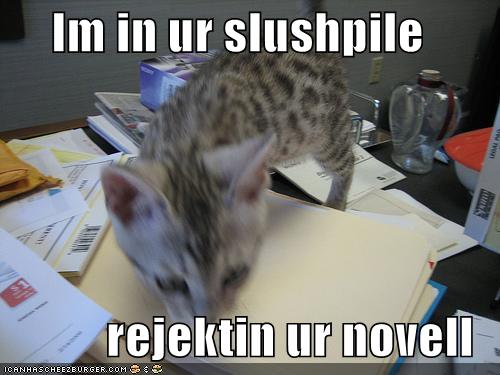
All those manuscripts that didn't make it out of the slush pile? The publisher sent their authors polite rejection letters, saying not that the manuscript is crap, but that it "didn't meet their needs at this time."
LOLcat built from original photo by sutefani in orlando,
under a Creative Commons-Attribution license by way of Flickr
Having worked for big and small publishers, here is what I know about the reality of choosing and editing books:
  • Acquisitions editors and agents choose manuscripts to publish based on sellability, not on quality. Because they cannot tell the future any better than you or me, they use factors like whether an author has been published before to make decisions. Getting selected from the slush pile is due either to blind luck or — usually — connections within the industry.
  • The quality of editing varies widely. Most copy-editors and proofreaders are right out of university and they’re so badly underpaid that most quickly seek more rewarding employment.
In reality, authors today do most of what publishers did 20 years ago: research, check facts, write, edit, copy-edit and proofread. Interior design or layout is capably handled by word processing apps. Howey and any number of other authors concur that most authors published by big companies have to do their own promotion. The days of book launch tours are long gone. Bix publishers only spend money to promote their sure-fire winners: their biggest sellers and celebrity authors.
The only money they shell out for new writers and relative unknowns, even for their mid-list authors, are for printing and distributing copies to bookstores.
But it’s not hard for the individual author to handle that part, as well. Software does most of the layout and production of e-books. Smashwords, Amazon and iTunes give step-by-step instructions on how to create a good e-book. Amazon’s CreateSpace system does the same for printed books. Their quality is equal to or better than commercial publishers’, and their prices are better than anything I’ve found in 30 years of managing printing.
That leaves cover design. More on that later.

The independent reality


Hugh Howey, from his website.
Hugh Howey, compares the self-published independent author to the independent musician. “We admire anyone who learns the grammar of chords and then strings these phrases together into music.” They begin by playing cover tunes, progress to busking and open-mic nights, get small gigs and hope to open for a big act or be discovered by a major label. “This is how artists are born. They are self-made.”
Like a musician, Howey became an overnight success after years of hard work. His breakthrough, best-selling novel, Wool, was the eighth or ninth title that he published through Amazon’s Kindle Select program. After he sold half a million copies, Simon & Schuster offered seven figures for the publishing rights. Ridley Scott optioned film rights.
According to Forbes magazine, Howey turned down S&S’s original seven-figure offer. Instead, he sold just the print rights for six figures, keeping the e-book rights for himself because he thinks that S&S won’t be able to sell enough to make up the royalty difference.

Proposing a new publishing model

Writers can, and do. perform all the functions of a commercial publisher. In other words, authors don’t need publishers.
I suggest a cooperative model of publishing, where authors, editors, designers and marketers work together to bring new electronic or print books to audiences with as little intermediation as possible.
(Image found on Ted Landphair's America blog, originally from whiteafrican, Flickr Creative Commons)

Many of you readers already know about the authors’ cooperative I belong to, Independent Authors International. With 13 members so far, it’s a consortium of writers who commit to supporting each other in development, production and promotion of each other’s work.
My latest book, One Shade of Red, is a good example of the process. Once I had written and re-written the manuscript, I turned it over to another iAi member, Gary Henry, independent author of American Goddesses. He performed the story editor function, pointing out where I needed to develop a character more, plot errors, purple prose and weak writing.
Cinta Garcia de la Rosa, author of The Funny Adventures of Little Nani, performed a second review. Bruce Blake, author of the Khirro’s Journey trilogy, and Benjamin Wretlind, author of Sketches from the Spanish Mustang, plus my usual editor, my wife, Roxanne Bury, provided copy-editing and proofreading.
David C. Cassidy, author of Velvet Rain, designed a fantastic cover.
In return, I edited or will edit their books, or will provide other services. I also do what I can to promote their books on Twitter, Facebook, Google+ and LinkedIn, and through my blog.
This service swap or barter exchange need not be the only way for this to work; authors could pay editors and designers cash, or provide a royalty, or come to other arrangements.
The point is, there are thousands of people with the skills needed to produce professional books. These skills are not locked down by publishing companies in London, New York and Toronto.
With this model, while the author retain control of the book and the money it earns (if any), the book still achieves the quality standard the Bix companies like to say they’re all about. The iAi colophon is a symbol of that standard.
Will iAi and other co-operative ventures replace the Bix? They’re big companies with a lot of assets. But they’re going to have to learn to adapt to the new reality, rather than fight against it.
Hugh Howey is right: this is a great time to be an author.
If you’re an author, I encourage you to check out Independent Authors International. And if you think you’d like to get involved, send an email.

Wednesday, May 15, 2013

The Little Nani blog tour


Today, Written Words is happy to host a stop on the blog tour for the relaunch of The Funny Adventures of Little Nani by Cinta Garcia de la Rosa.
Yesterday’s stop on the tour was Helle Soe Gade’s photo and writing blog, where Cinta explained how and why she’s relaunching her collection of charming, hilarious and empowering stories for children. Here’s an abbreviated version of the blurb:

Little Nani is a little girl who likes helping people. However, when she helps people the results can be a bit unexpected. Why is that? Little Nani is a witch! Or at least she wants to be a witch. With her magic wand, she will try to cast different spells to help her friends, but she won’t be successful all the time.

Funny ostriches, horses that love reading, super-fast turtles, grumpy zombies… Little Nani has lots of friends!
Cinta provides places in the book for readers to draw their own illustrations of Little Nani’s misadventures. But now, Cinta herself will explain what led to The Funny Adventures of Little Nani.

What inspired you to write children's fiction?

That’s a good question. It’s so good that I don’t have a clue about how to answer it! Seriously though, I’m not sure. One day Little Nani popped into my head and I considered that maybe she would be more suitable for kids than for adults. But it seems that adults enjoy her adventures too, so that’s a bonus.

I have been a teacher for 16 years, and I love children. Writing for children was quite a challenge and at the same time something easy to do.

Where are most of your readers? North America? The UK? Europe?

Since I write in English, I don’t have many readers in Europe. So most of my readers are in North America and the UK.

Where did you get the name "Little Nani"?

In 2004 and 2005 I was living in London, working as an au pair. Au pairs live with a host family and help to take care of the children. So I was a nanny. I was living with a Jamaican family, where I had to take care of three girls. The three of them were very surprised to see that their nanny was such a tiny person (yes, I am very short), so they started to call me “Little Nanny.” Since Little Nani is a reflection of myself, I thought it proper to use the nickname my lovely girls from London gave me.

Are any of the characters in Little Nani or the second book based on real people that you know?

Yes, lots of them. I can’t avoid it. I have a funny conversation with a friend, or a friend does something funny, or I live a certain situation, and the character pops into my head immediately. I will talk more about this question in my blog stop tomorrow on My Books & I.

Have you ever had an adventure like one of Little Nani’s? Where you thought you could solve a problem, but where the attempt went wrong and the situation ended up being unpredictably worse?

Actually, yes. While I was in London, I had a Spanish friend there who was constantly in trouble, so the mother of the children I was living with didn’t really like her. I had to come back to Spain in a hurry when my family informed me that my mum was ill, so I thought that maybe if I made my friend help me with the preparations and made her look like a sensible girl, my “host mother” would like her better. I told my friend to come over to the house and offer herself to go with me to the airport and to take some of my bags to her house, which was closer to the bus station, so I didn’t need to walk with those heavy bags and all the luggage myself. She did that and my “host mother” was quite happy to see that my friend was trying to be helpful for a change.

I went to bed and the next morning, when collecting all my things, I discovered that my friend had taken the bag with my passport and money! I panicked, but then I thought that she would bring the bags, so there won’t be any problem. The problem was that she overslept, arrived at the airport too late and I missed my flight. So I tried to help her and it backfired on me.

If you could turn anyone in your life into an animal, who would it be and which animal would you choose?

It would be my sister. Taking into account that she is pretty lazy and her favourite hobby is just to lie down on the sofa, I would turn her into a cat, so she could spend her days doing nothing.

What do you consider your greatest writing challenge?

My biggest challenge is to write something longer than a short story. I am a pantser, so I don’t like planning. Indeed, I am unable to plan. I spent a whole day planning my choose-your-own-adventure Little Nani stories and that caused my worst writer’s block ever. My brain simply shuts down when it has to deal with planning. So my greatest writing challenge is to manage to write a novel or, at least, a novella.

Are there any other children's authors that inspired you or that you admire?

I don’t really read children’s books, so I don’t know many children’s authors. But if I have to name one author for children that I admire, it has to be Beatrix Potter. Her stories and illustrations are charming.

Who are the other writers that you admire and that may have influenced your writing?

My favourite author is Jane Austen, hands down. Some people say that my stories have a certain touch that reminds her style. Yeah, sure, I wish.... But sometimes I tend to write sentences in a way that sounds weird in the 21st century but sounded perfectly fine during the Regency period.

What is next for Cinta Garcia de la Rosa? Will you continue with children's literature, or turn to more work along the lines of A Foreigner in London? It seems to me that that could turn into a novel.

What’s next? Well, I have lots of plans for Little Nani, as I explained yesterday on Helle Soe Gade’s blog, but I don’t want to be just a children’s author. So there will be more stories along the lines of A Foreigner in London. In fact, I am planning several collections of short stories, based on different topics and emotions.

What do you hope to have accomplished as a writer in the next five years?

Well, in the next five years I hope to have many other books under my belt, and maybe I can even be moderately famous. I would love to travel the world signing books and attending to book fairs. That would be a dream come true.

Thank you, Cinta.

Thanks to you, Scott, for hosting me today.

GIVEAWAY!

Don’t forget to leave a comment, so you can enter the giveaway for the opportunity to win a signed copy of “The Funny Adventures of Little Nani”. If you leave comments in several blogs during the tour, you will get an entry for each comment. So don’t hesitate to comment!

Judge for yourselfcheck out Cinta's book:

The Funny Adventures of Little Nani (print) on Createspace: http://www.createspace.com/3914481

E-book: Amazon (US): http://www.amazon.com/Funny-Adventures-Little-Nani-ebook/dp/B009YMBXJW/ref=tag_dpp_lp_edpp_ttl_in

Amazon (UK): http://www.amazon.co.uk/Funny-Adventures-Little-Nani-ebook/dp/B009YMBXJW/ref=cm_cr_pr_pb_t

A Foriegner in London (e-book) at Smashwords: http://www.smashwords.com/books/view/298936


Visit Cinta's blogs:

Cinta's Corner http://cintascorner.wordpress.com/


I Can't Stop Reading http://icantstopreadingblog.com/

Indie Authors You Want to Read http://authorsyouwanttoread.wordpress.com/

Visit Cinta's Author page on Independent Authors International: http://independentauthorsinternational.org/iAi/Cinta_Garcia.html

And follow Cinta on Twitter: http://twitter.com/CintaGarciaRosa

Friday, May 10, 2013

Cover re-reveal: The Funny Adventures of Little Nani


It’s amazing how much better books can be when they’re under the full control of their authors. For example, here’s a new cover for The Funny Adventures of Little Nani, Cinta Garcia de la Rosa’s first published title.

Cinta released charming collection of interactive stories for children in September 2012. While the cover features a drawing by the book’s illustrator, Almudena Romero, the design uses a template from CreateSpace. “It is OK, but it is not what I wanted for my book,” she says. So Cinta had a new cover, suitable for print, designed by Mark Stone.

“All my Little Nani covers will follow the same format, so they will be easily recognisable for its readers.”

We can’t wait to see the next collection, Cinta!


What is Little Nani about?

Little Nani is a little girl who likes helping people. However, when she helps people the results can be a bit unexpected. Why is that? Little Nani is a witch! Or at least she wants to be a witch. With her magic wand, she tries to cast different spells to help her friends, but she won't be successful all the time.

Follow Little Nani in her funny adventures and meet her extraordinary friends. Funny ostriches, horses that love reading, super-fast turtles, grumpy zombies... Little Nani has lots of friends! You can also draw your own characters!

Little Nani is willing to become a good witch. Will she manage to do it? Who knows? Read the stories and discover what happens next!

About the author

Cinta Garcia de la Rosa is a Spanish writer who has loved the written word since he discovered she was able to read books at age 5. Since then, she has become a bookworm and reads around 100 books every year. She also writes, every day, compulsively, even in the middle of the night. You cannot control when inspiration hits you, can you? She writes in English because she is convinced that in a previous life she was British, so writing in English feels more natural to her than writing in her native language. Yes, she is crazy like that.

Cinta Garcia is the author of “The Funny Adventures of Little Nani”, a collection of short stories for children, and “A Foreigner in London”, a short story published on Smashwords. She is a member of Independent Authors International.


You can get your own copies at:

The Funny Adventures of Little Nani (print) on Createspace: http://www.createspace.com/3914481

E-book: Amazon (US): http://www.amazon.com/Funny-Adventures-Little-Nani-ebook/dp/B009YMBXJW/ref=tag_dpp_lp_edpp_ttl_in

Amazon (UK): http://www.amazon.co.uk/Funny-Adventures-Little-Nani-ebook/dp/B009YMBXJW/ref=cm_cr_pr_pb_t

A Foriegner in London (e-book) at Smashwords: http://www.smashwords.com/books/view/298936


MEDIA LINKS:

Twitter: http://twitter.com/CintaGarciaRosa

Facebook: https://www.facebook.com/pages/Cinta-Garc%C3%ADa-de-la-Rosa-Author/333755993341596

Goodreads: http://www.goodreads.com/author/show/6470058.Cinta_Garc_a_de_la_Rosa

Amazon Author: http://www.amazon.com/Cinta-Garc%C3%ADa-de-la-Rosa/e/B009LHYYSM

Smashwords Author: http://www.smashwords.com/profile/view/Austenite78

Website: http://www.cintagarciadelarosa.com/

Independent Authors International author

Blogs: Cinta's Corner http://cintascorner.wordpress.com/
I Can't Stop Reading http://icantstopreadingblog.com/ //

Indie Authors You Want to Read http://authorsyouwanttoread.wordpress.com/

Pinterest: http://pinterest.com/CintaGarciaRosa/

Tumblr: http://www.tumblr.com/blog/cintascorner

About.me: http://about.me/cintagarcia

Authorsdb: http://authorsdb.com/authors-directory/1034-cinta-garcia-de-la-rosa

Askdavid.com: http://askdavid.com/reviews/book/children-book/3237


Tuesday, December 18, 2012

Independent book review: The Funny Adventures of Little Nani

The Funny Adventures of Little Nani

By Cinta Garcia de la Rosa


Cinta Garcia de la Rosa remembers what it means to be a child.  Her book, The Funny Adventures of Little Nani, proves this not only through entertaining and hilariously preposterous stories, but by engaging children in the creative process of her book.

Little Nani is a young girl with an irresistible and irrepressible positive outlook on everything that happens. She derives infectious joy from helping other people — or at least, trying to help.

At some point just before the action of the book begins, Little Nani has ordered a magic wand over the Internet. It arrives, and it has power; but Nani, as a child, does not have the patience to read the instruction manual or go through the online training program. So, she does not learn the spells properly. Thus, the results of her efforts are always a little different from what she intended, or indeed, what the objects of her help ever wanted.

With Little Nani, Garcia demonstrates fine craftsmanship as a writer and a storyteller. Her professionalism as a writer is demonstrated in the care that shows in the prose, and in the fine colour illustrations by Almudena Romero. 

The book comprises 10 stories about Little Nani: turning her friends into ostriches, meeting the world’s fastest turtle, getting a complete set of the novels of Jane Austen for her friend, the horse.

Where Garcia goes beyond what most writers do is firmly rooted in her understanding of children. What do children want to do when they read, watch or hear a story they like? They want to create more of it, of course. Garcia gives them the opportunity to participate in the creation of the Little Nani legend: every chapter has at least one spot where the author invites the reader to draw their own illustrations of the events of the story.

The only criticism I can offer is that it could have used one more edit. Garcia’s choice of prepositions is odd in some places. It may be a European thing, because it’s never wrong or illogical — it’s just not quite the choice of someone whose first language is English. But I cannot fault Garcia for that.

To sum up, kudos to Cinta Garcia de la Rosa for creating a wonderful children’s book that not only entertains, but also engages the audience in telling the story.


Disclaimer: Cinta Garcia de la Rose, like me, is a member of Independent Authors International, a cooperative organization of writers unaffiliated with any major commercial publisher.

Find The Funny Adventures of Little Nani on Amazon
Visit Cinta Garcia de la Rosa's blog.