Showing posts with label Benjamin X. Wretlind. Show all posts

Monday, June 10, 2013

Brevity infused with vision: Independent author Benjamin Wretlind on writing style

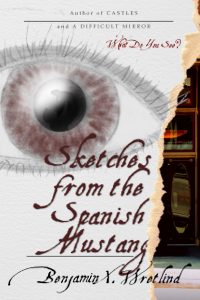
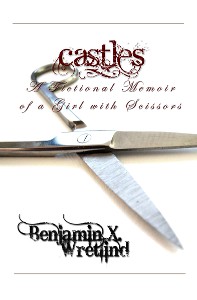
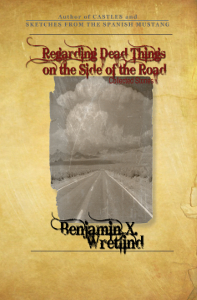
Ben Wretlind has broken new ground as an author with his novels Castles: A fictional Memoir of a Girl with Scissors and Sketches from the Spanish Mustang, and with his collection of short stories (which he wrote over several years), Regarding Dead Things on the Side of the Road.
All his writing displays a distinctive, poetic style of writing prose. I asked him about how he developed his style, and what it means.


How would you describe your own writing style?

I can't describe my own writing style any more than I can describe myself in the mirror. What I see is different from what the world sees. If there was a gun to my head, though, I might say "character-driven."

Your style has changed between what shows in the Regarding Dead Things collection and Castles: A Fictional Memoir of a Girl with Scissors. How much of that was intentional, and how much was a natural evolution? Are you happy with your style, or are there aspects of it you try to change during rewriting or editing?

We grow. Physically, of course, we grow from birth until death, but in terms of putting words on paper we grow by our experiences. If I showed you a story I'd written as an 8-year-old and one that I'd written as a 41-year old, you'd—naturally—see a shift in style. The stories written in Regarding Dead Things reflect my state of being during my twenties and thirties. Castles was written
over seven years, and in fact, I couldn't finish it until I had developed a style that was uniquely Maggie's (the main character). I had to grow to finish Maggie's story. There was nothing intentional about it.
But am I happy with it? To be happy with my style means I must have grown up, shed all of my skin, and completed my journey. I'm just not there.

What are the important elements of your style? What are you trying to achieve?

Brevity infused with vision. I want you to read what I see in my head.

Your two major works so far revolve around female characters: Maggie is the protagonist of Castles, and the stories in Sketches from the Spanish Mustang are linked by the Artist, also a woman. Why did you choose to base these stories on female characters? Did you find a special challenge in writing from a feminine point of view? Did that decision affect your writing style?

I've often said that the voice of Maggie in Castles is not my own. She "spoke" to me, and I wrote down what she said. That's my story, and I'm sticking to it. The Artist, however, was a deliberate attempt to write as a female character because I knew it would be a challenge. To "write what you know" isn't always the best option, in my opinion, because then you're never growing.

How can you expand your horizons if you're simply spouting off your own truths?

Find the truth in others, visual the quirks, feel someone else's pain for a moment and then open your eyes.

Are there any authors whose style you admire? Do you try to emulate them?

Ray Bradbury taught me more in the first chapter of The Martian Chronicles than any other writer before or since. "Rocket Summer." I haven't gotten it out of my head since I was a wee one stealing my brother's paperbacks.

Are there authors whose writing style you dislike? 

Not really. I won't say there are authors I can't read—there are many, actually—but to each his or her own. To dislike a writer's style because it is trite or flowery or morose or disjointed is akin, in my opinion, to disliking a person's face or ears or their hair cut. We all grow, and even the most accomplished writer who might be a household name grows as well. That doesn't mean I'll be able to read it, though.

How can readers identify your writing style? Are there particular words or kinds of words that you tend to favour? Sentence structures? Or is it more in the story, the pacing or the characters?

I would hope it's the characters that people relate to. If people remember me for writing character-based novels that speak directly to them (or through them), then I've achieved something.

Do you think your audience responds to your writing style, consciously or unconsciously?

Both. I want Maggie to stick with your unconscious until you're driven mad. I want the Artist to make you think consciously until you see with someone else's eyes. Audience response is really hard to gauge in 20-word reviews, but I see success and I see failure. You can't reach them all.
How important do you think writing style is to an author's commercial success?

Commercial success is a nasty thing. I've always believed, from my earliest years, that those authors who achieve commercial success are driven by outside forces to remain inside the lines. When you go outside the lines—when you grow as a writer—your success won't be possible unless the airport-novel-creating-machine wants you to be successful. Just look at a list of "Top 25 Beach Reads." Ugh. Don’t get me started. Is there a stupid virus out there?

Do you think your style will change in the future? Is there something different you would like to do in terms of style in a future book?

It'll change as we change. I can't say what the future holds in terms of style, however, but if you put that gun to my head again I would have to say I would like to write a multi-lingual novel and see just how well that's received.

Thanks, Ben!

Benjamin’s books include: Castles: A Fictional Memoir of a Girl with Scissors
Available on Amazon Sketches from the Spanish Mustang Available on Amazon
Regarding Dead Things on the Side of the Road: Collected Stories
Available on Amazon And his work in progress, Driving the Spike, is excerpted on the Guild ofDreams fantasy authors’ collective blog.  


Ben's blog is Drippings from the Mind of Me
Follow Ben on Twitter: @BXWretlind 
Tuesday, November 27, 2012

Independent book review: Sketches from the Spanish Mustang


By Benjamin X. Wretlind

5 stars


Benjamin X. Wretlind’s beautiful, haunting and, to a writer, mind-blowing Sketches from the Spanish Mustang is literature of the highest kind.

Sketches from the Spanish Mustang is a novel in disguise as a cycle of stories set in the town of Cripple Creek, Colorado, where the Spanish Mustang is one of a row of cheap casinos and bars on the main street. Each story in the cycle focuses on a character who is irrevocably damaged, close to shattering — and some do shatter in the telling of their tales. Linking them all together is The Artist, who sits across the street from the Spanish Mustang, drawing the people she sees in her sketchbook. When she fills the book, she hopes to achieve some kind of release or redemption, we learn.

Sketches from the Spanish Mustang crosses any number of literary boundaries. It meets the requirements for “contemporary urban fantasy,” as ghosts, demons and perhaps the spirit of Death, itself feature prominently. On the other hand, it also qualifies as mainstream literature, because these fantasy genre devices could be interpreted as manifestations of delusion.

No, wait. They can’t be. No, this is fantasy.

Unless ghosts and demons are objectively real ...

The plot

The first Sketch is The Five Fortunes of Fulano. Fulano is a migrant worker from Mexico who is brought into Colorado by human smugglers for some unspecified but clearly horrible employment. Misfortune strands him in the desert, where he meets a demon, or perhaps it’s the spirit of Death. He strikes a deal, and his sacrifice is enough to make you weep.

Nathan is a good, if boring man who discovers his wife is cheating on him. This story gets close to black humour, but it’s not for the squeamish.

The story of Mighty Chief Dan Chappose, I have to admit, made me cringe a little because the character is an alcoholic Native American. But Wretlind skirts the problem of stereotyping with a story so layered, sensitive and realistic that we see deeper than the stereotypes and ethnicity to a person haunted by history, family and ghosts of every definition.

It’s not all gloomy, though; Betty and Veronica are two habitual gamblers with their own spots at the slot machines, feeding in quarters or dollars or whatever you put into slot machines these days, arguing about their systems for eventually winning. Josh and Brandon are two teenagers scheming to get booze at the Mustang even though they’re underage:
“All he had to do was stroll in, sit down and spend a little of the allowance he'd been given last week. Nickel machines would be fine, Brandon had told him. The idea was to see if the waitress would give him a drink without asking for identification. They'd rehearsed what to say and how to say it, made sure their seventeen-year-old facial stubble was grown out enough and trimmed appropriately and reviewed the case files of the rumors at the high school—kids who'd pulled off the impossible, kids who managed to get free drinks without being accosted.”

Writing chops

While each Sketch is a separate story — Wretlind published a number of them separately as short stories — the author weaves them together skilfully. Each Sketch separated by a chapter about the Artist or the Town of Cripple Creek, which is a character in itself.

The different characters cross paths and interact; Carolyn is the waitress that Josh and Brandon ask for drinks; her boss is the man sleeping with Nathan’s wife, and so on. While the characters are leads in their own stories, they’re also supporting cast in each others’, even though they don’t know it.

Wretlind crosses that artificial border between fantasy and literature, between dream and reality. (Let’s face it: by definition, any fiction is a fantasy, anyway.) By weaving together the different stories of these solid, flawed, sympathetic and realistic characters, including the town of Cripple Creek itself, the author demonstrates not only the social ties that link all of humanity, but sketches a picture in itself of the invisible energy that links all of us.

And it’s that energy that ties all these disparate stories together and makes this book well worth reading.


A professional, artistic style

As a writer, Wretlind is a professional artist. His writing is lean, without any excess. Yet, he also manages to be descriptive, and I appreciate this kind of writing.

Only a handful of people walked up and down the sidewalks in front of the casinos. Most were inside, looking for that one chance at supposed financial freedom that had hitherto evaded them. An older couple—maybe in their mid-sixties—sat on a bench almost directly across from her. Their faces were locked in perpetual frowns; cigarettes dangled from shaky hands. The man wore a leather jacket, festooned with embroidered motorcycle festivals of the past: Sturgis, Daytona, Lone Star Bike Week. His white beard hung to his chest, contrasting the dark jacket and the even darker Greek fisherman’s hat which no doubt covered a receding hairline. He suddenly guffawed at something the woman said and patted her thigh. His smile quickly returned to a frown. With her skinny jeans and rhinestone-speckled denim jacket, the two would make a good subject to sketch . . . but not today.

At the same time, Wretlind avoids the mistakes many new writers make. There are no information dumps; he describes the characters, but we learn their back stories as we read the tale. We don’t have to read page after page about relationships or history or the structure of arcane brotherhoods. The personal is universal; the specific is general. We put together the big picture by focusing on details.

Just like in life!

You can find Sketches from the Spanish Mustang on Smashwords, Amazon, Barnes & Noble, iBooks, the Kobo bookstore, Diesel, the Sony Reader Store,  and other major retailers.
And also be sure to look up Ben Wretlind’s own blog, Drippings from the Mind of Me.


Tuesday, September 04, 2012

What do free giveaways on Amazon lead to? Lots of people getting your book for free.


Through the Labour Day long weekend, I used three of the five days out of ninety in which Amazon lets me set my book’s price to zero as a promotion. As best as I can figure it, over 1,400 people downloaded a full e-book copy of The Bones of the Earth gratis.

Of course, it’s done very little for my bank account.

Downloads versus rankings

As a member of Independent Authors International, a writers’ cooperative group, I participated in the group’s first Labor Day Free Reads event. Seven of us (see last week’s post) all set September 1 to 3 as “free days” on our Amazon Kindle Select accounts. We joined and/or notified I don’t know how many bloggers, portals, reviewers and Facebook groups to publicize it; we wrote and shared updates for our own Facebook pages and scheduled hundreds of tweets.

The giveaway began at midnight on September 1. While some participants thought progress was slow, for my own part, I was happy. I had over 300 downloads by Saturday evening, and when I got up the next morning, some 30 hours or so into the program, Amazon US was showing over 600 downloads. The UK site showed 39 downloads, plus one sale of The Bones of the Earth, Part One: Initiation Rites.

Some of the other participants noted that there were no downloads from the UK site after sometime on Saturday afternoon, September 1. It turned out there was some kind of glitch in Amazon.co.uk’s tallying system. I experienced it, too: while downloads from the US site climbed fairly steadily all weekend, the UK site was stuck at 39.

More exciting to watch were the rankings. By the end of Saturday, The Bones of the Earth had advanced to no. 1,300 or so in the Free lists, and by Sunday afternoon, September 2, it was number 2 in Historical Fantasy in Amazon.com’s US Free lists, and number 5 in Epic Fantasy; in the UK, despite only showing 39 downloads, it reached number 1 in Historical Fantasy!

After that, it started falling in the rankings, to number 3 and finally settling at number 5 in historical fantasy, and number 451 overall, by the end of the event, even though total downloads kept advancing.

Image: Creative Commons

Why did I give my book away for free after trying to sell it for so many months?

Good question. I’m glad I asked it.

Many other indie authors who have tried the Kindle Select giveaway program since it became available at the beginning of this year reported a sales spike immediately following the end of the giveaway period. For example, Russell Blake made his Geronimo Breach free for three days in January and saw about 12,000 downloads. “Then, when it went back to paid, a funny thing happened. After languishing for the first day, it shot like a rocket, finally hitting #165 in the paid Kindle store,” he reported in his blog.

Russell wasn’t the only one. I read similar stories from several other indie authors. But as time went on and more and more independent writers used the program, the results were less and less striking.

Still, I was hopeful. Writers I respected for both their writing and marketing ability kept using the program. In the summer, I participated as a supporter of the Book Pushalooza for Derek Blass, Elise Stokes, Robert Guthrie, Shannon Mayer and a few others. The planning and organization in that group effort was amazing.

Lessons learned

How did iAi Labor Day Free Reads go? For me, 1,400 downloads is great — it’s many times more copies than I have sold in the past 8 months, even if it was a small number compared to Russell Blake’s results.

Still, I have to keep that in perspective. Russell was already selling thousands of copies of his book before he had the giveaway.

Another lesson: maybe next time, I won’t do this over a long weekend. People, and readers are people, often go away from their computers during holidays.

Yet another lesson: I will participate for a longer period in the Facebook and other groups that I want to promote my book before asking them to do that.

And there are still more bloggers and reviewers to contact.

As far as sales go: strangely enough, I have sold 12 copies of The Bones of the Earth, Part 1: Initiation Rites at 99 cents through the weekend. I don’t understand this, because Part 1 is, as the title implies, the first part of the full novel. Part 1 came with parts 2 and 3 for free last weekend. I’m not complaining — four bucks is enough for two cups of good coffee. But it seems strange to me. I guess the fact that Part 1 is the first part of the full book is not that clear to some people. Anyway, I’m glad people bought the story, and I hope it makes them want to read the rest of it.

As for the hoped-for sales spike: I’m writing this during that first day after the end of the event, during which Russell Blake reported “languishing” sales. So I’ll watch my reports from Amazon. And I’ll let you know how it’s going.


Sunday, September 02, 2012

Progress report: Amazon promotional giveaway event

It’s one day into the first promotional giveaway of my book, The Bones of the Earth, and I’m thrilled with the results. The numbers may not seem huge to some people, but for me, they’re great.

As I mentioned in the post last week, I’m participating in Independent Authors International’s first multi-author, multi-book giveaway through Amazon. Throughout this Labour Day long weekend, seven of us have used our Amazon Kindle Select program free days to give away copies of our e-books.

In total, there have been over 700 downloads of my book in the first 34 hours of the multi-author giveaway event. As I’m writing this, The Bones of the Earth is ranked the number two historical fantasy in Amazon’s Free lists, and number 1 in Amazon UK’s lists!

Strangely, traffic on my blog is not much heavier than normal. Other participants and friends like Cinta Garcia (who guest posted here a few months back) have noticed heavier blog traffic.

So, great results? Compared to my book’s sales since the beginning of the year, this is great! Compared to the big sellers, fair to middling.

Reasons? Perhaps the last long weekend of the summer was not a great choice: there are a lot of other things for people to do, like go to the beach one last time, or get the kids ready for school. Or maybe there are a lot of other giveaways to compete with.

Those are the results so far. I promise to publish further updates for anyone who is thinking of trying this strategy.

Tuesday, July 31, 2012

The 777 challenge


Joe McCoubrey has nominated me for the 777 Challenge.
Joe is author of thrillers like the soon-to-be-released Someone Has to Pay and Absence of Rules. He’s a very active blogger and member of the Master Koda Facebook group. As he explained on his blog, he was tagged for the 777 Challenge last week.

The idea for the Challenge is to post seven sentences from page 7 or 77 of your work-in-progress, and nominate seven other authors you admire to pass the challenge on to.

Before getting to my seven sentences, one explanation: this excerpt probably won’t end up on page 7. I’ve written about three-quarters of the book, but because the plot isn’t linear, I haven’t finished with Chapter 1, yet.

So what we have here is what’s currently on page 7, but pages 1 and 2 represent fractions of chapters.

The WIP is tentatively titled Walking from the Soviet Union. It's the story of my father-in-law, who was drafted into the Red Army in 1941, between the Molotov-von Ribbentrop Pact’s dismemberment of Poland and the invasion of the USSR by Nazi Germany. The story combines my memories of Maurice and his stories of his wartime experience.

Page 7 deals with his induction into the Army, and one person in particular that he met in training camp:

“Good lord,” said Maurice, in Ukrainian.
“You—you look exactly like me!” said the other.

The two men stared at each other, then stood back to look each other up and down. Other cadets looked at them curiously, and soon started to laugh. “Hey, look at the twins!” said one.

“Who are you?” Maurice asked, almost afraid to hear the answer.

“Hrech Kowalchuk,” the other answered.
Okay, here’s a little more, just to tell you what was going on:

Maurice was relieved to hear that the man’s voice was distinct from his own. “From Kharkiv. Not too far from here. Who are you?”
“Maurice Bury. Ternopyl.” He looked for a long time at the other man, still barely able to believe his eyes. From the look on Kowalchuk’s face, he felt the same. 
Now, for the seven authors whose blogs I want to encourage you all to visit — and who I hope will carry the 777 Challenge further:

  1. Rob Guthrie
  2. Scott Morgan
  3. Gary Henry 
  4. Alan McDermott
  5. Will Granger
  6. Roger Eschbacher
  7. Benjamin X. Wretlind
 Readers, encourage them to pick up the challenge!

Friday, July 27, 2012

Who are iAi?


On Monday, I used this blog to announce the launch of a new group of independent authors from around the world, aptly called Independent Authors International, or iAi.

iAi is a cooperative publishing model. The idea is to bring together the skills and resources that a traditional publishing company offers to writers: appraisal of ideas, editing, proofreading, design, formatting for publication and promotion — while leaving control, and revenue, in the hands of the author.

All writers have several skills in addition to writing. Some I know are also skilled in graphic design; some have of necessity become skilled in efficiently formatting manuscripts for e-publication or printing. And some are good at promoting, marketing and selling books.

Books that are reviewed by iAi members, professionally edited (by a member or another professional), professionally designed and manufactured to a high standard, can bear the iAi colophon — a standard of quality.

Members of iAi share their skills, and at the same time, raise the quality, professionalism and credibility of its members work.

I’m proud to be associated with these skilled, talented and professional authors:

Haresh Daswani: Evolution of Insanity

Roger Eschbacher: Dragonfriend: Leonard the Great, Book 1

Will Granger: Anabar’s Run, Anabar Rises, and horror short stories

RS Guthrie: Black Beast, LOST and the newly released Dark Prairies

Gary Henry: American Goddesses, What Happened to Jory and Other Dark Departures, The Moon Poem and Other Strange Jingle Jangles

Alan McDermott: Gray Justice and Gray Resurrection

Zoe Saadia: At Road’s End, The Young Jaguar, The Jaguar Warrior, The Warrior’s Way
Elise Stokes: Cassidy Jones and the Secret Formula, Cassidy Jones and Vulcan’s Gift

Benjamin X. Wretlind: Castles: A Fictional Memoir of a Girl with Scissors, Sketches from the Spanish Mustang


Their names are all linked to their Author pages on the iAi website. If you’re looking for some good e-books to read, you’d have a hard time finding anything better!