Sunday, June 23, 2013

Montreal means funny

Guest post by Stephanie Noel

Let me be honest. I don't like winter; I don't care if the Montreal Canadians make it to the series or not and maple syrup, although delicious, is not something I pour on everything (I will, however, defend ours as the best in the world. Take that, Vermont!) Yes, I am French Canadian, why do you ask?

When Scott asked me to come up a guest post about the influence of Montreal in my writing, I was delighted. Then, after telling everyone that cares (or doesn't, really I didn't give them much of a choice) that I was going to write a guest post — moi! — I started thinking about how I was going to tackle this topic. It would have been easy to write about the first few things that come to mind when thinking about Quebec (aside from the three listed above and poutine): the English/French rivalry the province's desire for independence and the fact that our students demonstrate with little red square pinned to their clothes while banging on pots and pans.

Those topics I discarded as overdone. I kept on brainstorming.

I could also have talked about the realities of a Francophone writing in English in a province that will die defending La loi 101. This too, I felt had been explored numerous times. So I went deeper (insert Inception joke of your choice here). What is it that living in Montreal brings to my writing? What is so typical of Montreal that it permeates almost all spheres of our lives? When I found it, I realized that it had been staring me in the face all along.


What really influences my writing as a Montrealer is humour.
Humour is so natural to me that I take it for granted. I'm not saying that Montreal (or Quebec) has the monopoly on humour in Canada (I enjoy the acts of many English-Canadian stand-up comics, such as Russell Peters), but it is definitely an important part of our lives. We have the biggest humour festival in the world (Just for Laughs), a stand-up comedy university (our ratio of stand-up comedian per capita must be unusually high), and many girls will turn down a good-looking guy because he doesn't make her laugh. I know I have.
Montreal's Just for Laughs is the world's biggest comedy festival.
Photo: Wikimedia Commons

Being funny is what allowed me to survive high school relatively unscarred and has allowed me to make friends easily despite my shyness. I always felt that making people laugh was half the battle. Lastly, I'm convinced that our dads make the worst puns in all of Canada (my dad has shamed me more than once at the supermarket.)

I can't speak for everyone, obviously, but for me, it translates into a quirky writing style, infused with humour and wisecracking. There is of course a big difference between trying to be funny on purpose and just ending up being amusing. I am deadpan and quick with repartee, but I can't write comedy. I have never really tried, but I know it would just end up being boring because I can't be funny on demand. I need context, someone to give me something to work with. That's what happens when I write. I do a lot of automatic humour when working on the first draft and as a result, my characters do things that make me smile, even sometimes laugh. I don't try; it just happens.

Maybe this constant desire to be funny is a manifestation of the traditional Quebec underdog mentality. For a very long time, the province had an inferiority complex (and sometimes still does); while Anglophones were, historically, white collars with two kids, a dog and a white picket fence, Francophones plowed fields, manned assembly lines and reproduced as fast as bunnies. It's possible that humour was a way for French Canadians to defend themselves by mocking the powers that be. Moreover, as I mentioned earlier, people can't antagonize you if you make them laugh. As Jimmy Carr (famously controversial British stand-up comedian says, "I write these jokes so that you'll love me."
Yes, Stephanie Noel is a Montrealer — which is why she's always
fashionable, even to wash the champagne glasses.

To sum it all, I could say that although I write in English and hardly identify with most of the French-Canadian culture, I think that Montreal has contributed to make me a writer with a sense of humour. A twisted and very dark one, mind you, but a sense of humour nonetheless.

Allow me to babble a little more to thank Scott for this great opportunity to reflect on the influences Montreal has had and still has on me.

Thank you, Stephanie!

Stephanie Noel is an avid reader, inspired writer and seasoned traveller based in, of course, Montreal, Canada. She graduated from Université de Montréal with a degree in East Asian Studies and Anthropology. She recently came back to Canada after five years spent teaching Japan. She’s currently working on different fiction and non-fiction projects. You can follow her on her blog, A Truth Universally Acknowledged, on her Facebook page, and on Twitter @atuaStephanieN. Also, leave a comment, below!


Friday, June 21, 2013

Communicator's Toolbox review: Belkin's Ultimate Keyboard and Case for iPad

The Communicator's Toolbox


One of the original goals of this blog was to review technology developed for professional communicators. While I have reviewed digital cameras, laser and inkjet printers, software and even the iPad 2, it's been a long time since I've focused on the writer's tools.

I've been using the Belkin cover/keyboard combination for about a month, now, since the company sent me a demo at my request for a review model. Overall, I have to say I'm thrilled with it.

I got my iPad2 about two years ago, just before a trip to Austria and Switzerland. With it, I bought a Kensington KeyFolio case with an integrated Bluetooth keyboard for two reasons: first, I wanted a sturdy protective carrying case for the iPad; and second, I wanted a real keyboard, as opposed to a virtual one.

Compared to Kensington case

The Kensington KeyFolio fulfilled its purposes well. Its tough synthetic leather construction has protected the iPad well. However, Kensington made some compromises with the keyboard to get it to fit in a space the same width as the iPad itself. There is only one Shift key, for example, and the apostrophe/foot mark key is one row lower than on the standard QWERTY keyboard.

Those don't seem like huge issues, but it took me a while to get used to it. Only after I started using that keyboard did I realize that I use both Shift keys, depending on which letter I'm trying to capitalize. Also, getting a semi-colon every time I expected an apostrophe was annoying.

The other drawback to the KeyFolio was its size. The synthetic leather is pretty thick. I thought at first that would be a better protector for the fragile-looking iPad. But the KeyFolio makes the iPad a bulky device, hard to put into an already overstuffed briefcase.

It's also heavier. At 567 grams (1.25 pounds), the KeyFolio is almost as heavy as the iPad2's 601 grams (1.33 pounds). Suddenly, I was toting over a kilogram of tablet computer — heavier than a MacBook Air laptop computer.

The new protector

I heard about the Belkin Ultimate Keyboard Case for the iPad through a press release in my Mailbox (I get a LOT of press releases). When the item itself arrived, I was instantly delighted. Belkin designed the case to preserve the iPad's thin profile and form factor — two of its main selling points.
The base is made of aluminum alloy, and it's so thin, it's almost not there. Belkin says the keyboard is only 6.4 mm thick. The top is a textured rubber-like substance that provides adequate protection, at least in my experience so far. It has holes for the iPad's switches, camera, and earbud and power ports.

One of my greatest fears since getting
my iPad2.
Image source: laptoprepairleyland.co.uk 

Open it up and that same rubbery material is the hinge that attaches the two halves of the case: the rubber-backed shell that holds the iPad itself, and the aluminum-backed keyboard half. This is the only part that worries me — the rubber is very flexible and I always imagine it tearing.

But this flexibility is one of the great features of the case. On the keyboard side, above the keyboard itself, are three magnetic strips that hold the iPad up at your choice of three angles.
Belkin also uses the magnetism to power off and on the iPad when you close the case, just like with Apple's own tri-fold iPad cover.

A fully functional keyboard

The keyboard is smaller than the standard for a desktop computer, of course, to match the width of the iPad itself (or height, depending on how you hold it: 24.1 cm or 9.5 inches), but the layout is the QWERTY standard. It has two Shift keys, as well as Command, Option/Alt, and Fn keys. Overall, the typing experience on it is not much different from typing on a desktop computer's keyboard, except that the keys are a little closer together. The keys click satisfyingly when you depress them — unlike the standard Apple keyboard.

Drawbacks

The aluminum back is prone to scratching, like all aluminum. After a month, there are several noticeable scratches and scuff marks on mine, and I don't consider myself a rough user. The hardest surfaces my iPad has touched are desks and tables, and the inside of my briefcase or pannier saddlebags.
Getting my iPad into the case was tricky, and getting it out again almost as hard. However, I can't imagine when that would be necessary.

Bottom line

Belkin's Ultimate Keyboard Case for the iPad is a great accessory for the professional communicator who wants to use the iPad — or for anyone who uses the iPad, travels or commutes with it, prefers a physical keyboard and is as worried about dropping or damaging the iPad itself. It's very lightweight, almost unnoticeable in my hands. It doesn't interfere with the operation of the iPad at all. In fact, I typed this review on my Belkin Keyboard Case. Plus, it provides peace of mind about damaging the tablet.
While it is prone to scuffs, it has protected my iPad. For a hundred bucks, no iPad owner should be without one.

Find out more on Belkin's site: www.belkin.com/us/p/P-F5L149

Tuesday, June 18, 2013

Quit being a dumb app: Guest post by Lloyd Corder, PhD.


I've followed communications professional Lloyd Corder's email newsletter, C-Note$, for years. It's always full of clear, useful advice—the kind that makes you say, "Of course—why didn't I see that before?"   I asked Lloyd to weigh in on how today's communications technology, including social media, e-newsletters (like his), blogs and so on have changed the way he communicates. As usual, he came back with some useful, clear advice. And as usual, I reacted with "Of course. Why didin't I think of that before?"
 

How to keep your smart phone from screwing up your relationships

Lloyd Corder, Ph.D.
 
Recently, I got this note from an entrepreneurial client and friend of mine who started a metal powders company that makes high tech parts for spaceflight companies like Amazon founder Jeff Bezos’ Blue Origin:  
I have to tell you, that I think of you more than you realize I'm sure. Every time I'm going into a meeting with someone, I pull my phone out and turn it off or to vibrate. You did that one time we met and I never forgot how I felt "Wow, he's taking this very serious and only wants to concentrate on me while we're meeting." Very powerful stuff.
That made my day.

 
I’ve spent my professional career helping others become better communicators. It may be called marketing research, ad testing, strategic marketing planning, leadership communications or even university teaching, but it boils down to figuring out how you can be better today than you were yesterday. Slight, continuous improvements lead to big results over time.
 
In working with hundreds of clients over the last 25 years, I’ve come to believe that the most profound gift you can give someone is your time and complete attention.
 
Within in your grasp—every day and at multiple times—you have the power to show you truly care…you are a great listener…you can accept someone for who and where they are in their life…you can show and be loved…and—most importantly—you can make someone’s life better.
 
But giving your time and complete attention is darned near impossible if you’re spending all your time fiddling with your phone.
 
Don’t get me wrong. I love my smart phone. I can reply to clients faster. I can delegate projects instantaneously. I can update my social media status like no body’s business.
 
But smart phones have a dark side, too: 

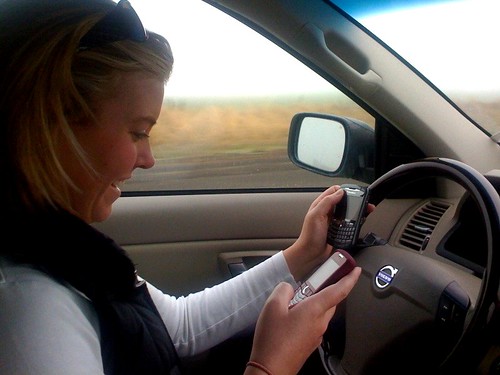
  • Smart phones are the single biggest distraction in our lives. For many of us, instead of us being “all in” when we’re meeting with someone we know is important—like our friends, family members, coworkers and others—we are only partly paying attention. We may be there physically, but mentally and emotionally we’re thinking about emails, texting someone miles away, surfing the Internet or wondering how many likes we’ll get from our latest post. Our smart phones make it seem like we are afflicted with some form of attention deficit disorder.
  • Smart phones mess up our eye contact. We trust people who look at us. It’s tough to read someone when they are constantly looking away or at their phone. It suggests they would rather be somewhere else or doing something different. Smart phones are seductive. They trick us into thinking that I’ll just look away for a moment, and then I’ll be able to refocus. Forget it. You’ll want to check your phone every few minutes. It will become such a force of habit that you won’t even realize you’re doing it.
  • Smart phones make us feel like we have more control, but we actually don’t. We have so many new communications tools available to us. But are we any better communicators? Are your relationships better now than they were five years ago? Does it really matter to you that you now know the minutia of other peoples’ lives through their barrage of posts? Wouldn’t you rather understand the big picture of the people you care about?
Well, what should you do about all of this? Especially if you’re younger and have spent your entire life online, taking a break from your phone may be an out-of-body experience for you.
 
From my vantage point, you have two basic options.
 
First, you can go on letting your smart phone be the boss of your life. Bring it everywhere you go. Never turn it off. Let it distract, seduce and control you to your heart’s content. If you chose this path, don’t worry. A lot of people are on it. You’ll blend in fine and most people won’t notice the difference anyway—since they will be on their smart phones doing the same thing.
 
Or, if you dare, you could decide that maybe part of the purpose of your life is to help make the world you’re living in a little better place, if just for one moment or one minute or one hour or one day.
 
You can do that by sharing your time and complete attention with the people you’re in front of. Forget about your smart phone for a minute. Silence it and put it away. Be totally in the moment.
 
If you’re in a business meeting, require that everyone put their “screens down” and give their attention to topic at hand…especially if you’ve spent a fortune getting them to the meeting.
 
What I’m suggesting may sound like it’s easy to do, but it’s easier not to do. You will struggle. Your smart phone will tempt you to pay more attention to it than who you’re meeting with. But don’t you do it!
 
Just try getting through one meeting without your phone. If you falter, forgive yourself and try again with your second meeting. Like any important change in your life, it will take two or three weeks of diligent effort, then it will start to seem totally natural to put away your phone and get focused on the conversation at hand.
 
You will also quickly find yourself in the top five percent, separated from your competitors and everyone else…and being noticed by important people and people who are important to you. You’ll seem like a natural winner.
 
And at that point, you may just find that your influence, impact and life are exponentially better than they were when you were playing with that dumb phone all the time! __________
 
Lloyd Corder, Ph.D. is founder and CEO of strategic marketing research firm CorCom, Inc. and teaches at the Tepper School of Business at Carnegie Mellon University. He is a frequent keynote, convention and motivational speaker, and he has appeared on business-oriented radio and television programs. Corder’s studies have been published in more than 500 magazines and newspapers. For additional information and resources, please visit www.corcom-inc.com or contact him at corder@corcom-inc.com.

Sunday, June 16, 2013

Father's day sample: Advice

For Father's Day, I present a fatherly excerpt from my latest book, One Shade of Red.

Picture: Wikipedia Commons
Sunday dinner with my parents followed a routine that varied only with the seasons. I’d usually show up after 6, when my Dad would have almost finished barbequing the steaks to black shoe-sole consistency. But since I had come early this time, I had to help out like I had when I was 14.


I entered the kitchen from the back yard at the same moment that Dad came in from the hallway. “Hey, big guy!” he boomed, as usual, while opening the fridge and taking out a big, flat dish. Four big, red steaks marinated in a thick, red sauce. “Came early to help out?”

“Helping” Dad meant starting the barbeque — no propane for him. He insisted on charcoal, and that meant starting an hour before you wanted to eat, pouring briquettes into the ball-shaped bottom of the barbeque, dousing it with some liquid that smelled suspiciously like gasoline and trying to touch a lit match to the fluid while standing as far back as you could. After that, “helping” would involve fetching barbeque utensils, barbeque sauce, another bottle of beer and anything else that came to his mind.

“Sure,” I said, reaching for the tray. That brought me close to him, and I realized for the first time that day how reluctant I was to stand next to him, now that I was taller than him. I had outgrown Dad in height a couple of years ago, but being able to look down on him did not make me feel any stronger than him, not with his wide shoulders and forearms like wrestling anacondas. But for how long had I been so loathe to stand close enough that my height superiority was obvious?

“It’s too soon to take the steaks out, son. You can start the briquets burning.”

My heart sank.

While we waited for the briquettes to turn gray, I sat on a patio chair and chatted with my Mom. I was guiltily aware that I didn’t do this much, and she loved it. “So, how’s the book?”


“Exciting. Lots of action, and I can really see eye-to-eye with the character. Sometimes, I’d like to do the things he does.”

“It doesn’t seem like your usual reading material.”

“I’ve read everything by Bulgakov and Nabokov and Gabriel Garcia Marquez. I thought I would try some of these new writers for a change.”

At supper, my little sister and I dutifully chewed through the steaks and kidded Dad about his complete lack of barbequing ability, as usual.

“What are you talking about? They’re perfect!” he argued, as usual.

At least I could wash it down with beer. Diana, my sister, wasn’t old enough, yet, but Dad let her drink some of Mom’s wine.

Supper over, Dad said he had to work on a contract and went upstairs to my old bedroom, which he had converted into an office. After Diana and I cleaned up the kitchen, I went up to my old room, too.

“Dad, I need some advice.”

I have never seen anyone simultaneously look so surprised, gratified and thoughtful. He put down his mechanical pencil and took off his bifocals. “About?” Without glasses, his hazel eyes squinted a little.

I sat down in the “guest” chair in his office — an antique foreman’s chair, made of solid oak or something. It weighed a ton and was as comfortable as sitting on stone. I had always wondered where he had found it. It was as far removed from his desk chair as a feather bed from a Catholic altar.

“You know I hired Tyler to help with cleaning pools. And I set him up with a bunch of clients.”

“I’ve never found it wise to hire your friends. It never works out,” Dad said.

“What? But you’re friends with John Andrienos, and he’s your foreman on half the jobs!”

“I hired him and then made friends with him,” Dad answered. “That’s okay. That works: you work alongside someone, come to respect them, become friends. It’s natural. But when you hire a friend to work for you, they seem to think your friendship is a free pass or something.”

“You’re right. Tyler isn’t working out.”

“What do you mean, specifically?”

“He’s always late. Half the time, he doesn’t show up at customers’ places. When he does, he never does a full job. The customers are getting pissed off.”

“Have you spoken to him about this?” Dad leaned back in his comfortable, ergonomic chair and swung his glasses between his fingers.

Dad loved being asked for advice.
Photo from Noel Kingsley's blog.

“Yah, I told him the issues. I even gave him a warning.”

Dad looked out the window, where the setting sun made the sky pink and orange. He pushed his thick grey hair back from his forehead before answering. “I’ve heard he’s had some employment problems, already.”

“He’s been fired three times already this year.”

“Hmm. Sounds like Tyler has a problem. Three employers already have had enough of him, and now, you.”

“Yah.”

“So, what do you want advice with?”

This was hard. Dad had this annoying habit of making you voice exactly what you mean. Using real words.

“What should I do?”

Dad looked at me with his unnerving look. “What do you want?” he asked finally.

“Huh?” God, you can be lame, said my brain.

“What do you want for your pool-cleaning business?”

“Geez, Dad, why do you always have to make these talks a lesson? I want it to succeed.”

“Good. And what does that mean?”

I knew this answer from years of business lessons from the city’s most philosophical contractor. “Profits.”

“Let’s cut to the chase, son,” Dad said. “You have a problem: your employee is causing customers to complain. What is the outcome you want from this?”

“I want my customers to like me again.”

“So, what do you need for that to happen?”

Dad: always making me confront reality. “I need ... to get rid of Tyler.”

“Not necessarily. Do you think that Tyler can change? Can he behave differently, so that he doesn’t make your customers leave?

“I don’t know. Anyway, I’ve decided I don’t need to worry about that anymore. I need someone to replace Tyler. I just can’t take back all his clients — there aren’t enough hours in the day.”

“So, you’ve decided to let Tyler go?”

I took a deep breath. This was still hard to say. “Yes. But who can I get to take his place?”

“You want a recommendation?”

I nodded. “You know a lot of people.”

Dad looked at the sunset again. “You know, the construction business has slowed down a lot, lately. I haven’t had enough work to give out to my usual crew.”

“I’m sorry.”

“It’s not your fault, son. You know, I’m glad you’ve found a new way to make money this summer. It’s taken a lot of pressure off my shoulders.”

“So, do you know anyone that could help me?”

He looked out the window again. “You know Philip Lamontaigne? Bob and Maureen’s son? He’s a bit older than you, but he’s a good worker. I have not had enough work this year to be able to hire him, and he’s been looking for work.”

I remembered Philip. One of those skinny guys with a skanky beard. He always had weed on him, always had a new girlfriend and a next girlfriend. “Phil is a good worker?”

“I had him on-call last summer. He never failed to show up on time, always did more than asked of him.”
Note to self, by S@Z, creative commons license


Wow. Phil Lamontaigne, professional dirtbag, was a good worker. “So, you think he’d be a good pool cleaner?”

“Can you show him the ropes?”

“No problem.”

Dad flipped through screens on his laptop and wrote a phone number on a post-it note. Dad has always loved post-it notes.


One Shade of Red is an erotic comedy e-book, available from Amazon, Smashwords, Barnes & Noble, Kobo, the iTunes bookstore and other e-retailers.

Thursday, June 13, 2013

Independent book review: Reckoning, by RS Guthrie

 With Reckoning, RS Guthrie takes the fiction writer’s rule book, shreds it in mighty fingers and reassembles it into a new way of engaging audiences.
Reckoning is the third of Guthrie’s books to feature Denver Detective Robert Macaulay, also known as Bobby Mac and also known as the heir to the occult power of Clan MacAulay.

Busting through the genre boundaries

Reckoning, like Black Beast and LOST, the previous Bobby Mac novels, is a noir cop thriller, a police procedural whose villain just happens to be (spoiler alert!) a demon.
Right there, he’s broken the artificial boundaries imposed on genres. Guthrie’s Bobby Mac novels read like gritty cop stories, yet somehow the supernatural elements fit perfectly.
Another rule that he breaks: modulating between the first and third person perspective. Most of the book is narrated by Bobby Mac, and Guthrie’s command of the tough, no-nonsense cop dialect (ever notice how cops all sound the same, no matter where they come from?) is flawless. But where the story needs a third-person omniscient POV, Guthrie smoothly shifts for exactly as long as he needs to.
He has created his own style here. It's as if Bobby Mac is sitting beside you on the porch, telling you what happened. No, actually, it's more like he's sitting across a campfire on a moonless night, telling you about what is deep in those shadows. At times, Guthrie gets a little too philosophical, waxing about the relationships between parents and children or mentors and protégés; occasionally, I started to lose patience. But for all that, Guthrie kept me flipping pages (or flicking my iPad screen, to be precise).

Plot

This trilogy is all about the battle between a demon, Samhain, who is opposed on earth primarily by the Clan MacAulay of Scotland. Today, that clan is represented by Detective Bobby Macaulay of the Denver police force, who has inherited the Clan’s ancient weapon against Hell, the Crucifix of Ardincaple.
Decades ago, Pink Floyd said "One day you find, 10 years have got behind you.” The story of Reckoning picks up where LOST left off, but 10 years later. Bobby Mac has remarried, had another family — triplet girls — and is starting to think about retiring from the police force. Evil returns in the form of a serial killer plaguing Denver. In a nod to noir thrillers of yore, the first case mimics the Black Dahlia.
Like any good police procedural, the story follows Bobby Mac tracking down clues and fighting against the awful realization that the enemy he knows best, and thought destroyed, has returned.

Best and worst

The best part of Guthrie’s stories are the relationships between the characters. They’re all combinations of positive and negative qualities, inconsistent and flawed. You never really know their motivations, because the characters themselves are never really sure just what combination of attitudes, fears, desires and blindnesses are driving them.
I have always enjoyed Guthrie’s descriptions of Bobby Mac and his son trying to communicate through all the layers of love and mistrust and history and baggage. However, as mentioned, this time it seemed to get a little long. The narrative seemed to keep veering off onto tangents.
Also, I felt that with this installment of the story, you really had to have read the first two books to understand what was going on.
For example, as the book approaches the final confrontation between good and evil, Bobby Mac explains "the whole story" to his partner, but not explicitly in the story. The book reads more like "I told him the whole story,” rather than recapping it, or describing some action that would encapsulate the conflict. While this technique is a good way to abbreviate another info-dump and avoid rehashing stuff that loyal readers already know, it also risks alienating those who have not read the previous installments. (Maybe it's a clever way of boosting sales of the other books.)
Overall, Reckoning, the finale of the Bobby Mac trilogy (although Guthrie keeps saying he'll have other stories about Bobby Mac) is an enjoyable, satisfying completion to the trilogy. It wraps it all up in Guthrie's lean, aggressive writing style without missing a beat or leaving a loose end untied.
And it's engaging, one of those stories you can't put down.
If you want a good read that breaks all those worn out conventions of genre boundaries and unnecessary rules, read Reckoning. But you should probably read LOST first, and probably Black Beast before that.
To get the books, the best place to start is Guthrie's website or his blog. Or visit his Amazon author's page.
You can also get a signed copy of Reckoning directly from Rob.

Monday, June 10, 2013

Brevity infused with vision: Independent author Benjamin Wretlind on writing style

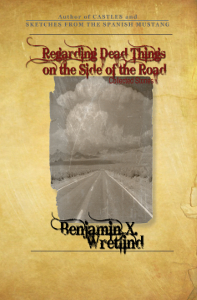
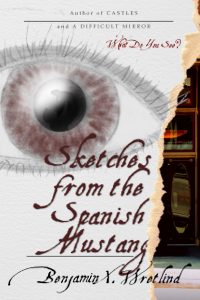
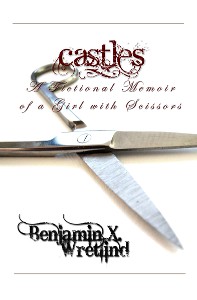
Ben Wretlind has broken new ground as an author with his novels Castles: A fictional Memoir of a Girl with Scissors and Sketches from the Spanish Mustang, and with his collection of short stories (which he wrote over several years), Regarding Dead Things on the Side of the Road.
All his writing displays a distinctive, poetic style of writing prose. I asked him about how he developed his style, and what it means.


How would you describe your own writing style?

I can't describe my own writing style any more than I can describe myself in the mirror. What I see is different from what the world sees. If there was a gun to my head, though, I might say "character-driven."

Your style has changed between what shows in the Regarding Dead Things collection and Castles: A Fictional Memoir of a Girl with Scissors. How much of that was intentional, and how much was a natural evolution? Are you happy with your style, or are there aspects of it you try to change during rewriting or editing?

We grow. Physically, of course, we grow from birth until death, but in terms of putting words on paper we grow by our experiences. If I showed you a story I'd written as an 8-year-old and one that I'd written as a 41-year old, you'd—naturally—see a shift in style. The stories written in Regarding Dead Things reflect my state of being during my twenties and thirties. Castles was written
over seven years, and in fact, I couldn't finish it until I had developed a style that was uniquely Maggie's (the main character). I had to grow to finish Maggie's story. There was nothing intentional about it.
But am I happy with it? To be happy with my style means I must have grown up, shed all of my skin, and completed my journey. I'm just not there.

What are the important elements of your style? What are you trying to achieve?

Brevity infused with vision. I want you to read what I see in my head.

Your two major works so far revolve around female characters: Maggie is the protagonist of Castles, and the stories in Sketches from the Spanish Mustang are linked by the Artist, also a woman. Why did you choose to base these stories on female characters? Did you find a special challenge in writing from a feminine point of view? Did that decision affect your writing style?

I've often said that the voice of Maggie in Castles is not my own. She "spoke" to me, and I wrote down what she said. That's my story, and I'm sticking to it. The Artist, however, was a deliberate attempt to write as a female character because I knew it would be a challenge. To "write what you know" isn't always the best option, in my opinion, because then you're never growing.

How can you expand your horizons if you're simply spouting off your own truths?

Find the truth in others, visual the quirks, feel someone else's pain for a moment and then open your eyes.

Are there any authors whose style you admire? Do you try to emulate them?

Ray Bradbury taught me more in the first chapter of The Martian Chronicles than any other writer before or since. "Rocket Summer." I haven't gotten it out of my head since I was a wee one stealing my brother's paperbacks.

Are there authors whose writing style you dislike? 

Not really. I won't say there are authors I can't read—there are many, actually—but to each his or her own. To dislike a writer's style because it is trite or flowery or morose or disjointed is akin, in my opinion, to disliking a person's face or ears or their hair cut. We all grow, and even the most accomplished writer who might be a household name grows as well. That doesn't mean I'll be able to read it, though.

How can readers identify your writing style? Are there particular words or kinds of words that you tend to favour? Sentence structures? Or is it more in the story, the pacing or the characters?

I would hope it's the characters that people relate to. If people remember me for writing character-based novels that speak directly to them (or through them), then I've achieved something.

Do you think your audience responds to your writing style, consciously or unconsciously?

Both. I want Maggie to stick with your unconscious until you're driven mad. I want the Artist to make you think consciously until you see with someone else's eyes. Audience response is really hard to gauge in 20-word reviews, but I see success and I see failure. You can't reach them all.

How important do you think writing style is to an author's commercial success?

Commercial success is a nasty thing. I've always believed, from my earliest years, that those authors who achieve commercial success are driven by outside forces to remain inside the lines. When you go outside the lines—when you grow as a writer—your success won't be possible unless the airport-novel-creating-machine wants you to be successful. Just look at a list of "Top 25 Beach Reads." Ugh. Don’t get me started. Is there a stupid virus out there?

Do you think your style will change in the future? Is there something different you would like to do in terms of style in a future book?

It'll change as we change. I can't say what the future holds in terms of style, however, but if you put that gun to my head again I would have to say I would like to write a multi-lingual novel and see just how well that's received.

Thanks, Ben!

Benjamin’s books include: Castles: A Fictional Memoir of a Girl with Scissors
Available on Amazon Sketches from the Spanish Mustang Available on Amazon
Regarding Dead Things on the Side of the Road: Collected Stories
Available on Amazon And his work in progress, Driving the Spike, is excerpted on the Guild ofDreams fantasy authors’ collective blog.  


Ben's blog is Drippings from the Mind of Me
Follow Ben on Twitter: @BXWretlind 

Friday, June 07, 2013

Cover reveal: Rule of Fire by Autumn Birt

Rule of Fire launches on the solstice: June 21, and you can see the fantastic cover here, right now!


 Six friends stand alone against the combined Orders of Fire, Water, Air, and Earth, protecting a girl whose forbidden abilities have condemn her to death. Now they are joined by a man who was once the Curse, the Church's most powerful weapon and Ria's greatest threat. Left with no name and no memory, the decision to aid this stranger will cost friendships and more as the group of friends journey north to seek a tribe of people lost to time amid an ancient war. The path home is riddled with dangers as the Church of Four Orders still seeks Ria and the former Water Priestess Nirine. For one High Priest, the desire for vengeance is personal.

Ria must unravel the mysteries of her power to find acceptance in a world where her abilities are considered a taint. Is the strange gift of magic an aberration that should be destroyed or something far more, related to the skills held by the Elementals who rule Myrrah?

The sequel to Born of Water, Rule of Fire is book 2 in the epic fantasy trilogy, the Rise of the Fifth Order. Return to the world of Myrrah ruled by the Church of Four Orders. Release is scheduled for June 21st!

Learn more about the world of Myrrah and book 1, Born of Water, on Autumn’s blog, Weifarer’s Wandering

About the author

Autumn Birt is an indie author with two other books currently available: the adventure fantasy novel Born of Water and Born of Water’s Novel Companion. The sequel is scheduled for release in June of 2013. She has plans for many more novels. Check out Weifarer’s Wandering and her Facebook page for updates.
She is also a travel and fiction writer currently based in Maine, where she lives in a yurt with her husband and lovable Cairn Terriers. Her work is featured on the adventure travel website, No Map Nomads, where she is the co-editor and writer (and also known as Weifarer). On her writing blog,  Weifarer’s Wandering, she opines about the fun and trials of being a writer as well as upcoming releases.

Autumn is also a member of Guild of Dreams, which features her blog posts as well as those of eleven other fantasy writers.

With a Bachelor of Arts degree from Bucknell University in Studio Arts and English, Autumn once considered a career in illustration. After a few years of selling paintings while working as the manager of a gallery and custom framing store, a party and fine gifts store in Virginia, working retail at a gourmet kitchen store, being the head embroiderer at a college clothing store, and finally waitressing for a year, she decided to head back to University. After two years of intense science courses, this career path change led to a Master of Science degree in Ecology and Environmental Sciences from the University of Maine in Orono. Since graduating with her M.S., Autumn has worked for the USDA Natural Resources Conservation Service.

A wanderer at heart, Autumn’s desire to travel has led her to France while still in high school, a year abroad in Manchester, UK which led to excursions in Wales, Scotland, Ireland and around many parts of England, and more recent trips with family to Mexico (both the Pacific and Gulf of Mexico sides), US Virgin Islands, British Virgin Islands, Bahamas, Spain, Gibraltar, Morocco, Costa Rica, Saba, Barbados, St. Lucia, St. Maarten, and four Canadian provinces. She has plans for many further adventures both real and fictional.

Connect with Autumn online:

Wednesday, June 05, 2013

Now out: the third Cassidy Jones Adventure


One of my favourite middle-grade adventure superheroes is Cassidy Jones. The brainchild of independent author Elise Stokes, Cassidy Jones became a hit about a year and half ago, when a middle school in the US took Stokes’ debut novel, Cassidy Jones and the Secret Formula, as a school project. And now, you can enter a Rafflecopter contest to win all three e-books: Win ALL THREE Cassidy Jones books! Just enter this Rafflecopter: Rafflecopter giveaway.

I know I’m not the intended audience for Cassidy Jones, but I was impressed by the sheer quality of the writing. Stokes is a writer who clearly loves the language and has the skill to use it to create interesting, believable characters in compelling situations. She knows plot and pacing and how to describe action and setting, and when to leave the description to the readers’ imagination.

The follow-up novel, Cassidy Jones and Vulcan’s Gift, took the story to greater strengths, developing the secondary characters more along with Cassidy herself, and filling in some enticing details about Cassidy’s mysterious neighbour—and catalyst in turning Cassidy into a superhero.

Now, the third book in the series is out: Cassidy Jones and the Seventh Attendant. What’s it about?


Some Secrets Are Better Left Buried…

When the mysterious Gavin Phillips returns to Seattle after a prolonged and unexplained absence, he threatens to expose fifteen-year-old Cassidy Jones’s incredible secret: she is a superhero. But his presence is far more sinister than she realizes, for it soon becomes apparent that his hidden agenda holds a dark and dangerous intent that will unleash an unparalleled evil upon an unsuspecting world. Can Cassidy stop him before all is lost?
For your entertainment, here’s a sample:

A police car screamed past me as I veered off Fifth Avenue and into an alley. Sirens came from every direction on their way to the museum. I ran until I was sure no one was pursuing me and slid into the shadows of a doorway to assess the damage. A small cry of panic tore from my throat when I saw the ravaged costume, spotted with blood. I had been shot so many times, it was a miracle I hadn’t been cut in half.

“No, no, no, no,” I chanted, worming a trembling finger into a bullet hole. Due to the hardness of my skin, I couldn’t feel anything through my numbed fingertips, so I ripped away the costume and lifted the black tank underneath, exposing my stomach, which was peppered with bullets. They reminded me of corks lodged in wine bottles. Small amounts of blood burbled up around the bullets, as if they plugged a dam.

Tears of relief smarted my eyes. This was one of those rare occasions when I was grateful to be a mutant.


“It’s going to be okay. These can be removed. I’ll heal.” I dried my eyes with my forearm and suddenly realized I couldn’t hear Emery in the earpiece, nor the background noise of the coffeehouse. We had somehow lost our phone connection. I retrieved my phone and punched the speed dial.

“Are you all right?” Emery answered. The sounds of sirens,the museum’s alarm, talking, shouting, and a police officer on a megaphone flowed through the receiver along with his voice. “Cassidy,” he said again when I didn’t answer.


“I don’t know what to do.” I wiped back a sudden flood of tears with the tattered sleeve of my mummy costume. “My head’s scrambled. I can’t think straight.”


“Do you know where you are?”

“Yeah.” I glanced around. “No. I’m not sure. It’s weird that I can’t feel any pain. I should feel pain.”

“Cassidy, listen carefully,” Emery said slowly and calmly,which meant he wasn’t calm at all. “You’re only four blocks from Riley’s office—”

“How do you know—” I began to ask, then remembered GPS. I struck my forehead with my palm in an attempt to clear the haze.

“You’ll be fine,” Emery soothed. “I’ll take care of you. Please concentrate.”

He explained how to get to the back of Riley’s building through alleys, avoiding the main streets. I would have known this if I could think properly.


“There are a lot of people on the streets now, so take care not to be seen. I’m only two blocks away from Riley’s office. I’ll let you in through the emergency exit in back. Everything will be fine, Cassidy. This is almost over. Repeat back to me everything I just told you.”

I tried but couldn’t. The bullets felt heavy in my stomach. A horrifying thought struck me: What if my skin suddenly softens and the bullets get swallowed up in my flesh?

“Hurry, Emery.” I disconnected the call and shot toward the street. We need to get these bullets out of me!


At the street, I looked around, recognizing where I was—or believing I did. Spying an alley, I ran across the street toward it, leaping over a parked car. I saw two men and a woman in the alley ahead. One man held a switchblade to the other man’s throat while the woman riffled through his pockets. I moved so fast, none of them saw me until the mugger with the switchblade was yanked off his feet by the back of his jacket collar.


“Help!” he screamed as I dragged him behind me, arms flailing, boot heels bumping along the asphalt.


I emerged from the alley into a street bustling with activity and flung the mugger toward an oncoming police car. Lights flashing,siren blaring, the police car screeched to a halt and the mugger hit the hood,tumbling over it with the switchblade still gripped in his hand.


I jammed the cell phone between my teeth and took a flying leap at the nearest building, catching a windowsill on the second floor. I scaled the protruding bricks as swiftly as a spider scurrying up a wall and heaved myself over the ledge and onto the roof. Pausing to catch my breath, I spat the phone into my hand and looked down. A small crowd had gathered below to gape at me.


The dazed mugger, sprawled atop the police car, dropped his switchblade, which clattered across the hood and onto the asphalt. The officer in the passenger’s seat stared up at me with a radio microphone to his mouth,but his lips weren’t moving, as if he were at a loss about how to call in what he had just witnessed.

Get Cassidy Jones and the Seventh Attendant at:

Amazon USA

BONUS:


Sunday, June 02, 2013

Sample Sunday: The heat is on

The heat is on. Summer is here in Ottawa. Even though I'm spending a lot of this weekend in cold water, the air is heavy and thick with moisture.
This week's sample is from my erotic romantic comedy, One Shade of Red. Most of you already know that it's a spoof of the biggest bestseller, 50 Shades ... you know the one I mean.

In this excerpt, the hero, Damian, is working outdoors during the hottest summer in Toronto's history. And this is before the mayoral-crack scandal.


Seeing a man working in the hot sun does something to some women ... at least, we men in the hot sun hope so.


By the end of the third week, I had Mrs. Casales’ pool and deck looking much better. In fact, they looked great.

For no reason I could define, I had gone well beyond pool cleaning. I had cleaned the inside of the pool and scraped out all the slime and goop, vacuumed the accumulated dust out of the bottom and cleared the skimmers until they looked new.

Every time I had come, I had scrubbed the concrete pool deck. I even went to far as to bring clippers from my parents’ tool shed and hack back the overgrown hedges so that they would not drop so many leaves into the pool. I told myself that I was only making my work easier for myself in the long run, but my brain did not believe me.

Mrs. Casales obliged me by exclaiming how much better her whole back yard looked every time I finished. Occasionally, her two little kids, a boy and girl, both under 10 years old, would scamper in and wait impatiently when I told them they had to wait after I poured in the chlorine. “The water’s not good for swimming yet,” I said every time. “You’ll have to wait at least an hour.” They would stand at the side of the pool, bouncing on the balls of their feet, until one would think of something else to do and they’d chase each other across the yard or into the house.

Mrs. Casales always came out with iced tea or lemonade when I was done, and we’d sit at her patio set and chat about the pool-cleaning business, or the upcoming university year, or sometimes about her kids.

She seemed cheerful enough when we talked, but she never mentioned a husband. I remembered what Alexis had said about her marriage breaking up, but I did not know how to ask her about that without risking spoiling her mood.

At the end of the third week, the sixth time I had cleaned the pool, deck and the back yard in general, I took a deep breath and surveyed my handiwork. Part of my brain demanded to know why I had gone so far beyond pool cleaning, and another part of my brain refused to admit why.

Mrs. Casales came out of the kitchen with two bottles of Heineken. No children were in sight. “The water is perfectly balanced today, Mrs. Casales, so the kids can come swimming right away,” I said as I took a bottle from her hand.

“The kids are at their cousin’s this afternoon. We’re alone today,” she said and took a sip of her beer. “And call me Leda.”

On that hot afternoon, cold beer went down like salvation. I could feel heat radiating off my skin. I pressed the cold bottle against my hot forehead, relishing the ache it caused.

We sat at her squeaky, unsteady patio table. I stretched my legs in front of me. Mrs. Casales’ — Leda’s — pool was the last on my itinerary, and the day seemed to be going in an excellent direction.

I looked at her; she was wearing a thin cover-up over a two-piece bathing suit. I watched her neck pulse as she drank more beer. She had tied her crazy hair with one of those scrunchie things that girls like. “Thanks for the beer.”

She wasn’t bad looking, I thought. A little overweight, but that gave her nice curves. She was no Alexis, but to borrow Patrick’s tired joke, I wouldn’t kick her out of bed for eating cookies.

“Thank you, Damian, for doing such a great job. I appreciate how you’ve gone well beyond the pool cleaner’s job description. I did notice the way you trimmed the bushes and neatened up the whole yard.” She patted my knee and moved a little closer toward me.

“It was just to keep so many leaves and branches from falling into the pool,” I said. “So it made my own job a little easier.”

“Nonsense. You were trying to make me happier. And I truly appreciate that, Damian. Really, I do. And I should pay you back. One good turn deserves another.”

“No, no, the payment is what it is. We agreed. A deal is a deal.”

“Then, I should pay you back in some other way.” She looked right into my eyes.

My mouth felt dry, and pouring more beer into it did not help.

“Do you always work with your shirt off?” she said, and I suddenly felt conscious of my bare chest.

“Just when it’s this hot...”

I could not finish answering her because her mouth pressed against mine.   One Shade of Red is an erotic comedy e-book, available from Amazon, Smashwords, Barnes & Noble, Kobo, the iTunes bookstore and other e-retailers.