Showing posts with label non-fiction. Show all posts

Monday, March 03, 2014

What do great writers like to read? Gary Henry and Mohana Rajakumar

Image courtesy Mary Okeke Reviews
This week, two very different authors answer my unscientific survey of best sellers.

Gary Henry is author of the urban fantasy novel American Goddesses and a collection of short stories, What Happened to Jory and Other Dark Departures.

Mohanalakshmi Rajakumar is author of a number of literary novels that explore such as Love Comes Later (excerpted two weeks ago in Written Words), An Unlikely Goddess, The Dohmestics and Qatari Voices, among other works of fiction and non-fiction. Over to you!

Name three characteristics of books that you like. What makes you keep reading a book? What are some books that you weren't able to put down until you finished them?

Gary Henry: I like simplicity. It should be easy to follow the narrative and stay on top of what's  happening. That doesn't exclude plot twists and turns. But I don't like having to backtrack to figure out what's going on.

I like character description so that I can get an idea of what the characters look like, in addition to what they say and do. I call that — what characters say, do and look like — the character triangle.

I like books written in active voice and with vivid verbs.

Mohana Rajakumar: I love books that give readers insight into culture they wouldn't otherwise have; features strong women behaving in empowering ways; are a mixture of history and imagination.

Responding to the voice of the author (if non-fiction) or the characters who the story is about; of course not knowing what will happen next is always a plus.

Right now The Language of Baklava by Diana Abu-Jaber is my current favorite read. She remembers everything and there are recipes included!

Do you consciously try to emulate these books? If so, what form does that take: plot, structure, characters, settings, author's voice and word choice?

Mohana Rajakumar: I am thinking about how to revise my own memoir to be more compelling! Readers have loved it but some have found the essays disjointed. Diana's takes a chronological approach so I'd have to go back and create a lot of content if I hoped to adopt her style completely.

Gary Henry: I do. It's these kinds of books that inspired me as a kid to want to write books like them. Specifically, books by Robert E. Howard (Conan), George MacDonald Fraser (Flashman) and Len Deighton (too many to name). Biggest influence on me has been their handling of characters and word choice — active voice and vivid verbs.

Do you try to avoid any of the techniques or conventions followed by your favourite writers?

Gary Henry: No. I just try to avoid overtly copying. I have turned to favourite writers during my own writing at times to see how they, Fraser for instance, might have described a woman's face, and try to follow his technique, but draw the line at lifting copy.

Mohana Rajakumar: Not yet but that doesn't mean it couldn't happen in the future.


What rules of writing do you intentionally break?


Mohana Rajakumar: Staying in one point of view the entire story; sometimes if you have an interesting cast of characters, it's better to hop around and give readers a 360 experience.

Gary Henry: I've broken the rule about introducing important characters late, but that's not something I'll make into a habit. Rules are good, especially when we're getting started as writers. Always remember, though, it's your story, and if you don't please yourself with it, it'll be hard to please anyone else. Take that rule with a generous bit of salt, too.

Gary Henry is a writer, runner and dog dad, who lives in Lawrence, Kansas with wife Karen and canine kids Lambchop and Sophie Jones. He is managing editor at Durability + Design Magazine, a glossy print monthly covering architectural design, technology and construction. He is the author of AMERICAN GODDESSES, a sexy super-powered paranormal fantasy thriller for e-book readers, available on at Amazon.com  

Visit his blogs, Honest Indie Book Reviews, and his new Indie Universe. Follow him on Twitter @LiteraryGary. And visit his Author page on Independent Authors International.

Mohanalakshmi Rajakumar is a South Asian American who has lived in Qatar since 2005. She has since published seven e-books including a mom-ior for first time mothers, Mommy But Still Me, a guide for aspiring writers, So You Want to Sell a Million Copies, a short story collection, Coloured and Other Stories, and a novel about women’s friendships, Saving Peace

From Dunes to Dior, named as a Best Indie book in 2013, is a collection of essays related to her experiences as a female South Asian American living in the Arabian Gulf. Love Comes Later, a literary romance set in Qatar and London, won the Best Indie Book Award for Romance in 2013. The Dohmestics is an inside look into compound life, the day to day dynamics between housemaids and their employers.

Visit Mohana’s website  or follow her latest on Twitter @moha_doha, on Facebook, Youtube or Pinterest.

You can visit Mohana’s Author Page on Amazon. Also, visit her Author page on Best Selling Reads.


Wednesday, September 11, 2013

Conveying emotion while avoiding cliché: Rachel Thompson on style


This edition of Written Words turns to Rachel Thompson, author of A Walk in the Snark, The Mancode: Exposed and most recently, Broken Pieces. She has graciously agreed to answer my pesky questions about writing style.

How would you describe your own writing style?

I've always been fascinated by writers who can express themselves with the least amount of words, yet still lyrically. That's why I'm such a fan of Hemingway. I tend to write in shorter sentences, with as few words as possible. 

You made a major shift between your first two books, The Mancode Exposed and A Walk in the Snark, and your third, Broken Pieces, in terms of subject matter and tone. Do you also think you wrote differently? Do you think your use of language changed?

The topics of male/female relationships are still there, and I'm still nonfiction, but yes, the tone is radically different. After writing the first two humor books, I found myself returning again and again to the childhood sexual abuse I experienced as a child and had never spoken or written about. It just seemed like it was time.

Are there any authors whose style you admire? Do you try to emulate them?

I hated Hemingway when I was younger, but very much appreciate his style now. I admire Hanuki Murakami immensely. John Irving and Pat Conroy also, for their ability to tell wonderful stories with rich characters. I'm enjoying more poetry now, especially by Dylan Thomas and Pablo Neruda. I enjoy David Sedaris very much. I'm also a huge advocate for women, and read as many female writers as I can. Those who influence me are Virginia Wolff, Lorrie Moore, Anne Rice's earlier works and Margaret Atwood — love her work. And indie authors like Christine Nolfi, Steena Holmes, and Terri Guiliano Long are extremely talented. 

Are there authors whose writing style you dislike?

It's interesting — I've attempted to read House of Leaves (by Mark Z. Danielewski) several times and just can't get through it. I'm very process-oriented and linear. That book is crazy. It's on my To Do list, though. :) 

How important is your writing style to you? Are you happy with your style, or are there aspects of it you try to change during rewriting or editing?

I do like my style. I find I work best with a loose structural outline (for example, “trust” or “love” as topics) and then I just let my mind go. It seems to work well with poetic structure in particular. I'm playing with sonnets right now. I tend to write in past tense more than I'd like. 

How can readers identify your writing style? Are there particular words or kinds of words that you tend to favour? Sentence structures? Or is it more in the story, the pacing or the characters?

As a nonfiction writer, I'm fascinated endlessly by the psychology of relationships, so I tend to use words that convey emotion, while avoiding clichés (e.g. heart, soul), which can be difficult! Avoiding cliché is a huge deal for me. With regard to pacing, in this past book I was struggling with the structure and how it lent itself to pacing. My brilliant editor, Jessica Swift, suggested I don't get mired in the structure while I was writing — rather, allow the pieces to go where they led me. This ended up working quite well and it's how we ended up structuring the book.

Meaning, it's not: essay, poem, prose; essay, poem, prose. It's whatever felt right for each section.

Do you think your audience responds to your writing style, consciously or unconsciously?

I do. We're taught to be chronological thinkers, but emotions don't conveniently fit into that neat little timeline. So with this book, I present it in pieces (as the title implies) so the reader will feel the same discomfort I did as I lived them. Even a 1-star review that complains about disliking the “disjointedness” of the book's structure is a win for me since that’s exactly what I wanted.

How important do you think writing style is to an author's commercial success?

I wish I had an easy answer. I had no idea people would respond to this book the way they have. Sometimes I read a NYTimes bestseller and think, “really?” So I suppose my answer is that yes, style does contribute, but we as authors also have to connect with readers at an emotional level for the work to resonate.


Where do you see yourself going creatively next? Tell us about your work in progress. What can your readers expect from RachelintheOC?

My social media book for authors (Let's Deconstruct! is the tentative title) is with my editor. We should be done with that process by October and I hope to release in November. I've started writing the next in the Broken series, titled Broken Places. I was hoping to release by December but we shall see — I'm thinking more spring of next year at this point. I don't want to rush it. And I recently signed with Booktrope to create the print version of Broken Pieces. That should be out in October or November also. 

Thanks, Rachel in the oh-see!

Thank you!

Rachel Thompson (aka RachelintheOC) is a bestselling author and social media/author marketing consultant. She is a founding member of the BestSelling Reads association of writers of new fiction.
Her three books, A Walk In The Snark, The Mancode: Exposed and Broken Pieces are all #1 Kindle bestsellers and garner five-star reviews from fans and professional reviewers alike.
When not writing, she helps authors and other professionals with branding and social media through her company, BadRedhead Media. Her articles appear regularly in the San Francisco Book Review (BadRedhead Says…), 12Most.com, bitrebels.com, and BookPromotion.com.
While she did live in “the OC” — Orange County, California, Rachel and family moved to Northern California in 2012 to be closer to family and friends — but really, because her family was tired of her burnt food and Rachel’s mom is a great cook.
She hates walks in the rain, running out of coffee, and coconut.

Find Rachel Thompson online: 

Email RachelintheOC(at)gmail.com
Website: rachelintheoc.com
Consulting company: BadRedhead Media 


Facebook 

Twitter 
Rachel: @RachelintheOC
Business: @BadRedheadMedia

LinkedIn

Goodreads  


Thursday, August 29, 2013

How to write a report I will read

My last post focused on fiction: how to write a novel I would enjoy reading.
There are far more people in the world who have to write other kinds of documents: letters, proposals, memos, instructions, report — which may or may not be fictitious.

These writers also need some guidance, at least to judge from many of the reports I have to read. So here are a few tips on how to write a report that I will be able to read.

1.   Start at the end

Get to the point immediately. No one reads reports for pleasure. They want to know “what’s in this for me?”

Start with your more important point: what does this report mean? In other words, the conclusion. State that up front. In fact, write it down first.
Think of writing your report as taking a road trip. What’s the first thing you do? You enter the destination into MapQuest (or Google Maps, or whatever). You find out exactly where it is and you get directions from where you are now.

Your conclusion, which should be the thesis statement of your report, is your destination. Now, you need to work out how to get there.

2.   Get a GRIP

Regular readers will know my copyrighted formula to writing: Goal, Idea, Reader and Plan

Goal — Your purpose. Why are you going to your destination? What will you do when you get there? In terms of writing, what result do you want from this report? It could be to change a policy in the workplace, or it could be to inform colleagues about safer working procedures. Whatever it is, have a clear idea about it. If you have trouble clarifying the purpose, answer this question: what do you want the reader(s) to do after they finish reading the report?

Reader — Whom is this report for? Who are they, specifically? What interests them? What motivates them? Why should they care about what you have to say?

Idea — Your main message, your thesis statement, the most important thing you have to say. Sum up your whole report into one grammatically correct sentence. If you can’t do that, you cannot make your point clearly to anyone else.
Image from Jamie Rubin, science-fiction author
http://www.jamierubin.net/2012/08/07/going-paperless-5-tips-for-how-a-paperless-lifestyle-can-better-capture-some-everyday-interactions/

Plan — This is your MapQuest/Google directions to the conclusion. A map has two main points: starting and destination. Now, your audience is uninformed, or at least not as aware of all the information you have. Where you want them to be is responding according to your Goal statement.

Typically, you need to present facts, show the links and relationships among them, and demonstrate to the readers why these are important. Tell the reader how the facts and links affect their job or life. 

For example, if you want to cause change in your organization, you will have to show how the current situation costs more money (or time, which is the same thing) than it has to. You have to demonstrate this is a pressing problem, or imminent threat to safety, employee morale or bottom-line profits. Then you have to demonstrate how your conclusion will solve all those problems.

3.   Write backwards

Write the conclusion first. That will put your destination, your main point, clearly at the top of your mind. And it will show you how to get there.
Then write the persuasive information that will bring your readers there. Follow your outline. Don’t skip anything. Fill in all the information your readers will need to accept your conclusion and take the action you want them to take.

National Museum of Health and Medicine. Educational and non-commercial use only.
Write the introduction last. State the problem (if there is one) and summarize your conclusion.

If you’re going to summarize anything, you have to have the full statement written out first. It’s far more difficult to say something succinctly first, then extend it to a full argument.

It’s like that old statement that’s been attributed to Mark Twain, Samuel Pepys, Oscar Wilde and many more: “Sorry to write you such a long letter; I didn’t have time to write a short one.”

4.   Control quality

Avoid jargon and business terms like “going forward,” “institutional arrangements,” “at the end of the day” or “outside the box.” These are emptyphrases. Just write what you mean.

Eliminate empty words and phrases that don’t add information. Replace noun phrases with verbs. Keep your sentences active (see my post on Writers Get Together).

And before you deliver your report to the audience, edit it. Go over it again. Watch out for clichés and vague thinking, as well as downright mistakes. Was the number supposed to be 51 or 15 cases of ammunition? Did that shipment arrive on February 8 or August 2?

5.   Proofread it one more time

It can’t hurt, and you may just catch something egregious. Better yet, have someone else read it over. You can’t proofread your own stuff.

Follow these guides, and you’ll have a much easier time writing a document that will have the results that you want.

Questions? Ask in the Comments section below.


Good luck!

Tuesday, September 11, 2012

What makes fiction good?


Creative Commons: Woman with books

Writing fiction is different from writing non-fiction. It’s harder.

With non-fiction, you may answer a need: “How to hammer nails straight,” or “How to deceive yourself into believing that this diet will actually work next week.”

In fiction, however, it’s completely up to the writer to make the reader need to read the content. And as I read fiction lately, I find myself trying to deconstruct the appeal some writers hold for me.

First, I want a story that pulls me along. I have to want to find out what happens next. While this strikes me as obvious, some writers apparently need to be told: don’t bore me.

I also appreciate originality. Many writers, particularly of cop or spy stories, seem to be trying to write an episode of their favourite TV show, rather than making up their own stories. Another tip: don’t make everyone beautiful. I’ve said it before: if you look around you, you won’t see a lot of beautiful people. A few, sure. But most humans are tolerable-looking, maybe attractive.

There’s also the depth of characterization, the writer’s ability to make a character or a situation real. Dialogue has a lot to do with this, but writing believable dialogue is very tricky. If you were to write down exactly what people actually say, it would make for very boring and incomprehensible prose — people make up what they say as they go along, and there are a lot of false starts and changes in tense and tone in ordinary speech. And then there’s all the information conveyed by tone of voice and body language. It takes an extraordinarily skilled writer to capture all of that.

How a writer writes

Writing style has a lot of impact on my enjoyment. There’s word choice, and sentence structure, but I don’t have patience for writers who are trying to impress me with their vocabulary. TELL THE STORY.

Many have said: “Show me, don’t tell me.” The writers I like best are those who, simply and clearly, bring me right into the situation.

Here’s a great example from the independent and best-selling Martin Crosbie. In the opening of My Temporary Life, he brings you intimately into the character’s life — and you don’t even notice his style:

I think I first smelled booze on Gerald when we were eleven, and as far as I know he’s been drinking ever since. We’re thirteen now, almost fourteen, and he still carries a mickey to school a couple of times a week. I know how he does it. He told me once. He raids his parents’ liquor cabinet and takes a little from every bottle, making up a toxic mixture of alcohol. He’s small and wiry, almost invisible really, so it’s probably quite easy for him to sneak around in his house, stealing things, unnoticed.
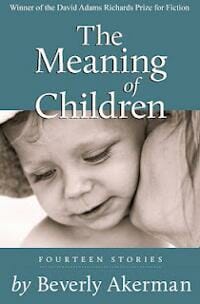
Another great Canadian independent author is Montrealer Beverly Akerman. This is the opening of the first story in her collection, The Meaning of Children:

When the arguing started, their voices would get louder and louder, till they broke into my dreams. That night, I woke and listened in the dark for what felt like a very long time. Perhaps I should have been afraid, but I wasn’t. For one thing, they never yelled at Lisa or me, and for another, they argued so often I was used to it. Besides, I learned a lot when they fought. But that night, the uproar was exceptional. Even Lisa woke up after a while, and she stood there in the crib in her fuzzy footed pyjamas, fingers in mouth, he eyes shiny and round as marbles. I finally got out of bed and padded down the hallway to see what it was about this time.

Both examples give you a lot of information, but not too much. They tell you about a character and make you want to read more, without overwhelming you with the dreaded “information dump.”

What not to do:

Here’s an example of an information dump (details altered to protect the guilty):
Michael Chapman stood wearily in line at the ferry’s bar. It had been a long trip, but he was nearing its end. Four years ago Michael was a twenty-eight-year-old investment counselor with a corner office in one of the gleaming glass towers of Atlanta. He thought he had it all — until his marriage disintegrated in a messy divorce in which his wife got the house, the kids, and everything else important to him. After eight more months of pointless activity, he walked away from his job, cashed in what remained of his investments, and bought a ticket to England.
Not only does that use a lot of clichés (“gleaming glass towers,” “marriage disintegrated,” “messy divorce,” “walked away from his job”), there’s no reason to dump all this here. Get on with the story: he’s in line at the bar — does he get his drink? Or does something get in the way? Where is the ferry going? How long has the journey been?

As the writer, you can build the back-story in as it's needed. Show me the pain of the divorce when Michael meets another potential romantic partner, or some other situation that calls for it. And he's 28, with kids and a corner office? In what universe, other than EL James's?

In On Unfaithful Wings, fantasy author Bruce Blake is a little more descriptive. But he doesn’t overwhelm you while making you feel for this character:

I stood with my back to the church, much the way I’d lived my life.

Rain poured down the eaves, splashing my shoes. Each drop pattering against the leather felt as though it landed directly on my mood. I tugged my suit jacket tighter and glanced at my watch — almost eleven p.m. If the rain didn’t let up soon, Trevor would be in bed, his belated birthday present another day late. After letting him down again, Rae probably wouldn’t let me give him the gift, anyway. A heavy sigh drew the taste of rain on dry soil into my lungs as I suppressed the desire to call her names in my head, to blame her for everything. It wasn’t her fault.


One more example to stress the points I’m trying to make: make it a close-up. It’s been said before: we find the universal in the particular. In A Birthday to Remember, Thomas L. Scott uses simple, clear language to take us all back to our own fifth birthdays:

Once, on a Saturday morning when I was just five years old, our house burned to the ground. Just before it happened, I was alone in the family room right off the kitchen, probably doing something I shouldn’t have been doing, like jumping on the furniture or bouncing a ball against the wall. You know, kid stuff. Well anyhow, the fire turned out to be one of those things which really wasn’t anybody’s fault, no matter how badly you wanted it to be. Circumstances came together and it just happened. Nobody likes to think stuff like that goes on but it does. It was my fifth birthday.
All these good examples put the reader right into the situation. They’re personal. Readers can identify with the character. If it were a movie, the director would be starting with a very close focus. Context comes later, naturally as the story rolls out.

In the next post, I’ll give you some more examples of the kind of writing I don’t like. Because you’re all writing for me, right?