Thursday, February 21, 2013

You know you want the best in new fiction


Get it now:

  • Authors defying commercial publishers and literary convention
  • leaping genre boundaries
  • and breaking rules.

Now get these hot new works — free.


BestSelling Reads brings together the best in new fiction — and gives you the chance to win a big honkin’ bunch FREE on a brand new iPad Mini!

Enter BSR’s great February Giveaway for a chance at a brand-new iPad Mini pre-loaded with an e-book from every BestSelling Reads member.

DON’T DELAY – THIS OFFER ENDS ON FEBRUARY 28, 2014.

ENTER NOW!

Take a look at a few of the cutting-edge books you could win:


VIGILANTE by Claude Bouchard: Because sometimes, criminals have to pay...


JAGUAR SUN (Jaguar Sun Book 1) by
Martha Bourke: A teenage shape-shifter discovers she is meant to ease the world's transition to a New Age as the Mayan calendar ends and a new world begins.

DOING MAX VINYL by Fred Brooke: Recycling fraud Max Vinyl suffers the worst week of his life when his environmentalist girlfriend, Tris, and returned Iraq War vet Annie Ogden team up to take him down.


THE BONES OF THE EARTH by Scott Bury: It’s the Dark Age, the earth has determined to erase human civilization with earthquakes, floods and plagues — and a young disabled must solve the riddle of the bones of the earth to save the woman he loves.

LICENCED TO THRILL, VOLUME 4 by Diane Capri: Four smart thrillers where justice rules!

  
SHADOW CAY by Leona DeRosa Bodie: Someone wants to make sure the Nesbitts never make it out of paradise alive.

THE NINTH DISTRICT by Doug Dorow: the Federal Reserve has never been robbed and FBI Special Agent Jack Miller means to keep it that way.


GONE AT ZERO HUNDRED by CR Hiatt: Two 18-year-old sleuths take on the perilous underworld in a club called The Devil's Door.

RED MOJO MAMA by Kathy Lynn Hall: Lydia "Red" Talbot has lost her mojo and getting it back means having to change a few things in her life.


3 LIES by Helen Hanson: Can a corporate dropout rescue his girlfriend before her kidneys fail or a CIA mission spins out of control? 

SHADES OF GRAY by Andy Holloman: Combine Breaking Bad with a dark remake of The Love Boat and you have all the colors in Shades of Gray.

LEAH'S WAKE by Terri Giuliano Long: This award-winning novel explores the struggle of teenagers coming of age, and coming to terms with the overwhelming feelings that rule them and the demanding world that challenges them.


PRICELESS by Shannon Mayer: A missing child, a werewolf for a pet, and the FBI on her tail — what could go wrong?
BLOOD ORCHIDS by Toby Neal: A fast-paced crime novel with a twist of romance, set on Hawaii.

SECOND CHANCE GRILL by Christine Nolfi: When Dr. Mary Chance inherits a restaurant in Liberty, Ohio, she can't resist falling for precocious Blossom Perini — or the girl's father. The bond they forge will transform all their lives and set in motion an outpouring of love that spreads across America.


THE SOCIETY OF SINNERS by Charity Parkerson: Evil lives in the dark.

MOONLIGHT ON THE NANTAHALA by Micheal Rivers: A story of dedicated friendship and undying love that will haunt your soul.

ARCADIA'S GIFT by Jesi Lea Ryan: Most people only experience death once. Arcadia Day is not most people.


CASSIDY JONES AND THE SECRET FORMULA by Elise Stokes: Discover how Cassidy Jones gains superpowers in her first action-adventure — an positive esteem-builder for teens, boys and girls. 


BROKEN PIECES by Rachel Thompson: It is rare when a writer puts so much of him or herself on the paper that you can see them bleed, but Rachel Thompson boldly steps out of the shadows and puts herself in the light that shows her wounds, her flaws, her heart and you can't help but be moved.

AMELIA'S STORY by D.G. Torrens: A life of pain and rejection — the powerful true story of one young girl’s struggle to survive the state care system in the 70s and 80s.

SAY MY NAME by Rebecca Tsaros-Dickson: A tale of two lovers in their 40s coming to terms with their true feelings after decades of unrequited passion. Anyone who has ever loved, lost and held out hope in spite of it all will see a piece of themselves in this novella — and it may not be easy to face.


POST-APOCALYPTIC NOMADIC WARRIORS by Ben Wallace: A fast-paced action and adventure novel set in a horrific future that doesn’t take itself too seriously.


NOTHING STAYS IN VEGAS by Elena Welch-Aitken: When Lexi is confronted with the past, she can no longer deny the truth to anyone because as she now knows, what happens in Vegas, stays in Vegas — except when it doesn't.


MILL PEOPLE by Alle Wells: Jesse Finney's story captures the life of a Southern mill town from the late 1800s to the mid-twentieth century.
LAST ONE CHOSEN by Stephen Woodfin: How do you neutralize the most dangerous man on the planet?


Plus more action-adventure, thriller, romance, humour, science-fiction and non-fiction from

Natasha Brown

David C. Cassidy

John-Paul Davis


David Leadbeater

Kirkus MacGowan

Alan McDermott

Caleb Pirtle

Mohanalakshmi Rajakumar

Raine Thomas

And David Vinjamuri 

CONTEST CLOSES FEBRUARY 28.


Enter now: BestSelling Reads’ February Deal


Tuesday, February 19, 2013

I have won TWO (count 'em!) Liebster Awards for blogging!

Two good friends, fellow bloggers and writers have nominated me for the Liebster Award for Blogging: Christine Nolfi, founder of the BestSelling Reads group; and Bruce Blake, fantasy author and fellow member of Independent Authors International.

As a Liebster Winner (Liebsterite? Liebsterine?), I now have to:

• tell you 11 random facts about myself

• answer 11 questions that Christine and Bruce sent

• nominate 11 authors; and

• send them 11 completely new questions.

11 random facts about me

1. My last name has changed twice in my life, and I’m not running from the law.

2. I was born in Winnipeg, Manitoba, the land of frozen Januaries.

3. I had a LOT of hair when I was in university.

4. I suck at paperwork.

5. My first car was a 1969 Cutlass two-door with a V8 engine.

6. I cannot focus a camera myself. I need auto-focus.

7. I know how to sail a sloop.

8. I have occasionally been unkind to others. Okay, more than occasionally. Sorry.

9. I love maps.

10. I am fascinated by plate tectonics and ocean currents.

11. I could listen to Carlos Santana play guitar all day long.


11 Questions from Bruce A. Blake


1. Who is the most famous person you’ve ever met?

I waved once at Bruce Springsteen a couple of years ago in Lake Placid, New York, and he gave me a “peace” or “Victory” sign back. But I didn’t actually speak with him. I guess the most famous person I’ve ever met and spoken with is Bill Gates, back in the 80s, when he wasn’t the Wizard of Oz but merely the world’s youngest self-made billionaire.


2. What article of clothing could you not do without?

Pants are good for walking down the street, but for some other activities, they’re too ... obstructive. I’m not much of a clothes fan. I like my leather jackets, but I survived before I had them and I’ll survive without them, too.


3. You have one meal left before you are put to death. What would you eat and what did you do to be condemned?

I pissed off the people in power by asking too many tough questions. Seriously, back when I was a full-time journalist, I once made a guy sweat with so many questions. And it wasn’t even that serious a story!

My last meal: New York steak with perogies and lots and lots of fried onions; two bottles of Chianti from Baron Ricasoli’s most private, select cellar; a gallon of Stella Artois beer to wash it down; chocolate soufflĂ© for dessert, finished with lots of Remi Martin Louis XIII cognac. While getting oral sex from the SOB who condemned me.


4. If you were a computer program, which one would you be?

A grammar checker vastly better than Microsoft’s, one that would suggest shorter and more elegant sentences.


5. What book have you read that you most wished you had written?

Either Life of Pi, Winter’s Tale or The Master and Margarita.


6. If you could only own one movie, which one would it be?

David Lean’s Doctor Zhivago, the movie with Omar Sharif.


7. Sweet or savoury?

Boldly, dangerously savoury.


8. Would you rather give a speech in front of a large audience or touch your tongue to frozen metal?

Already touched my tongue to frozen metal, back in Grade 1. Don’t want to do it again. Already spoken to large audiences. That wasn’t as bad.


9. If you had your choice, are you an early bird or a late riser?

Early bird. I do have the choice. Sleeping is such a waste of time.


10. You have a new pet and it is entirely up to you to name the beast. What kind of animal is it and what do you call it?

How about a swordfish named Cyrano.


11. If you could recommend one non-fiction book, which one would it be?

Stephen Hawking’s A Brief History of Time.


11 questions from Christine Nolfi:


1. Describe your life five years from now.

Here’s the fantasy writer’s answer: I make more than enough money from selling books to live comfortably. I come down to my main-floor study every morning with a big cup of coffee to write, correspond, update social media and create my next work. I can afford to take my family on vacations once or twice a year, and occasionally give an interview or a talk on my work, the writing process or the publishing world.


Now the reality: in five years, I’ll probably be doing more or less what I’m doing right now, except that I’ll have five more books available at bookstores.


2. What was your favorite toy during childhood?

I remember a turquoise Matchbox car, and later, a larger die-cast Batmobile. I also had a GI Joe (back when Joe was bigger than Barbie) as an astronaut, with a Mercury space capsule and a silver space suit.

But I have to admit that the leisure items I spent the most time with while growing up were books.


3. Most embarrassing moment during adolescence?

Geez, Christine, whose side are you on? Okay, this story requires a little background: in Canada, we have a TV games show called Reach for the Top, where teams of high-school students compete in answering trivia questions — kind of like a team version of Jeopardy for teens.

In Grade 11, I had two friends on my high school’s Reach for the Top team, and one Saturday I accompanied them to the TV studio. This was a working studio in a small-city station; the only accommodation for a live audience were a few random chairs at the back.

I sat on a high stool. At the very end of the show, when my team had won, I applauded. I don’t know what I did, but the stool tipped and I toppled onto my butt. Watching the taped show later, I saw my friends on the team pointing at me (off-camera, thankfully) and laughing as the credits started to roll.


4. What do you most enjoy about the writing process?

I know that some people say “I don’t like writing — I like having written.” I disagree. I love the process, I love thinking up ideas and the way they take their own shape as I type them onto the screen.


5. You can spend the day with someone famous (living or dead). Who do you choose? Why? What do you talk about?

Jack Kerouac. We could talk about writing, about breaking into the publishing world, gaining attention and the interface between literature, music and other arts.

6. How many unfinished manuscripts sit dusty and unloved in your office?

Many dusty, none unloved. I really plan to finish them all, one day.

  • There’s the high-adventure science-fiction novel that I began with “It was a dark and stormy night.”
  • Then the story of the girl who stole all her research from her unappreciative employer.
  • Dark Clouds, the story of the son of the Witch Queen.
  • A psycho-killer story.
  • My memoriam to my father-in-law, who was drafted into the Red Army in 1941 and later escaped, with the 12 men under his command, from a German POW camp.
  • The doctor's in-laws
  • And several more.

7. Of which of your works are you most proud?

So far, it’s the only novel that’s been published so far: The Bones of the Earth. I am proud of it for being my first published novel, and because I believe it’s a good novel. It has several levels: it’s an adventure story, but it also illustrates the struggles of a young man with a disability in an unforgiving society.

The plot encompasses all seven basic stories: the quest, revenge, rite of passage, kill the king, fish out of water, redemption and of course, boy meets girl — you gotta have a love story!

And I’m also proud of it for earning some very good reviews. Not a huge number (not a huge number of sales, either), but mostly very positive.

8. Please share the most heartwarming or amusing comment you’re received from a reader.

There have been many, I am very thankful to be able to say. I am so moved when readers tell me how they love Javor, the protagonist of my novel, The Bones of the Earth. For example: “Javor, whom I love, is the slayer of monsters and dragons,” from Linda, a reviewer on Goodreads.” And a good Internet friend and fellow author, Cinta Garcia Rosa, wrote about Javor “One of my favourite characters from now on.”


9. Do you eat your veggies?

Absolutely! Not only do I love vegetables (and meat, and dairy, and sweets, and ... food), I hit the “5 to 10 a day” mark every day!

10. What was the catalyst that drove your to write your first book?

I had wanted to write a dragon story for my children for a long time, and I wanted to write something that went beyond typical fantasy. Also, I wanted to write something that evoked eastern European cultures, something largely overlooked in Western literature.

The catalyst had two sparks:

• David Keys’ Catastrophe: An investigation into the origins of the modern world, which theorizes that the eruption of the Krakoa volcano in Indonesia in 535 AD led not only to the plague that killed Emperor Justinian, but the migration of the Avars from China to Europe, the rise of the Turks and the weakening of other civilizations around the world.

• At about the same time, I came across a theory (cannot find it again, alas) that the historical King Arthur and Beowulf both died that same year — 535 AD. That led to the story!

11. Favorite vacation spot?

Vienna. Friendly, clean, courteous, walkable with unbelievably great food and dense, rich culture!

11 new questions for authors:


1. Which villain character did you have the most fun writing. Admit it, you loved it!
2. In the genre you have chosen to write in, which convention (typically followed by other authors in the same genre) drive you nuts the most?

3. What genre that you have not written in yet would you most like to? What’s holding you back?

4. Have you ever written a character based very closely on someone you know in your real life?

5. What word or phrase do you find you overuse the most?

6. Name your favourite author: what is it about that person’s writing that appeals to you so much?

7. What music do you listen to while you write?

8. Coffee or tea?

9. Dog or cat?

10. Who was Jessica Rabbit?

11. If you could meet one fictional character from any book other than your own, who would it be? Why? What would you talk about?


And now, the next 11 victims authors to receive the Liebster Award:


1. David C. Cassidy

2. Cinta Garcia Rosa

3. Scott Morgan

4. Roger Eschbacher

5. Gary Henry

6. Benjamin X. Wretlind

7. Martin Crosbie

8. David Mark Brown

9. Alan McDermott

10. Kathy Lynn Hall
 
11. RS Guthrie
 

Sunday, February 17, 2013

Finding her unique voice: Best-selling Martha Bourke on the writer's style

What is writing style? How important is it to the reader, to the writer and to the writer’s success in reaching an audience?


This week, I asked Martha Bourke, author of the Jaguar Sun series of “young adult” novels and fellow member of BestSelling Reads about the importance and impact of her writing style.

How would you describe your own writing style?

A lot of my work is centered on dialogue, so the narrative really moves along. A lot of readers have described my writing as having a kind of breathless feel. It’s not done on purpose, but that description makes a lot of sense. Along with that, I add in quite a few cliffhangers throughout.

Are there any authors whose style you admire? Do you try to emulate them?

I’m obsessed with books, both Indie and traditional, so there are scads of authors I admire. I don’t try to emulate anyone. For one thing, their styles are very different from my own. Also, every writer brings something very special and unique to a story. Writing, like any other art form, is a kind of self-expression. I think that would be lost if everyone tried to write like everyone else. Having said that, most writers I know are avid readers, and I’m sure we’re being influenced along the way somewhere.

Are there authors whose writing style you dislike?

You know, Scott, sometimes it’s just a case of an author and me not hitting it off. But there are certain cases I can predict. For example, I love the story of The Lord of the Rings. Tolkien is fabulous, don’t get me wrong. And like me, he was a linguist. But those books are just so incredibly dense. I read them all as a kid, but I know for sure if I tried to get threw them now, I’d have a major case of pick it up, put it down syndrome.

How important is your writing style to you? Are you happy with your style, or are there aspects of it you try to change during rewriting or editing?

My writing style very closely matches the way I think when I’m writing and the way I see different parts of the plot in my head. So I feel comfortable with it. Being naturally dialogue-oriented means that as I do my rewrites, I am bound to find areas that lack enough description. There’s always a fine balance between giving the reader just enough and being unclear. I’m also always trying to tighten up my writing, making sure to show and not tell.


How can readers identify your writing style? Are there particular words or kinds of words that you tend to favour? Sentence structures? Or is it more in the story, the pacing or the characters?

I think that in my Young Adult series, the kinds of words or expressions I use lend a kind of credibility to the age group I’m writing. Voice is so important in YA (young adult). Trying to keep it sounding authentic is a challenge, and word choice and sentence structure are key. Right now I’m writing an adult spin-off series from my YA books. I definitely found that my structure changed. It’s still dialogue-based and fast-paced, but it’s written in shorter sentences that often are just one lines. I use conjunctions to add punch, which I suppose I could have done in my YA series, but just never did. So some of the hallmarks of my writing are the same for the two series and some are different.


Do you think writing with a female protagonist and POV, as opposed to a male POV, changes the style, in terms of word choice, sentence structure or other language elements?

I tend to think of my characters as individuals. They all have their own culture, background, race, gender, sexual orientation, and place within in the story. I think all of these things influence the way a writer creates a protagonist, as well as any other character. Gender is a part of the mix, but without the other pieces of the puzzle, the character is very one-dimensional. Having said that, the concerns of a male or female protagonist could be different based on gender. Men and women can think very differently within those other confines, so it depends a lot on the story I’m telling.

How important do you think writing style is to an author's commercial success?

I think it can be a very important part of the package. I say package because it seems to me that some readers are most drawn to a compelling story, while others find the manner in which that story is told to be key.
Cover art that represents the story well is definitely also on the list.
I don’t think that a great writing style guarantees a book will be successful, though. There are lots of books out there from some fabulous authors that just won’t sell. I do believe that while writing style doesn’t guarantee a reader will pick up a book, it’s probably a big factor as to whether or not the book gets put down finished or unfinished.

Thanks so much for having me, Scott!

Thank you, Martha!

Martha Bourke grew up in Burlington, Vermont, often considered a hub of “free thinking.” She was encouraged to write and be creative at a very young age. She spent fifteen years creating and teaching in foreign language programs for young children. She continued to write on the side, trying out a variety of fiction genres. Then she discovered the Young Adult genres — specifically, paranormal romance. She was hooked!

Martha and her husband of thirteen years have carved out their own little piece of Vermont in the Massachusetts countryside. When not writing, she loves spending time with her animals, listening to good music, and reading.
You can find her books, Jaguar Sun and Jaguar Moon, and her novella, Revelations (part of the Jaguar Sun series) on Amazon, Barnes & Noble, Smashwords, the Kobo e-bookstore and the iBookstore. You can find all her writing on her blog and website, www.marthabourke.com.

Book 3 of the series, Jaguar Hunter, and the spin-off New Breed novels, are coming this year!

Wednesday, February 13, 2013

Writers, quit your whining, or you'll get a Write Hook to the jugular

A new book by Scott Morgan, my brother from another mother and father ... and country ... who somehow got all the good looks ...


How To Be A Whiny Beeyotch

71 Writing Excuses Meet the Back of My Hand


Okay, I gotta whine: I didn’t get around to blogging about this before February 8, its release date — cuz, uh (lemme flip through the advance review copy of this book to find a good excuse. Hey, there are a bunch!)
  • I have been swamped with real life
  • I have a job
  • I have kids
  • I’m too old

Wait a minute. Scott’s new book blows all that bullshit to smithereens. Smelly, disgusting smithereens.

With How To Be A Whiny Beeyotch: 71 Writing Excuses Meet the Back of My Hand, Scott Morgan not only takes you by the jugular (Yes, you, the wannabe writer, you), he shakes you around and throws you over your overstuffed couch against your brick wall. Then he kicks you until all the bullshit is gone.


Just what the writer who can’t get started needs.

Scott Morgan is an excellent writer. His short stories are some of the best I have ever read — and I’ve read a lot. From a stylistic as well as a story-telling perspective, he’s matchless.

He’s a speaker, teacher, coach, journalist, essayist, blogger, editor, screenplay writer, short-story writer — I think the only thing he has not written is a novel. Yet.

He is perhaps best known for his guide for writers, Character Development from the Inside Out, and his blog, Write Hook. His newest book continues the advice for writers, but ramps it up.

Want to be a writer? Can’t get started, or finished, or continue? Stuff getting in the way of your becoming the next Dostoevsky, or Chandler, or (God forbid) EL James?


Scott Morgan dispells what’s getting in your way: your own bullshit. He has compiled 71 common excuses he has heard from people for not writing, and blows each one away.


Here’s a great one:

5 . I've been swamped with real life

UNLESS you're homeless, you have stuff to do around the house — bills to pay, checks to write, dinners to make, tires to lube, roofs to repair. And if you are homeless, you have a variety of other problems to deal with.

Here's a news flash (and you can trust me when I say that because I was a newsman): Crap like this never stops! Life will always pull at you. You will always have bills to pay and things to fix and kids to pick up from baseball practice. You will always have family obligations and overtime nights and sick pets and power outages getting in the way. It isn't a matter of how many issues you face in a given day, it's a matter of how fast you bounce back and get back to writing.

If you want your writing to go nowhere, just keep telling yourself how busy you are. It won't be long before you listen, and then it's only a short trip to being controlled by external forces.

And here’s the excuse that I used for so many years (to myself — I never actually said it to anyone else.) And while I knew the answer, I wish Scott could have come back in time and hit my jugular with his analysis 15 years ago: 
2. I don't have anything to say

THIS one always astounds me, because the people who say it to me seem to have no end of family drama, work stories, observations, and LOL-laden bon mots they pick up on Facebook or wherever else. There really does seem to be some weird inverse relationship between the amount people talk and the amount of confidence they have in their ability to say anything.
If you have a job, you have something to say. Same goes if you've ever had a date. A relationship.

Children. If you've ever been to school or camp. If you've ever belonged to a group. If you've ever hung out with friends. If you've ever been rejected, hurt, or set back — especially if you've managed to overcome the problem. If you've ever played sports or owned a cat. Played in a band. Had a dream (a lifelong one, not necessarily the sleeping kind).
If you've ever sat in the house alone and contemplated your life. If you're afraid of something. If you're in love. If you believe in God. If you don't believe in God. If you're a vegetarian. If you're a political partisan. If you have a hobby or have ever read a book or seen a movie or heard a song that has moved you to action or to tears — then you have something to goddamn say.
In short, you have something to goddamn say. The very fact that you're old enough to read this page and comprehend whatever is on it means you have something to say.
And it's important that we hear it. So say it.

Writers and wannabe writers alike need to read this, to dispel the walls they’ve built between themselves and their audiences. Because they’re made, as Scott points out, of bullshit.

Thanks, Scott!
Get How To Be A Whiny Beeyotch: 71 Writing Excuses Meet the Back of My Hand on Amazon.

And don’t neglect one of the best reads in the blogosphere: Write Hook.

Tuesday, February 12, 2013

An independent guest review: 50 Shades

Fifty Shades of the worst book I ever read


by Evan Zenobia

Evan Zenobia is editor of the Eclipse News blog and a close friend. He has graciously given Written Words permission to reprint this independent review of the bestselling Fifty Shades of Grey.

A meaningless setting. A cast of thoroughly unbelievable, unrelatable, one-dimensional characters. Add some poorly written dialogue and boring sex, and what do you get? The inexplicably popular jumble of words and paper that E.L. James has somehow managed to pass off as literature.

I’m referring, of course, to Fifty Shades of Grey, which I’ve spent the last two and half weeks subjecting myself to in tolerable doses. Now that I am finally done, I have no quandaries about calling it the worst book I have ever read. There are poorly written books that still contain good stories, or at least carry a good message. And there are well written books that may still follow a bad story arc. But Fifty Shades is poorly written and a bad story. It has literally no redeeming qualities.

The “plot,” if it can be fairly called that, revolves around utterly boring literature student/graduate Anastasia Steele and her “erotic” adventures with the mysterious and wildly handsome young billionaire Christian Grey. The motor that drives the dilapidated hull of a storyline along is fuelled by Steele’s attempts to reconcile her sexual inexperience and romantic longing with Grey’s “kinky” sexual habits.

But really, for a 514-page erotic novel, I have never read anything so dull. And on top of the dullness, almost every aspect of the story is irritating.

Consider the setting. James sets her novel in Washington State, in the United States. Which is strange, considering that most of the characters speak as if they’re well-read 19th century British aristocrats, using words like “profligate” and “taciturn” in everyday conversation. Excepting, of course, Steele’s token Latino friend, JosĂ©, who throws colloquial Spanish into his speech with the frequency of Speedy Gonzales.

Also irritating is that James has chosen to write her book in first-person present tense. That alone is not the problem. Chuck Palahniuk wrote Fight Club the same way. But in Fight Club, the protagonist is crazy and also represents a social critique. In Fifty Shades, the protagonist is insufferable, stupid and boring. As such, the audience is forced to endure every stupid and pretentious thought that comes into her mind, whether it’s expressing her distaste for rap music before a BDSM romp or this gem on page 28, “I feel the color in my cheeks rising again. I must be color of The Communist Manifesto” (because, of course, Communist Manifesto is a shade of red you can find in any box of crayons or on paint swatches at Home Depot, and the Manifesto isn’t printed in black on white like every other book).

Meanwhile, the characters are almost all props leading up to the sex scenes, including Steele herself. Anastasia Steele apparently has three settings: blushing (sometimes the colour of communism), biting her lip (which arouses Grey), and drinking tea (again, mimicking the landed gentry of 19th century England rather than a young woman in Seattle, home of Starbucks). By her own admission, her favourite activity is reading old British novels by herself, and, at the age of 21, has never been drunk until Chapter 4 after finishing her final exams. (Newsflash to Steele: if you’re a literature student, and you’re not drunk until after your semester, you’re doing it wrong). She’s clumsy, and her hair never cooperates. Oh yes, and she’s a virgin.

Though this dull, sober virgin is pursued by JosĂ© and her boss’s son, she is only attracted to the young, gorgeous billionaire with the personality of an anal-retentive Jack Donaghy/Gordon Gecko hybrid… only less interesting. Christian Grey is just a creepy guy. He’s arrogant. When Steele drunk-dials him, he tracks her phone, drives to find her, holds her hair while she pukes, then drives her unconscious body to his hotel room where he tucks her into bed and removes her vomit-stained pants before sleeping with (but not banging) her. Then he sends his personal assistant to buy her sexy underwear.

In what world is stalking, kidnapping, and partially undressing someone without their consent not creepy?

Oh, and speaking of consent. A huge part of Grey’s kink is that he doesn’t have sex without written consent. In fact, he’s got a pile of paperwork to sign before sex can begin. Now, personally, I can’t think of anything less arousing than paperwork. Filing taxes and writing incident reports never got my blood going. But for super virgin bookworm Anastasia Steele, it’s just the right thing. And even though Grey is an emotionally distant, creepy, stalker jerk, she is so desperate to be with him that she puts up with it all.

The only other character that needs mention is Steele’s beautiful blonde roommate, Katherine Kavanagh. She begins a deep relationship with Grey’s brother Elliot. What doesn’t make sense, however, is that she maintains it even as she develops a fierce hostility towards Christian Grey. The character is not at all developed, so her behaviour comes off as shallow and irrational.

Aside from all that, the book is just bad. The writing is awkward and clunky. James pretentiously jams her book full of obscure synonyms, obviously hoping it will make the story appear to be a fine work of literature rather than boring mommy porn. Meanwhile, she takes more than one occasion to remind the audience of the supremacy of the British, especially in terms of literature, and the unbearability of the French and others. While offensive, it fits in with the rest of the book’s undeserved pretentious snobbishness.

Further, the book appears longer than it actually is. A good chunk of the paper is wasted in blank space representing an excessively long chain of email correspondence between Steele and Grey. Apparently they never heard of texting.

I don’t want to spoil too much, so I’ll leave it at that. This is the worst book I have ever read. I can only award it negative stars.

Oh, and the sex is all really, really boring.

Evan Zenobia is the pen name of the blogger of Eclipse News, which regularly holds Sun Media to account. Visit the blog and leave your comments!

Sunday, February 10, 2013

I said I missed winter — and winter came back

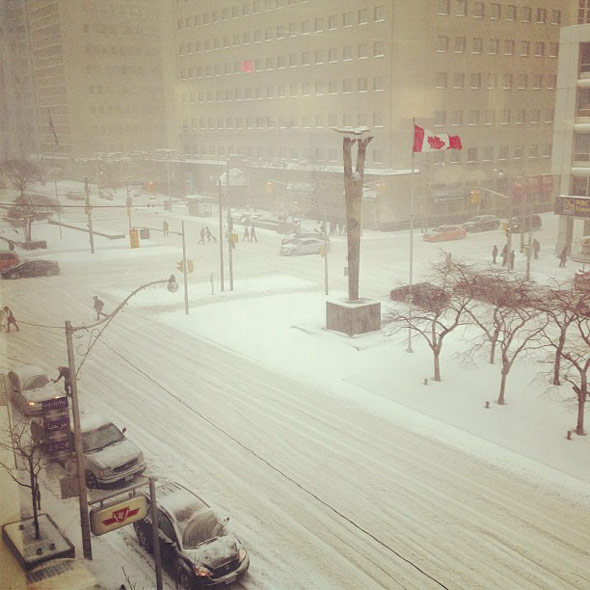
Photo of Toronto in snow by Adam Geezy, blogTO.
 
Ottawa gets hit by snow February 8, 2013
I had no idea the weather gods read my blog. Honestly, I didn’t even think they had a computer, let alone Internet access.

Ottawa on January 6, 2013
Four weeks ago, I wrote on this blog “Imiss winter.” The area where I live was going through an exceptional warm spell in mid-January. We lost a lot of snow, and I love snow. I love winter sports like skiing and skating. I love the feeling of cold air on my face as my body is wrapped in warm winter clothing.

I find a lot of inspiration in winter, too: in falling snow, in ice-covered fields, snow-laden evergreen branches. Winter is powerful, majestic and magical.

So, I wrote “I miss winter.” And winter came back. What does that say about the power of the written word?

The whole family is now enjoying being outside. The ice-sculptures at Ottawa’s Winterlude aren’t melting on the spot, for once.

But to all those digging out after the storm, the combination of an Alberta Clipper and a Texas Low that walloped half of North America on Friday and Saturday; to everyone stranded in an airport, to all who sat in a car or a truck in a traffic jam for hours; to anyone who: I’m sorry.

Next time, I’ll blog about how much I miss winning big in a lottery.

Thursday, February 07, 2013

Fantastic, chatty and readable: Terry Tyler on writing style


How important is writing style for the author and the reader? This week, Terry Tyler, independent author of four (soon to be five) novels that, like most of those I enjoy most, defy genre boundaries.

How would you describe your own writing style?

In some ways this is very difficult to answer, Scott, because I’m so close to it. I can tell you how some readers describe it, ie, chatty and easily readable. A couple of people have said that I write about serious or “heavy” subjects in a light way without trivialising them, which is a compliment I treasure — I’d hate to think I came across as superficial, though I don’t really do overly deep! I suppose I can best describe my style as conversational, even during the narrative parts. Some people find my novels amusing (as opposed to laughable, one hopes!!) — any humour tends to be observational; for instance, in my most recent novel, Dream On, I have a scene where a character is forced to go onto The Jeremy Kyle Show — okay, it comes from years of watching Jeremy Kyle whilst doing the ironing — I’ve never deliberately set out to write a humorous book; sometimes, that can come across as too formulaic, too studied, to be truly funny.

Presumably, Jeremy Kyle, the UK's answer to Jerry Springer.
Image source: Wikipedia

Are there any authors whose style you admire? Do you try to emulate them?

No, I don’t try to emulate anyone (*gets all sniffy* !) — can’t see any point in that! You have to write with your own voice. I admire loads of writers’ styles, in particular Bill Bryson, Dorothy Parker, Kate Atkinson, PJ O’Rourke, Jackie Collins, Evelyn Waugh, Lauren Weisberger, William Boyd — I could go on all day, but they are many and varied, as you can probably see already!

Are there authors whose writing style you dislike?

 Never been able to get on with DH Lawrence, John Grisham, JRR Tolkien or Sebastian Faulks. That Shakespeare bloke, some of his stuff bores me witless, too ... however, I wouldn’t go as far to say that I actually dislike them; they’re just not my cup of tea. The only stuff I actively dislike is the pretentious and the badly written.

How important is your writing style to you? Are you happy with your style, or are there aspects of it you try to change during rewriting or editing?

 I’d never try to change my style; how I write is how I write. I just try to improve it all the time. When I’m rewriting/editing, I’m constantly looking for ways to phrase a sentence more tightly, more succinctly, or more vividly. Obviously there are words and phrases I overuse, for which alternatives have to be found, but I think everyone has those! I’d love to be able to write a historical novel, but I don’t think the way I write would work with such a genre. Anyway, I don’t think I’ve got the patience for the year’s research that might be necessary for writing a good one!

How can readers identify your writing style? Are there particular words or kinds of words that you tend to favour? Sentence structures? Or is it more in the story, the pacing or the characters?

Again, it’s hard to say! But I do tend towards short punchy sentences to make impact, at times, and will, occasionally, begin a sentence with an “and,” a “but” or an “or” if it feels right — so shoot me! I use something that I’ve recently discovered is called “free indirect speech,” which is when the narrative consists of the thoughts of the character, without actually writing “he thought” this and that. It’s just something I’ve always done; I didn’t realise it had a name until I read it on the blog of someone who is doing an MA in creative writing! Most of my books are written in this fashion; I change from one POV to another all the way through them.

As far as the story goes, I write about real people in real situations. All my books are very current, dealing with themes and circumstances that affect so many people today, such as divorce, infidelity, alcohol and drug abuse, diet obsession, tragic accidents, unrequited love, situations one can get into via befriending people on social networking sites, Internet dating, TV talent shows, women who want to “have it all” — you name it!

The feedback I get from most readers of my books is that my characters are like people they know. I’ve read words to this effect in many, many of my reviews, and for that I am eternally grateful. As for kinds of words — I don’t write in flowery language; I think I write in quite a spare fashion. I tend to skip-read long descriptive passages, so I don’t include them in my own work. The dialogue is always appropriate to the person who is speaking, without overdoing it — for instance, in Dream On and its sequel Full Circle I have a Geordie [north-east English — SB] character, and I have to make sure that he doesn’t say “Why aye” and “Howay” too often. I’m allergic to clichĂ©s in dialogue, and work hard to make sure that my characters talk realistically — even if it means their language is a bit ripe at times, or that they say things that are not grammatically correct!

Do you think writing with a female protagonist and POV, as opposed to a male POV, changes the style, in terms of word choice, sentence structure or other language elements?

Oh yes, of course, because women think differently from men. I think the mistake some writers make is writing the POV of their character of the opposite sex in the way they would like them to think, not how they actually do think. Have you ever read any Jeffrey Archer? His female characters are completely cardboard! But then, all people think differently, regardless of their sex, don’t they? It’s all about keeping in character when you’re writing that particular person, and not making them say or do something just because it moves the plot to the required place.

How important do you think writing style is to an author's commercial success?

I’d like to say that individual writing style is terrifically important to such, but I suspect that, sadly, this is not true; some books that are imitations of well-known authors sell very well. For instance, I sometimes think that all a writer has to do is stick a cartoon of a girl in high heels on the front cover, along with a cupcake or two and some pink swirly writing, and it doesn’t matter if the style is derivative, it’ll still sell to the huge army of avid chick-lit readers! Then there’s the ever growing erotica market — I suspect the fans of this genre are more interested in the particular area of eroticism with which the book deals than the writing style!

But style as a whole, rather than just individual? Yes, that makes a difference. You see a lot of people tweeting their books thus: “If you like John Grisham (or Sophie Kinsella/Nick Hornby/A N Other Famous Author) you’ll love.... etc etc.” Obviously the comparison with the style of an established author is seen as a way of acquiring new readers. Hey, I’m as guilty of this sort of thing the next person — I don’t compare myself to well-known writers, but if others do I will quote them in a tweet! Aside from anything else, it gives an idea of what the prospective reader might be letting him/herself in for, doesn’t it?

So I suppose my answer is yes, writing style is important to commercial success. Ideally, the writers with a style all of their own will break out and become the most successful. Ideally; but then we don’t live in an ideal world, do we?

Thank you so much for inviting me to appear on your blog, Scott! I hope this interview has been of interest to you and your readers.

Thank you, Terry, for a delightful and inspiring interview!

Terry Tyler lives in the north of England with her husband. She has four novels on Amazon, of the contemporary women's fiction variety, though she is happy to say that men read them too! Her fifth, Full Circle, will be published within the next two months, all going well. She is about to start work on her sixth, which will be explore the subject of stalking, from both the victim and the stalker's point of view, a subject she has touched upon in previous novels.

Terry's books:

You Wish

Amazon USA
Amazon Canada

Nobody's Fault

Amazon UK
Amazon USA
Amazon Canada


The Other Side


Dream On


Monday, February 04, 2013

Update: One Shade takes a major step


 Creative Commons License. Some rights reserved by Reinis Ivanovs

One Shade of Red is now in front of its editor!

I have promised to keep you faithful readers apprised of my progress in publishing my second novel. So there it is: now with editor Gary Henry, author of American Goddesses and What Happened to Jory, member of Independent Authors International, literary critic (Honest Indie Book Reviews), editor and communications professional.

February is a month when we think of romance, eros, love ... mostly because of the greeting-card industry’s major success in manufacturing a reaon to buy greeting cards.
And I’ve helped perpetuate it (not that the greeting card industry needs my help in this), at least for one person: my editor. On February 1, I began sending the third draft of my new novel, One Shade of Red, to Gary, in batches of five chapters so as not to clog up his email server.
(Gary, I hope you enjoy the story even as you apply your manifold skills to making it better. And I hope that some of the content doesn’t distract you too much.)

Regular readers of Written Words know that One Shade of Red is my spoof of the incomprehensible best-seller, Fifty Shades of Gray. It was inspired by the thought, “I can write something sexy much better than this!”

Here’s the concept: Fifty Shades of Gray features the woman’s ultimate fantasy male — Christian Gray is immensely wealthy, beautiful, only 27 years old (how many 27-year-olds with that much money are there?), and he has a deep, dark, secret problem for the regular-girl heroine to fix. The heroine is so naive and good down to the toes of her sensible shoes that she’s a virgin at 22, yet has no problem achieving orgasm the first time she has sex.

One Shade of Red turns that completely upside-down. The narrator-protagonist is a young virgin male, Damian Serr. He’s 20, and for those of you who scoff at that idea for being just as unbelievable as a 22-year-old virgin in urban North America in the 21st century, the reason is that Damian has been dating the girl next door since they were both children. And the girl-next-door, Kristen ( ;)) is a very religious girl who resists Damian's efforts to move their physical relationship past the junior-high level.


Christian Gray is what women want. We already
know what men want.
Image source:
WeHeartVintage.co
Image copyright Some rights reserved by grumlinas


 The heroine of the story is Alexis Rosse, a beautiful young financial wizard. She has achieved immense wealth by the age of 30 in a much more believable way than Christian Gray: she inherited it from her late husband. Alexis is voluptuous and sexually voracious. And the major difference from Christian Gray: she has nothing wrong with her. There is nothing to fix.

What more could a man want than that?

The process

Because I don’t believe that the first draft of anything is ever fit for anyone else to see, I spent the past month and a half re-writing and editing what started as my National Novel Writing Month (NaNoWriMo) 2012 project.

When I finished writing the first draft, I realized that, in terms of erotic writing, One Shade went much further than EL James had in Fifty Shades. I can be quite descriptive (especially when it comes to something I really like). I showed my prime editor, my wife, Roxanne, some of my second draft. She declared: "It's porn. Good porn, but it’s still porn.”

That’s a label I want to stay away from. I have no problems with porn, per se, but having that label hung on me may just limit the novel’s success where I don’t want it to.


Fifty Shades is about as
risque as
this 1930s pin-up.
Image source:
Appletree Days blog
 So, I went through the manuscript again, scaling down the description, making the sex scenes less graphic. What I was trying for was something as graphic, as explicit as Fifty Shades, but more honest, more realistic, without, as I said, straying into the porn field.

It’s a shame, though, to throw out some of those very hot passages. Hmmm ... maybe there’s something I can do to salvage them? Recycle and repurpose?

What do you think?


Speaking of pin-ups, I couldn't resist this one. Should
I try to work this scene into the novel?
Source and copyright: Some rights reserved by grumlinas